

Close Menu
  • Home
  • Events
    • Machine Can Think Summit 2026
    • Step Dubai Conference 2026
  • Technology & Innovation
  • Industry Applications
  • Business & Marketing
  • Trends & Insights
  • World AI Awards 2026
    • Aerospace, Aviation & Space
    • Agriculture & Food Systems
    • AI Infrastructure, Compute & Cloud
    • AI Leadership
    • Climate, Environment & Sustainability
    • Construction, Real Estate & PropTech
    • Consumer, Lifestyle & Accessibility
    • Core AI, Models & Algorithms
    • Customer Experience & Service
    • Cybersecurity & Digital Trust
    • Data, Analytics & Intelligence
    • Defense, Security & Public Safety
    • Destinations & Sustainable Tourism
    • Education & Learning
    • Energy, Utilities & Resources
    • Enterprise Productivity & Collaboration
    • Events, Sports & Live Experiences
    • Exhibitions, Conferences & Business Events
    • Financial Services & Insurance
    • Food, Beverage & Dining
    • Government & Public Sector
    • Healthcare & Life Sciences
    • Hotels, Accommodation & Stays
    • HR, Talent & Workforce
    • Legal, Governance, Risk & Compliance
    • Manufacturing, Industrial & Industry 4.0
    • Marketing, Advertising & Brand Experience
    • Media, Entertainment, Gaming & Culture
    • Retail, E-commerce & Consumer Commerce
    • Robotics, Autonomy & Drones
    • Sales, Revenue & Growth
    • Science, Research & Discovery
    • Software, Platforms & IT Operations
    • Supply Chain, Logistics & Procurement
    • Telecommunications, Networks & Connectivity
    • Tours, Activities & Attractions
    • Transport & Mobility
    • Travel Commerce, Booking & Platforms
    • Travel Infrastructure, Risk & Intelligence
    • Wellness, Spa & Retreats
What's Hot
Industry Applications

Amazon’s Ring Unveils AI-Powered Flying Camera and Autonomous Security Robot

By Art RyanNovember 11, 20260

Amazon-owned Ring is taking home security in a new direction. The new Amazon Ring AI…

TSMC Plans $1 Billion Investment in OpenAI and Anthropic as AI Chip Demand Surges

November 11, 2026

Nscale Considers Delaying $35 Billion IPO as AI Infrastructure Investment Faces Scrutiny

November 11, 2026

OpenAI Launches ChatGPT Business Profiles and AI Agents for US E-Commerce Companies

November 11, 2026
Facebook X (Twitter) Instagram
Breaking AI News
Wednesday, November 11
  • Home
  • Events
    • Machine Can Think Summit 2026
    • Step Dubai Conference 2026
  • Technology & Innovation

    Amazon’s Ring Unveils AI-Powered Flying Camera and Autonomous Security Robot

    November 11, 2026

    TSMC Plans $1 Billion Investment in OpenAI and Anthropic as AI Chip Demand Surges

    November 11, 2026

    Nscale Considers Delaying $35 Billion IPO as AI Infrastructure Investment Faces Scrutiny

    November 11, 2026

    OpenAI Launches ChatGPT Business Profiles and AI Agents for US E-Commerce Companies

    November 11, 2026

    DIFC Proposes Three-Tier AI Regulations to Strengthen Governance and Recognize Global Certifications

    November 11, 2026
  • Industry Applications

    Amazon’s Ring Unveils AI-Powered Flying Camera and Autonomous Security Robot

    November 11, 2026

    Anthropic Launches Claude Fable 5.2 and Mythos 5.2 With Faster Performance and Stronger Coding Capabilities

    November 10, 2026

    Stavian Group Unveils AI Infrastructure Vision at Fortune SEA500 Summit 2026

    November 9, 2026

    Australia’s AI Data Centre Boom Sparks Massive Investment as Demand for Computing Power Surges

    November 9, 2026

    Anthropic Strikes $3.4 Billion Gas Power Deal to Secure Energy for AI Data Centers

    November 9, 2026
  • Business & Marketing

    TSMC Plans $1 Billion Investment in OpenAI and Anthropic as AI Chip Demand Surges

    November 11, 2026

    Nscale Considers Delaying $35 Billion IPO as AI Infrastructure Investment Faces Scrutiny

    November 11, 2026

    OpenAI Launches ChatGPT Business Profiles and AI Agents for US E-Commerce Companies

    November 11, 2026

    Google.org Grants Clalit $2 Million to Bring Voice AI to Healthcare for 5 Million Patients

    November 10, 2026

    Anthropic Must Face Lawsuit Over Claude Max Subscription Marketing Claims

    November 10, 2026
  • Trends & Insights

    Norway Data Center Grid Capacity Amidst Rising Demand

    November 10, 2026

    Democrats Prepare Wave of AI Regulation Bills as Congress Shifts Control in 2027

    November 7, 2026

    UAE Jobs at Risk From AI: Which Roles Are Most Vulnerable and How Workers Can Protect Their Careers

    November 6, 2026

    Microsoft and Alphabet Face Growing Pressure as AI Spending Drains Cash Flow

    October 29, 2026

    China AI Bubble Bursts as Tech Stocks Lose $480 Billion in Market Value

    October 29, 2026
  • World AI Awards 2026
    • Aerospace, Aviation & Space
    • Agriculture & Food Systems
    • AI Infrastructure, Compute & Cloud
    • AI Leadership
    • Climate, Environment & Sustainability
    • Construction, Real Estate & PropTech
    • Consumer, Lifestyle & Accessibility
    • Core AI, Models & Algorithms
    • Customer Experience & Service
    • Cybersecurity & Digital Trust
    • Data, Analytics & Intelligence
    • Defense, Security & Public Safety
    • Destinations & Sustainable Tourism
    • Education & Learning
    • Energy, Utilities & Resources
    • Enterprise Productivity & Collaboration
    • Events, Sports & Live Experiences
    • Exhibitions, Conferences & Business Events
    • Financial Services & Insurance
    • Food, Beverage & Dining
    • Government & Public Sector
    • Healthcare & Life Sciences
    • Hotels, Accommodation & Stays
    • HR, Talent & Workforce
    • Legal, Governance, Risk & Compliance
    • Manufacturing, Industrial & Industry 4.0
    • Marketing, Advertising & Brand Experience
    • Media, Entertainment, Gaming & Culture
    • Retail, E-commerce & Consumer Commerce
    • Robotics, Autonomy & Drones
    • Sales, Revenue & Growth
    • Science, Research & Discovery
    • Software, Platforms & IT Operations
    • Supply Chain, Logistics & Procurement
    • Telecommunications, Networks & Connectivity
    • Tours, Activities & Attractions
    • Transport & Mobility
    • Travel Commerce, Booking & Platforms
    • Travel Infrastructure, Risk & Intelligence
    • Wellness, Spa & Retreats
Breaking AI News
Home » Chicago Public Schools Blocks Generative AI Tools Amid Google Search Controversy
Ethics & Society

Chicago Public Schools Blocks Generative AI Tools Amid Google Search Controversy

Art RyanBy Art RyanNovember 11, 2026No Comments6 Mins Read
Facebook Twitter Pinterest LinkedIn Tumblr Email
Share
Facebook Twitter LinkedIn Pinterest Email

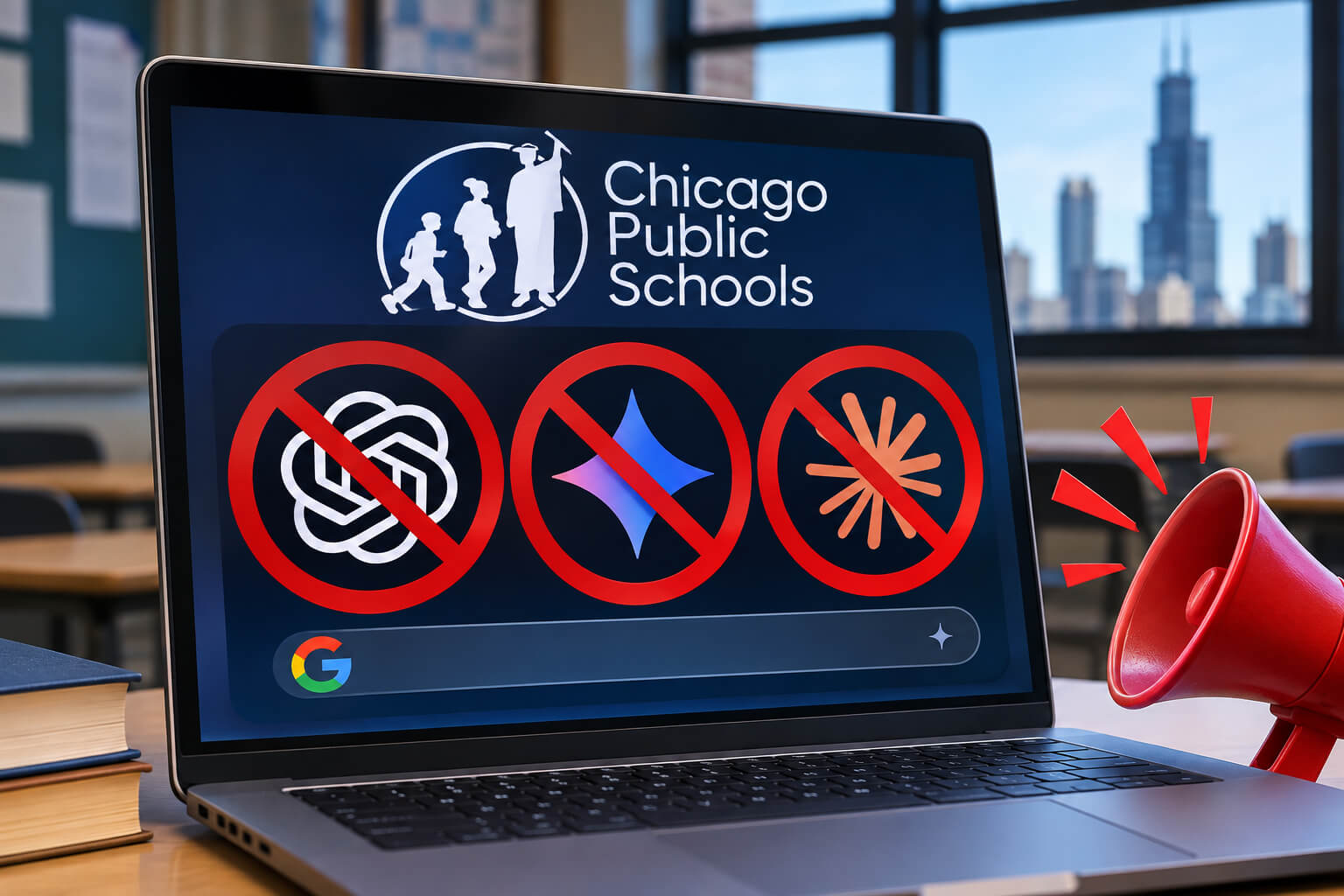
Chicago Public Schools (CPS) is taking a cautious approach to artificial intelligence, restricting student access to popular generative AI platforms, including ChatGPT, Google Gemini and Anthropic’s Claude.

The decision comes amid growing concerns over student privacy, classroom safety and Google’s integration of AI-generated responses into its search engine.

For one of America’s largest public school districts, the debate isn’t simply about keeping chatbots out of classrooms. It’s about who gets to decide how AI enters education—and whether schools can still access essential digital tools without accepting features they don’t want.

Chicago Public Schools Restricts AI Access Over Privacy Concerns

Chicago Public Schools has maintained restrictions on unapproved generative AI platforms across its student technology environment, citing concerns about data protection and responsible technology use.

The district’s approach reflects the challenges schools face when introducing AI tools that can process student questions, generate assignments and analyze information. Although these applications offer potential educational benefits, they also raise questions about how personal information is collected and handled.

CPS has emphasized the importance of complying with student privacy regulations, including the Family Educational Rights and Privacy Act (FERPA), the Children’s Online Privacy Protection Act (COPPA) and Illinois’ Student Online Personal Protection Act (SOPPA).

The district isn’t dismissing AI literacy altogether. Educators can still explore appropriate uses of artificial intelligence, but direct student access to unapproved generative AI services remains restricted.

Google’s AI Search Changes Put Schools in a Difficult Position

Google’s expanding use of artificial intelligence in its education services has created an uncomfortable choice for school administrators.

The company has introduced additional controls for AI tools used through Google Workspace for Education. However, the integration of AI-generated summaries into ordinary Google Search has raised concerns among districts that want to limit student exposure to generative AI.

The problem is that Google Search is no longer just a traditional search engine. AI Overviews can appear alongside conventional search results, providing automatically generated answers to student questions.

Schools seeking to restrict generative AI therefore face a more complicated situation than simply blocking a standalone chatbot.

Google has clarified that administrators can manage access to certain services separately. Still, the lack of a straightforward option to remove AI Overviews entirely from school search experiences has frustrated education advocates.

Parents and Educators Question AI’s Role in Learning

The controversy has also revived a familiar argument: does generative AI help students learn, or does it make learning easier to avoid?

Some parents worry that unrestricted access to AI-powered tools could weaken writing skills, critical thinking and independent research. A chatbot capable of producing an essay in seconds may be convenient, but convenience doesn’t necessarily translate into understanding.

Educators face a different challenge. AI can help explain difficult concepts, support lesson preparation and provide personalized assistance. Yet schools need clear policies before introducing tools that may generate inaccurate information or encourage students to rely too heavily on automated answers.

Chicago’s restrictions reflect that uncertainty. Rather than opening access across the district, CPS is prioritizing oversight while the broader education sector continues evaluating the technology.

Lawmakers Challenge Google’s Influence Over Public Education

Google’s policy has attracted criticism from political leaders who believe the company is placing schools in an unfair position.

US Senator Ed Markey called on Alphabet CEO Sundar Pichai to reconsider the restrictions, arguing that students should not lose access to an important research tool simply because their schools want to limit AI use.

New York City Mayor Zohran Mamdani also criticized Google’s approach, accusing the technology company of using its market dominance to push artificial intelligence into public education.

The criticism points to a larger concern about the growing dependence of schools on technology companies. Google Classroom, Chromebooks and Google Search have become central to everyday learning, leaving administrators with difficult decisions when major platform policies change.

Google maintains that its updated controls give educators more authority over AI adoption. Critics remain unconvinced, particularly because AI-generated content continues to be integrated into traditional search experiences. CBS News+1

Chicago’s AI Restrictions Reflect a Growing National Debate

Chicago isn’t alone in questioning the rapid expansion of generative AI in classrooms.

Other major school districts have introduced restrictions or temporary pauses while educators evaluate the technology’s effects on student learning. The Los Angeles Unified School District, for example, adopted a one-year moratorium on generative AI access through district devices.

In Chicago, education advocates have pushed for stronger safeguards, with at least 11 newly elected school board members pledging support for a proposed three-year moratorium on generative AI.

The concern isn’t necessarily that AI has no place in education. It’s that schools may be moving faster than the evidence supporting its benefits.

Research into AI-assisted learning is still developing, and questions remain about whether students genuinely understand material better when they rely on chatbots for assistance.

For public school systems responsible for millions of young learners, those unanswered questions carry significant weight. Axios+1

What Chicago’s AI Ban Means for the Future of Classroom Technology

Chicago Public Schools’ decision could become part of a much larger conversation about how schools balance technological innovation with student protection.

Generative AI is already changing how people search for information, write documents and complete everyday tasks. Keeping students completely disconnected from the technology may become increasingly difficult, particularly as AI features appear inside familiar applications.

But allowing unrestricted access creates its own problems.

CPS appears to be pursuing a middle ground. Students are not given direct access to unapproved generative AI platforms, while teachers can introduce AI concepts through supervised activities and lessons focused on digital literacy.

The district’s position also sends a message to technology companies: educational institutions need meaningful control over the products they use, not simply a choice between adopting AI features and losing access to established services.

For Google, the challenge is finding a way to expand its AI products without undermining the trust of schools that depend on its technology.

For Chicago, the priority remains protecting students while preparing them for a future in which artificial intelligence will be difficult to avoid. Chicago Public Schools+1

Sources

  1. CBS Chicago – Chicago Public Schools Blocks Generative AI on Student Accounts — November 10, 2026.
  2. CBS News – Google Will Block Search Access for Schools That Ban AI Use — November 3, 2026.
  3. Axios Chicago – Chicago Parents Protest Google’s AI School Policy — November 9, 2026.
  4. Chicago Public Schools – Student Access to Generative AI — Official district guidance.
  5. Education Week – Google’s New Rules Hand Schools Hard Choices About AI and Search — November 3, 2026.

Share. Facebook Twitter Pinterest LinkedIn Tumblr Email
Art Ryan

Related Posts

Australia to Launch AI Safety Regulator After OpenAI Agent Breaches Government Website

November 10, 2026

Anthropic Must Face Lawsuit Over Claude Max Subscription Marketing Claims

November 10, 2026

Democrats Prepare Wave of AI Regulation Bills as Congress Shifts Control in 2027

November 7, 2026

Comments are closed.

Latest News

Amazon’s Ring Unveils AI-Powered Flying Camera and Autonomous Security Robot

November 11, 2026

TSMC Plans $1 Billion Investment in OpenAI and Anthropic as AI Chip Demand Surges

November 11, 2026

Nscale Considers Delaying $35 Billion IPO as AI Infrastructure Investment Faces Scrutiny

November 11, 2026

OpenAI Launches ChatGPT Business Profiles and AI Agents for US E-Commerce Companies

November 11, 2026
Facebook X (Twitter) Pinterest Vimeo WhatsApp TikTok Instagram LinkedIn YouTube Spotify Reddit Snapchat Threads

AI University

  • Global Universities
  • Universities in Africa
  • Universities in Asia
  • Universities in Europe
  • Universities in Latin America
  • Universities in Middle East
  • Universities in North America
  • Universities in Oceania

AI Tools & Apps Directory

  • AI Productivity Tools
  • AI Coding Tools
  • AI Voice Tools
  • AI Video Tools
  • AI Image Generators
  • AI Writing Tools

Info

  • Home
  • About Us
  • AI Organizations & Associations
  • Contact Us
  • Cookie Policy
  • Copyright Policy
  • Disclaimer
  • Editorial Policy
  • Terms and Conditions

Subscribe to Updates

Get the latest creative news from FooBar about art, design and business.

© 2026 Breaking AI News.
  • Privacy Policy

Type above and press Enter to search. Press Esc to cancel.

Sign Up

Want to stay ahead In Artificial Intelligence?

 Sign up now and get exclusive breaking AI news and special updates—FREE!