


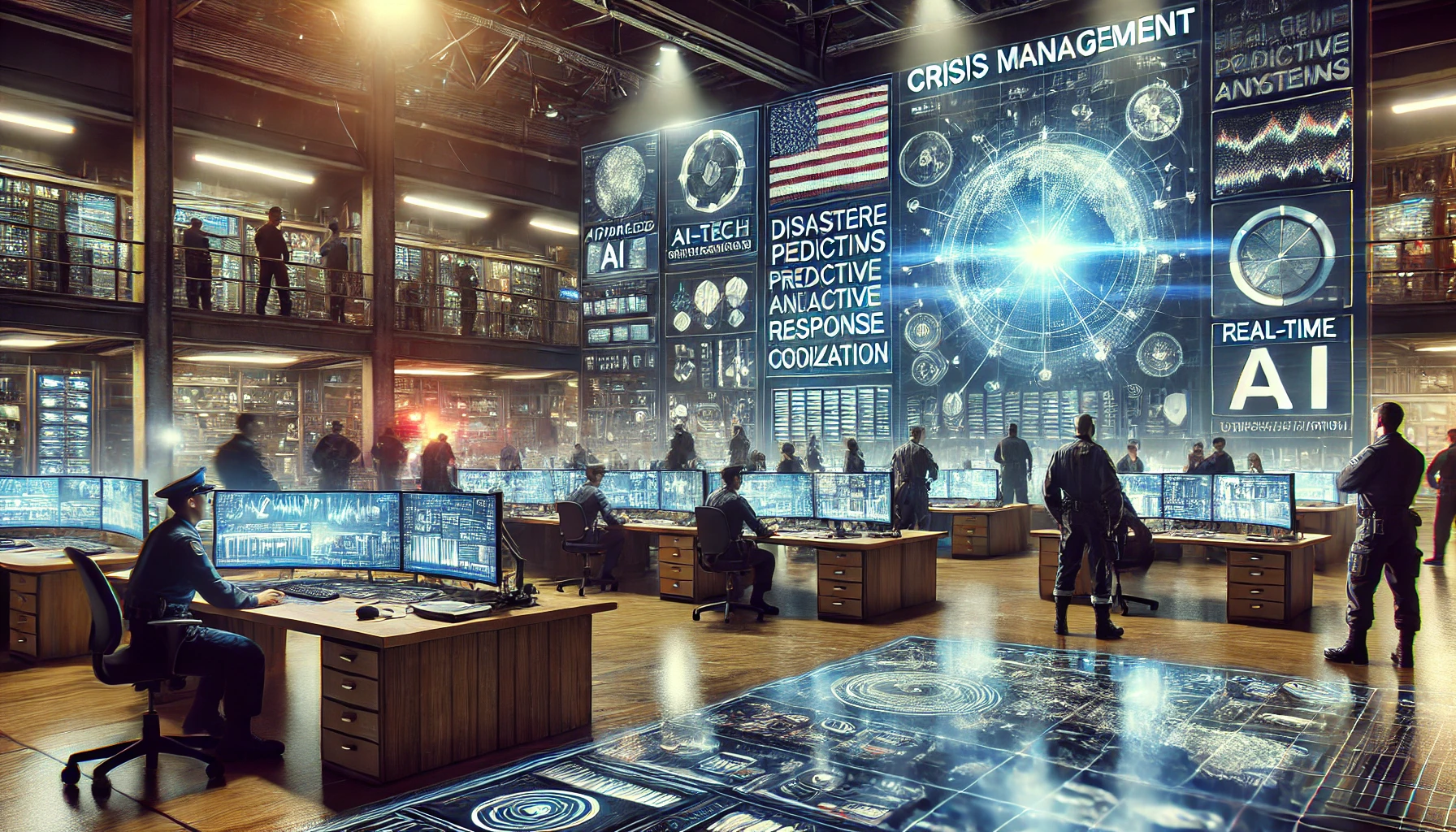
It’s ironic that AI, which has the potential to cause a crisis for companies and organizations, can also help them prepare for and manage a variety of crisis situations that are faced by government agencies and the private sector.
Reshaping Crisis Management
“I’ve seen firsthand how AI is reshaping our field by enhancing speed, situational awareness, and decision-making,” Emily Martuscello, the emergency management director for Nashua, New Hampshire, pointed out in an email interview.
“AI-driven platforms process real-time data from geospatial tools, social media, and 911 calls to provide responders with a clearer operational picture. For example, NOAA’s Next Generation Fire System leveragesAI to rapidly detect and assess wildfires using satellite imagery,” she noted.
“AI models forecast extreme weather, wildfires, and hazardous events, allowing emergency managers to pre-position resources and refine evacuation plans. AI’s ability to analyze hazard data has already cut down emergency planning timelines significantly, giving responders more time to engage with communities and prepare for worst-case scenarios,” according to Martuscello.
It is not clear whether NOAA’s fire system will be impacted by Elon Musk’s efforts to reduce the size of the federal government. NOAA has been asked to comment.
AI Smoke Detection
“In 2023, Cal Fire added artificial intelligence and smoke detection to the 1,114 cameras placed on high-elevation areas, such as mountain peaks and hilltops, throughout the state,” Statescoop reported.
“With over 1,000 cameras, it could be difficult for humans to monitor it, but it provides great situational awareness,” Marcus Hernandez, deputy chief in Cal Fire’s Office of Wildfire Technology Research and Development, said. “The smoke detection is great and one camera can see quite a distance, so there’s quite an efficiency when you look to devices on a coverage level.”
The cameras conduct 360-degree sweeps about every two minutes, and can see as far as 60 miles on clear days, and up to 120 miles on clear nights, according to the University of California, San Diego which operates California’s ALERTCalifornia public safety program and the cameras.
Roleplaying
“AI-powered roleplay simulations are transforming how teams prepare for these challenges. By replicating real-world crisis scenarios, these simulations give responders a low-risk space to practice decision-making, communication, and emotional regulation. This kind of dynamic, immersive training builds the confidence and resilience needed to navigate complex situations while maintaining empathy and composure. When ReflexAI gathers feedback from simulation participants, they highlight both the skill-building and confidence-building components of simulation practice,” Samuel Dorison, CEO and cofounder of ReflexAI, explained in an email interview.
Scalability
“Scalability is another key advantage. Crisis hotlines and emergency response teams often operate under tight resource constraints, making it difficult to provide consistent, hands-on training at scale. Limiting realistic practice reduces confidence. This not only hinders performance, but also increases stress and turnover. AI-powered simulations allow responders to engage in realistic practice anytime, anywhere—helping teams of any size refine critical skills like de-escalation and crisis communication. Importantly, AI creates a space where responders can learn from mistakes and improve without real-world consequences, strengthening emotional preparedness in a low-pressure environment,” Dorison said.
‘Its Potential Is Undeniable’
“AI is in the early stages of transforming emergency response, yet its potential is undeniable. AI is already enhancing early warning systems such as wildfire detection, severe weather systems, seismic detection, and environmental detection systems, allowing emergency managers to detect and predict when and where incidents or problems may occur or originate with greater accuracy. These systems provide crucial lead time for evacuations, resource deployment, and public warnings, ultimately reducing the scale of destruction and loss of life,” Randal A. Collins, president of the
Incident Management Teams Association, observed via email.
Revolutionizing Tactical Responses
“AI is also revolutionizing tactical response. AI and machine learning is being integrated with drones, robotic systems, real-time camera networks, and resource-tracking tools. These technologies are proving invaluable in high-risk operations such as search and rescue, hazardous materials incidents, and SWAT or counter-terrorism operations. By reducing human exposure to danger, AI-enabled tools are improving both responder safety and operational efficiency, Collins noted.
An Extension of Resources
“It’s not easy but I really do believe that AI has allowed us to immerse ourselves into navigating crises and anticipating what we might have to face. That being said, I want to say, it’s never perfect. So we always have to stick with what we know and our expertise. Never rely on AI to do the entirety of the homework. It’s really just an extension of resources to help you do the best for everyone,” Matthew Celestial, president and CEO of Statement Strategies explained.
‘Augmenting Our Ability To Lead’
“AI is not replacing emergency managers; it’s augmenting our ability to lead. As disasters become more complex and interconnected, the future of emergency response lies in Joint Cognitive Systems—where humans and AI work together to enhance crisis decision-making, response coordination, and public safety efforts,” Martuscello of Nashua, New Hampshire concluded.
Building Skills And Resilience
“Of course, AI is a tool, not a replacement for human experience or judgment. Human-to-human connection can be critical to support those in crisis. When used thoughtfully, AI builds both skills and resilience in responders, ensuring they can offer the best possible support to communities for years to come,” Dorison of ReflexAI concluded.
Hurdles To Adoption
“Despite its promise, AI adoption in public safety faces hurdles. Emergency response agencies are inherently and rightfully risk-averse—decisions in crisis situations can mean life or death. Unlike industries that rapidly embrace AI for efficiency, public safety agencies cannot afford errors caused by AI hallucinations, misinterpretations, or system failures. This caution has slowed the integration of AI-driven decision-making tools in frontline operations,” Collins of the Incident Management Teams Association warned.
Challenges
“Generative AI is no panacea [and an] evaluation of its early use in emergency management has identified concerns with output accuracy which lack validation mechanisms that can lead to over-reliance/false trust in AI generated outputs,”Clifford Oliver, a former FEMA assistant administrator and now the principal at Nanticoke Global Strategies, explained via email.
“These issues can negatively impact emergency response decision-making and operations. The challenge is merging the benefits of generative AI with positive aspects of human decision making and navigating around the potential problems AI can create. The solution to this challenge will evolve as AI continues to mature as an information technology, emergency managers become knowledgeable on how to properly incorporate AI in emergency management, and vendors that offer emergency management decision support information technology thoughtfully incorporate AI into their applications,” Oliver predicted.
The Next Frontier
“Still, the future is bright. The next frontier includes AI-powered unmanned fire suppression systems, autonomous rescue robots, and intelligent decision-support tools that analyze real-time data to optimize disaster response. These innovations will revolutionize crisis management by reducing human exposure to risk and enhancing operational effectiveness,” according to Collins.
“AI is beginning to make an impact, but its greatest contributions to emergency response are still ahead. With continued investment and careful implementation, AI will redefine how first responders mitigate, manage, and adapt to disasters,” he concluded.
While AI will not—and should not—completely replace the human factor in crisis management, the rapidly evolving tech tool will likely continue to help people prepare for and manage crisis situations more strategically, effectively, and efficiently than ever before.
Source: https://www.forbes.com/
