


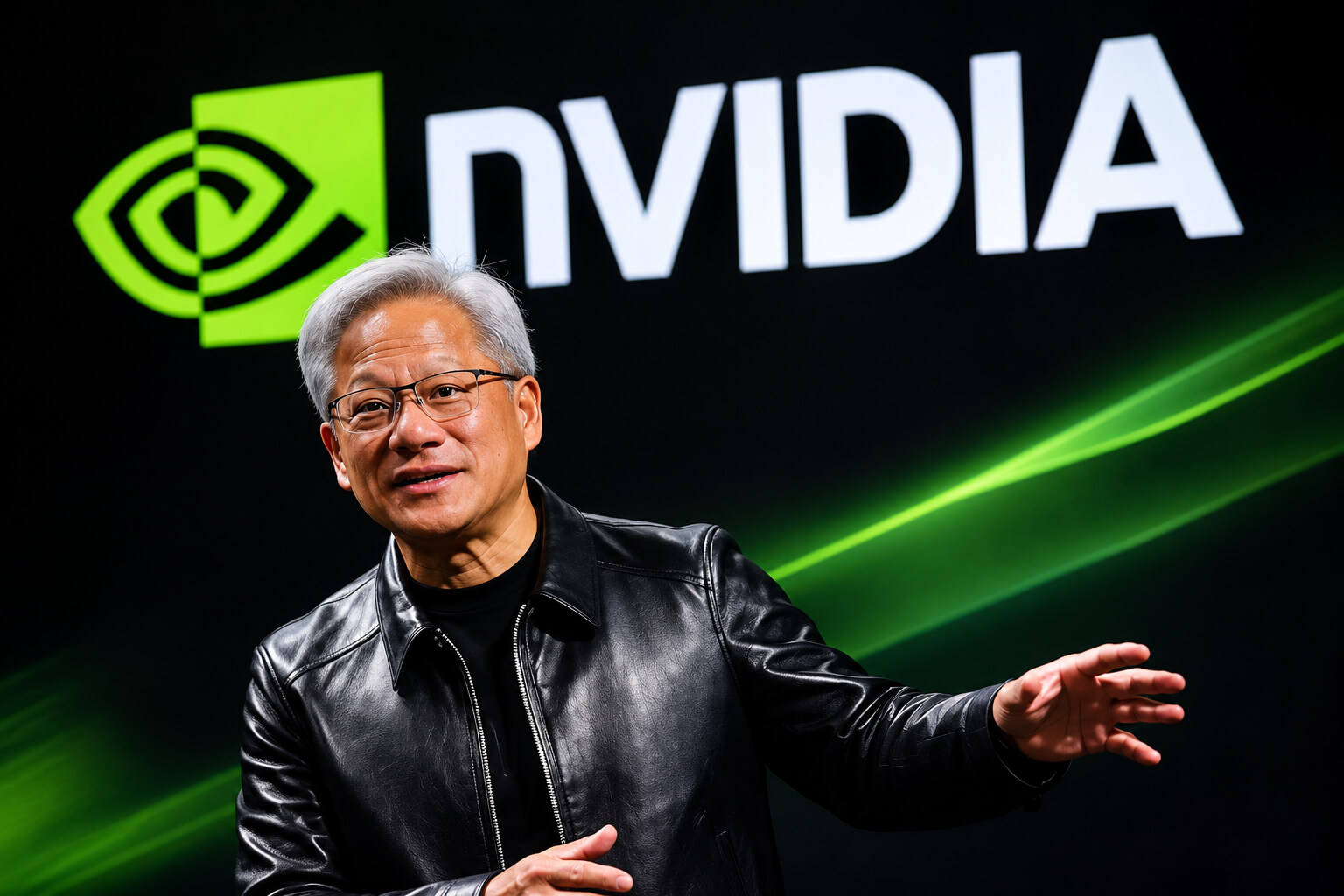
Nvidia is entering unfamiliar territory following the departure of Jensen Huang, the longtime chief executive who helped transform the company from a graphics chipmaker into one of the most influential businesses in artificial intelligence.
Huang’s resignation marks a major leadership shake-up for Nvidia, whose advanced processors power AI systems developed by some of the world’s largest technology companies. His departure also comes as investors question whether the enormous spending behind the global AI boom can continue delivering strong returns.
For more than three decades, Huang has been closely associated with Nvidia’s strategy, technological breakthroughs and expanding influence across the semiconductor industry. Now, the company faces the challenge of maintaining that momentum without the executive who helped build it.
Jensen Huang’s Departure Marks a Turning Point for Nvidia
Jensen Huang co-founded Nvidia in 1993 and spent more than three decades turning the company into a dominant force in accelerated computing. What began as a business focused largely on graphics processors eventually became a central player in artificial intelligence, cloud computing and high-performance data centers.
His leadership helped Nvidia capitalize on the rapid adoption of generative AI. As companies rushed to develop increasingly powerful AI models, demand for Nvidia’s processors surged. The company’s technology became essential to training and running advanced AI systems, giving Nvidia an unusually influential position in the global technology market.
Huang’s departure creates uncertainty because his role extended beyond traditional corporate management. He shaped Nvidia’s product strategy, maintained relationships with major customers and became one of the most recognizable figures in the AI industry.
Colette Kress Takes Over as Interim Nvidia CEO
Nvidia has appointed Chief Financial Officer Colette Kress as interim CEO while its board searches for a permanent successor. Kress has been with the company since 2013 and has overseen its financial operations during a period of extraordinary growth.
Her experience provides continuity at a time when Nvidia needs to reassure customers, investors and business partners. The company’s financial performance and expanding AI infrastructure business have made it a major player in global technology investment, leaving little room for prolonged leadership uncertainty.
The transition also raises questions about Nvidia’s future management structure. Huang’s influence shaped many of the company’s biggest decisions, and whoever takes over permanently will inherit the responsibility of protecting Nvidia’s market position while responding to growing competition.
Nvidia’s Leadership Shake-Up Raises Concerns Across the AI Market
The uncertainty surrounding Nvidia’s leadership has drawn attention across financial markets, where the company is widely viewed as a major indicator of confidence in artificial intelligence.
Nvidia’s importance extends well beyond its own stock performance. Its processors support the development of large language models, AI-powered applications and massive data centers. Technology companies have committed substantial resources to infrastructure built around Nvidia’s hardware and software ecosystem.
A leadership transition at such a central company naturally raises questions about future investment decisions. Investors will be watching whether Nvidia continues pursuing aggressive expansion or adopts a more cautious strategy under new management.
The situation could also create opportunities for competitors. AMD, Broadcom and other semiconductor companies are already competing for a larger share of the AI computing market. Any uncertainty surrounding Nvidia’s long-term direction could encourage customers to explore alternative technologies.
AI Infrastructure Expansion Faces New Uncertainty
Nvidia has become deeply connected to the global expansion of AI infrastructure. Its chips are used by cloud computing providers, research organizations and businesses developing increasingly sophisticated AI systems.
The company’s relationships with semiconductor manufacturers and technology suppliers are particularly important. Producing advanced AI processors requires complex manufacturing processes, specialized memory and extensive coordination across international supply chains.
A change in leadership does not automatically disrupt those operations. Existing production agreements, customer commitments and development schedules provide a degree of stability. However, future decisions about manufacturing capacity, research spending and infrastructure partnerships could look different under a new CEO.
That uncertainty matters because the AI industry is still investing heavily in computing capacity. Companies are building larger data centers, upgrading their infrastructure and developing models that require increasingly powerful hardware. Nvidia’s strategic decisions could influence how quickly those investments move forward.
Can Nvidia Maintain Its AI Dominance Without Jensen Huang?
Nvidia’s competitive position rests on more than its leadership. The company has spent years developing advanced processors, networking technologies and software tools that support AI workloads.
Its CUDA software platform remains particularly important. Developers and enterprises have built applications around Nvidia’s computing architecture, creating an ecosystem that competitors cannot easily replace.
That advantage gives Nvidia a strong foundation during its leadership transition. Customers with existing infrastructure investments are unlikely to abandon the company’s technology simply because its chief executive has changed.
Still, Huang’s ability to anticipate major shifts in computing played a substantial role in Nvidia’s success. He recognized the potential of accelerated computing long before generative AI became a mainstream business priority.
The next CEO will need to demonstrate similar strategic judgment while managing a company facing growing competition, rising customer expectations and increasing scrutiny over AI infrastructure spending.
Nvidia’s Upcoming Earnings Report Could Offer Early Clues
Nvidia’s next earnings announcement will be closely watched as investors look for signs that the leadership transition has affected the company’s operations or business outlook.
Financial results will provide insight into demand for AI processors, data center revenue and the company’s ability to maintain growth. Yet the market will also be paying attention to management’s comments about future investments, customer relationships and product development.
Nvidia’s leadership will need to reassure investors that its technology roadmap remains intact. The company has established an ambitious schedule for introducing increasingly powerful AI hardware, and maintaining those commitments will be important for customers planning long-term infrastructure investments.
The earnings announcement could become an early test of how effectively Nvidia communicates its strategy without Huang leading the discussion.
What Jensen Huang’s Exit Means for the Future of Artificial Intelligence
The departure of Jensen Huang does not mean the artificial intelligence boom is coming to an end. Demand for AI computing continues to be driven by technology companies, governments and enterprises investing in automation, advanced analytics and generative AI.
What changes is the level of certainty surrounding one of the industry’s most important suppliers.
Nvidia has played a defining role in the expansion of modern AI, and Huang helped establish the company’s reputation for anticipating where computing technology was heading. His exit leaves investors and industry partners evaluating whether that same vision can continue under different leadership.
The company still possesses substantial technological advantages, an established customer base and a powerful software ecosystem. Those strengths provide stability, but they do not eliminate the challenges associated with replacing a founder who has guided the business for more than three decades.
For Nvidia, the next chapter will be about proving that its success can continue beyond Jensen Huang. For the wider AI industry, it will be a test of whether the extraordinary momentum behind artificial intelligence can withstand a major leadership change at the company powering much of its growth.
Sources
- Reuters – Nvidia CEO Jensen Huang to Step Down in Big Blow to AI Boom
- Nvidia – Official Nvidia Newsroom
- Nvidia – Investor Relations and Financial Announcements
- Nvidia – CUDA Platform Overview
