


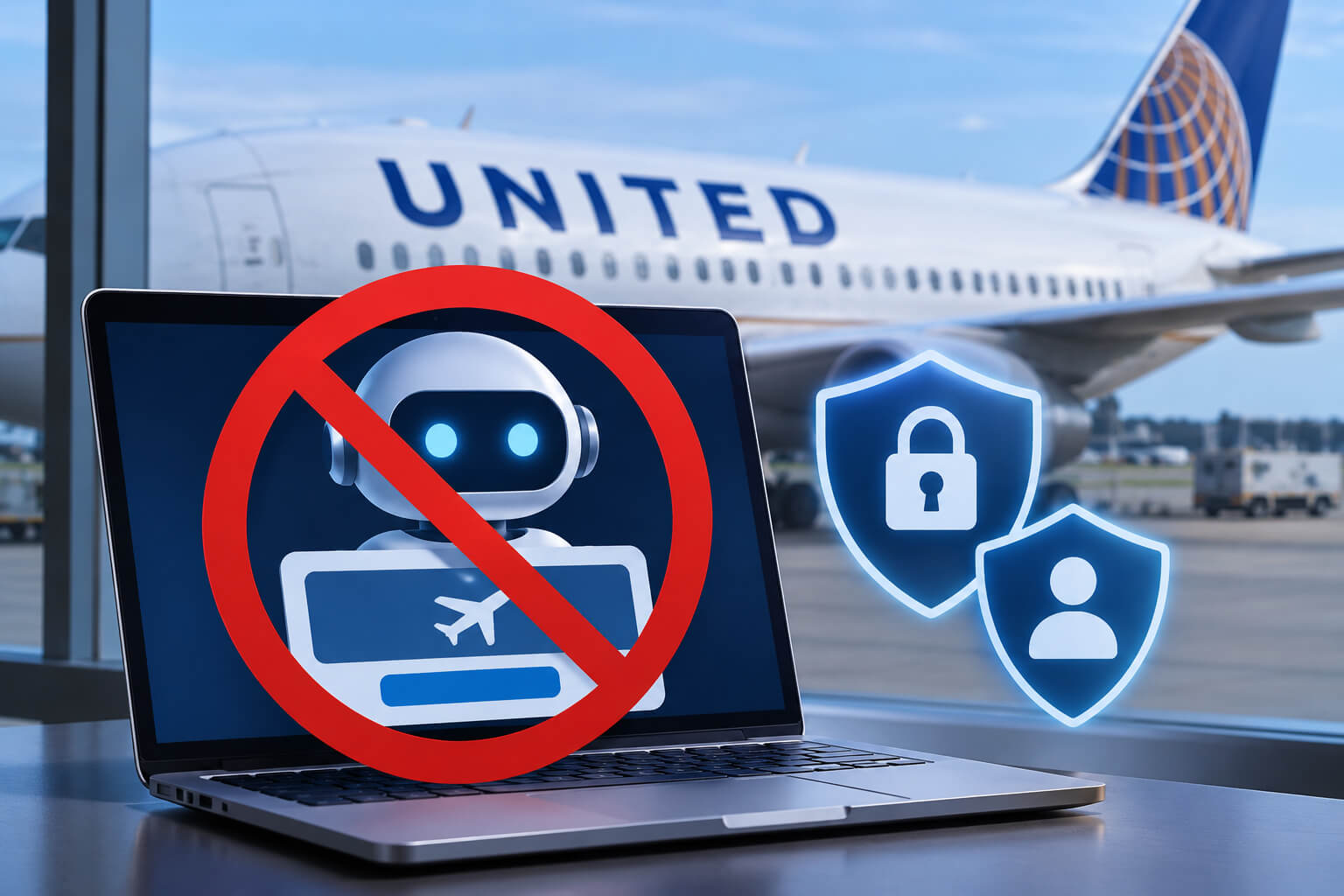
United Airlines is putting restrictions on artificial intelligence agents that book flights on behalf of travelers, raising fresh questions about how much control AI assistants should have over online transactions.
The airline announced on November 11, 2026, that it would block unauthorized third-party AI agents from accessing its booking systems. United cited concerns over customer privacy, unintended purchases and potential violations of federal aviation regulations.
The decision comes as AI companies develop increasingly autonomous assistants capable of searching for flights, comparing prices and making purchases without requiring users to handle every step.
United isn’t rejecting AI-powered travel planning altogether. But when it comes to booking tickets and managing passenger accounts, the airline wants tighter control.
United Airlines Raises Concerns Over AI Booking Security
United’s biggest concern is what happens when travelers give AI assistants access to their personal accounts.
Many AI agents need login credentials, payment information and other sensitive details to complete transactions. That creates potential security problems, particularly when third-party systems operate outside an airline’s direct supervision.
United warned that these tools could make purchases passengers never authorized, modify account information or use MileagePlus rewards without the account holder intending those actions.
The airline is responding by updating its booking, ticketing and distribution policies. The restrictions cover unauthorized AI agents accessing United’s own digital platforms and attempting transactions through travel agencies and aggregators.
For passengers, the concern is straightforward. An AI assistant might find a good airfare, but allowing it to complete the purchase introduces another system with access to personal and financial information.
Federal Aviation Regulations Complicate AI-Powered Travel
Security isn’t the only obstacle facing AI agents in the airline industry.
United also pointed to federal aviation requirements that involve direct passenger acknowledgment. During check-in, for example, travelers must confirm that their baggage does not contain prohibited materials, including explosives.
An automated assistant cannot independently verify what someone has packed.
United believes allowing AI agents to complete these steps could potentially conflict with regulations enforced by the Federal Aviation Administration and the US Department of Transportation.
That creates a difficult boundary for autonomous travel assistants. Searching for available flights involves processing information. Completing legally significant declarations requires a different level of accountability.
As AI agents become more capable of navigating websites and handling transactions, airlines will have to decide which actions can safely be automated and which still require direct human involvement.
United Airlines Wants to Keep Control of Its Booking Process
Beyond security, United’s decision also raises questions about who controls the relationship between airlines and travelers.
United CEO Scott Kirby has expressed reservations about allowing AI assistants to become another intermediary in airline ticket sales.
During an event in Chicago, Kirby said he did not want to create another middleman between the airline and its customers.
Airlines already work with online travel agencies, comparison websites and other booking platforms. Adding autonomous AI agents could create another layer between carriers and the people purchasing tickets.
Aviation analyst Henry Harteveldt of Atmosphere Research Group told CBS News that United’s approach may also reflect concerns about the costs associated with automated flight searches.
Every search places some demand on airline systems. A sharp increase in AI-generated requests could add expenses without necessarily producing more ticket sales.
United’s position suggests the airline is weighing the commercial impact of AI agents alongside the security risks.
Travelers Can Still Use AI to Find United Airlines Flights
United’s restrictions do not mean travelers will suddenly lose access to the airline’s fares through existing travel search services.
Platforms such as Google Flights, Kayak and Hopper can continue displaying United’s flight options and helping customers compare prices.
AI assistants can also help travelers research destinations, explore schedules and identify possible routes through permitted channels.
The restriction focuses on unauthorized AI agents accessing United’s systems to complete bookings or perform account-related actions.
That distinction matters for travelers who have started relying on AI to organize their trips. An assistant might recommend a flight and explain the available options, but completing the reservation may still require the passenger to use an approved booking channel.
United is keeping the door open to AI-assisted discovery while limiting how independently outside software can act within its systems.
Southwest and Delta Take Different Approaches to AI Travel
United’s restrictive approach contrasts with how some competing airlines are exploring AI-powered travel services.
Southwest Airlines has introduced a ChatGPT integration that allows users to search its flight inventory and discover available travel options through a conversational interface.
Delta Air Lines has also explored authenticated AI-assisted bookings, with additional safeguards for sensitive transactions.
The differences show how airlines are approaching the same technology from different directions.
For some carriers, AI assistants represent an opportunity to reach customers through new digital channels. For others, granting independent software access to booking systems introduces risks that outweigh the immediate benefits.
There is no industry-wide agreement yet on how autonomous travel assistants should interact with airline reservations.
What the AI Agent Restrictions Mean for United Passengers
Travelers who already use AI assistants to plan trips can continue using them for research, but they should be cautious about granting access to airline accounts.
United is discouraging customers from sharing their account credentials with unauthorized third-party AI services. Doing so could expose personal information or allow automated tools to make changes that passengers did not intend.
The airline also plans to update its Digital Trust Center with additional information about the restrictions, account protection and assistance for customers affected by unintended AI actions.
For now, travelers can continue booking United flights through the airline’s official website, mobile application and authorized travel services.
United has not ruled out reconsidering its approach as personal AI assistants improve. The company says it will continue evaluating how these technologies interact with its services.
AI Travel Booking Faces a Growing Trust Problem
United’s decision highlights a problem that extends well beyond the airline industry.
AI companies are moving toward autonomous agents that can handle increasingly complicated tasks, from shopping and reservations to financial transactions and account management.
But businesses are not necessarily ready to let those systems operate freely.
Banks, retailers and travel companies must consider what happens when an AI assistant makes a mistake, accesses sensitive information or performs an action without clear authorization.
The technology may be capable of completing a transaction, but that does not automatically mean a business will permit it.
United’s restrictions expose the tension between the convenience of autonomous AI and the responsibility companies have to protect customers.
For the emerging AI travel industry, the challenge is becoming clearer. Building assistants that can book flights is only part of the job. Getting airlines to trust them may prove much harder.
Sources
- CBS News – United Airlines Bans AI Agents From Booking Flights
- United Airlines Official Newsroom – United Restricts Access for Third-Party AI Agents
- The Wall Street Journal – United Airlines Is Banning AI Bots From Booking Flights
- Quartz – United Airlines Is Blocking Personal AI Agents From Booking Flights
