


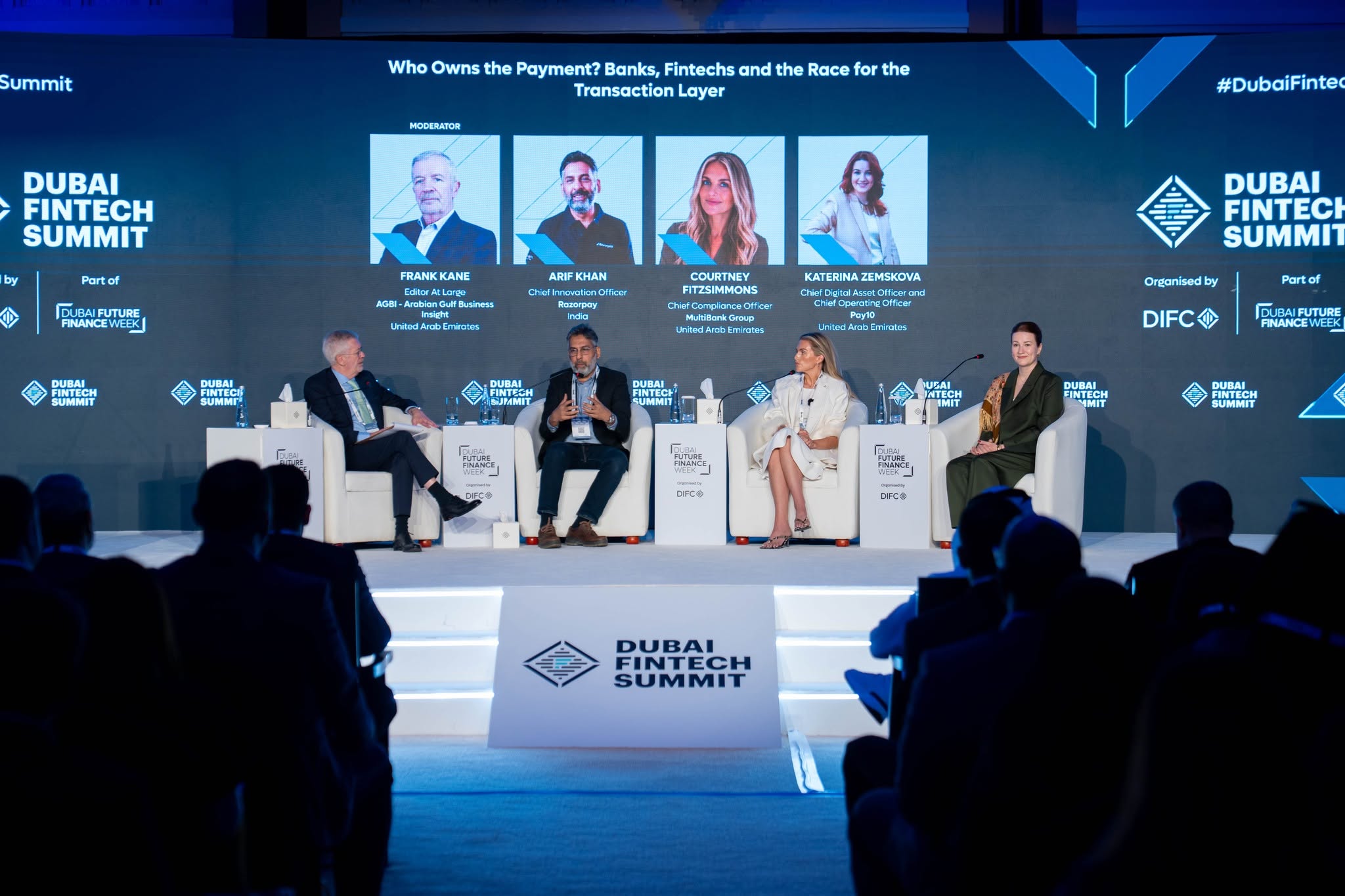
Artificial intelligence is moving deeper into the financial services industry, and payments are becoming one of its most important testing grounds. At the Dubai FinTech Summit 2026, industry executives explored how AI agents, automation, and connected financial infrastructure could change the way money moves between businesses, consumers, and financial institutions.
The discussion, held at Madinat Jumeirah in Dubai as part of Dubai Future Finance Week, brought together senior leaders from Razorpay, MultiBank Group, and Pay10. Their focus was on a question facing the payments industry: how can financial services become faster, smarter, and more accessible without creating new security risks?
As payment systems become increasingly digital, the conversation is expanding beyond transaction speed. Fraud prevention, regulatory compliance, interoperability, and the growing role of autonomous technologies are becoming equally important.
AI Agents Could Change How Payments Are Managed
AI agents are emerging as a potential next step in financial automation. Unlike traditional systems that follow fixed instructions, agent-based technologies can use available information to support decisions and carry out defined tasks within established controls. For payment providers, this could mean more efficient transaction processing, automated workflows, and faster responses to operational issues.
The technology could also change how businesses manage everyday financial activities. AI-powered systems may eventually help coordinate payments, monitor transaction activity, and identify potential processing problems without requiring constant manual intervention. Such developments could reduce administrative workloads and allow financial teams to concentrate on more complex decisions.
Yet greater autonomy introduces new questions about accountability. Financial institutions must determine how much control AI agents should have, particularly when handling sensitive information or initiating transactions. The discussion at Dubai FinTech Summit 2026 placed these considerations within the wider evolution of intelligent payment infrastructure.
Smarter Payment Infrastructure Takes Center Stage
Payment technology has improved considerably, but many financial systems still operate across disconnected platforms, institutions, and regulatory environments. This fragmentation can create delays, increase operational costs, and make financial transactions more complicated than necessary.
Greater interoperability could help address some of those limitations. By allowing financial networks and service providers to exchange information more effectively, connected payment ecosystems could reduce processing friction and improve access to financial services. Automation may also help payment providers manage growing transaction volumes without relying entirely on manual processes.
For businesses operating internationally, these developments could be particularly valuable. Cross-border payments often involve multiple intermediaries, different compliance requirements, and additional processing costs. More connected infrastructure could simplify parts of that process, although technical compatibility and regulatory differences remain significant challenges.
Fraud Prevention Remains a Critical Priority
Faster payments bring obvious advantages, but they can also leave financial institutions with less time to identify suspicious activity before transactions are completed. As digital transaction volumes increase, payment providers face growing pressure to strengthen their security systems without slowing legitimate transactions.
Artificial intelligence offers several potential advantages in this area. Machine learning systems can analyze transaction patterns, identify unusual behavior, and help compliance teams prioritize potentially fraudulent activity. These capabilities could become increasingly important as financial networks grow more complex and criminals develop more sophisticated methods of exploiting digital payment platforms.
Automation, however, does not eliminate financial risk. AI-powered security systems still require human oversight, accurate information, and safeguards against incorrect decisions. The Dubai FinTech Summit 2026 discussion highlighted the importance of balancing technological innovation with security and compliance as financial institutions adopt more advanced payment technologies.
Industry Leaders Examine the Future of Digital Payments
The session featured Arif Khan, Chief Innovation Officer at Razorpay; Courtney Fitzsimmons, Chief Compliance Officer at MultiBank Group; and Saad Kaleem, Global Chief Executive Officer at Pay10. Their participation brought together perspectives from payment innovation, regulatory compliance, and digital financial infrastructure.
Razorpay operates in the digital payments sector, where businesses increasingly depend on integrated financial tools and automated transaction services. MultiBank Group represents another important part of the financial ecosystem, where compliance and risk management play central roles in maintaining operational integrity. Pay10, meanwhile, operates in payment technology, a sector facing growing demand for secure, efficient, and interconnected financial services.
The combination of these perspectives reflected the broader challenges facing the payments industry. Developing faster transaction systems is only one part of the equation. Financial institutions must also ensure that emerging technologies can operate within regulatory frameworks while meeting the expectations of businesses and consumers.
Dubai Strengthens Its Role in Financial Technology Discussions
Dubai FinTech Summit 2026 provided a platform for examining how emerging technologies could influence the future of financial services. Organized by the Dubai International Financial Centre (DIFC), the event formed part of Dubai Future Finance Week and brought together discussions on innovation across the financial sector.
The increasing use of artificial intelligence in payment systems reflects a wider transformation taking place across banking, financial technology, and digital commerce. Financial institutions are exploring how automation can improve operational efficiency while responding to customer expectations for convenient and secure financial services.
Dubai’s position as an international financial and business hub also makes payment interoperability an important subject. Companies operating across different markets depend on reliable financial networks that can support transactions between institutions and jurisdictions. Discussions around connected financial ecosystems therefore extend beyond technical improvements and into the broader future of international commerce.
The Future of Payments Will Depend on Trust
AI agents and automated payment systems could eventually handle a larger share of routine financial processes. Their success, however, will depend on more than technological capability. Security, transparency, and regulatory accountability will influence how quickly financial institutions adopt these tools.
For payment providers, the opportunity lies in combining intelligent automation with dependable infrastructure. Customers want transactions that work quickly and reliably, but they also expect their financial information to remain protected. Financial institutions must find ways to deliver both without introducing unnecessary complexity.
The Dubai FinTech Summit 2026 discussion reflected that balance. As AI becomes more deeply integrated into financial services, the next phase of payment innovation will be shaped not only by what technology can automate, but by how safely and effectively it can operate.
Sources and References
- Dubai FinTech Summit – Official Website
- Dubai International Financial Centre (DIFC)
- Razorpay – Official Website
- MultiBank Group – Official Website
- Pay10 – Official Website
Editorial note: This article is based on the supplied session description. The sources are general references rather than verified session transcripts. No direct quotations or unverified individual speaker statements have been added.
