


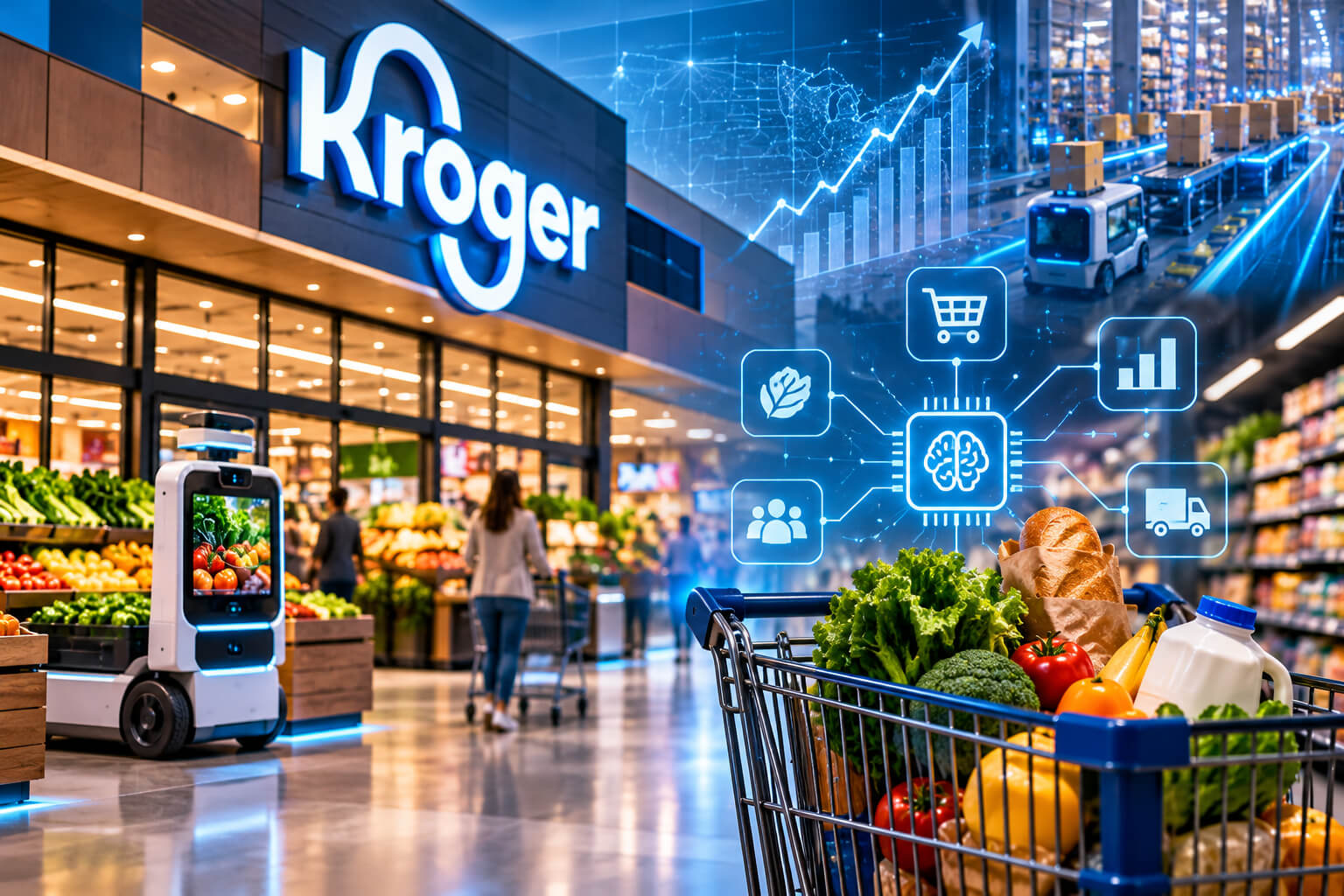
Kroger is preparing for a major business transformation as new CEO Greg Foran moves to strengthen the supermarket chain’s position in the increasingly competitive US grocery market. As part of this transformation, the Kroger AI strategy will play a key role in shaping the company’s future.
The company outlined its updated strategy on October 20, 2026, focusing on operational efficiency, lower costs and renewed investment in its core grocery business. Artificial intelligence will play a growing role in those changes.
Foran wants Kroger to operate with fewer layers of management, simplify internal processes and direct more resources toward customers. The strategy comes as Walmart, Aldi and other grocery retailers continue putting pressure on traditional supermarket chains.
Kroger also plans to improve its fresh-food selection, expand private-label products and strengthen digital shopping services.
The company faces a difficult balancing act. It needs to offer shoppers better value while protecting profitability, and it believes technology can help make that possible.
Kroger Plans to Use Artificial Intelligence to Improve Business Efficiency
Artificial intelligence is becoming an important part of Kroger’s efforts to modernise its operations. Rather than treating AI as a separate technology initiative, the company intends to integrate it into everyday business processes.
Kroger wants to eliminate repetitive administrative tasks, simplify corporate workflows and improve efficiency across its operations. The company also plans to strengthen purchasing practices and work more directly with suppliers to reduce unnecessary expenses.
These changes could help Kroger redirect spending toward areas that customers notice, including product prices, store improvements and shopping convenience.
Foran’s approach reflects a growing trend among major retailers. Companies are looking beyond AI-powered customer service tools and exploring how automation can improve the way entire organisations operate.
For Kroger, the challenge will be turning those technological improvements into measurable savings without disrupting essential business functions.
Kroger’s Corporate Restructuring Could Affect Thousands of Jobs
Kroger’s transformation will also involve substantial changes to its corporate workforce.
The company has outlined plans to reduce approximately one-third of its corporate positions over three years. The restructuring could affect around 3,000 employees as Kroger simplifies its organisational structure and eliminates overlapping responsibilities.
Artificial intelligence is expected to support some of those operational changes by automating routine tasks and reducing the need for certain administrative processes.
The planned reductions highlight how AI adoption is beginning to influence employment decisions across industries that traditionally depend on large corporate teams.
Kroger’s objective is to create a more efficient organisation that can respond faster to market changes. However, the workforce reductions also raise questions about how employees will be affected as automation becomes more deeply integrated into business operations.
The company will need to manage those changes while maintaining the operational stability required to serve millions of grocery customers.
Fresh Food and Affordable Prices Become Kroger’s Main Priorities
While artificial intelligence is attracting attention, Kroger’s broader strategy remains centred on its grocery business.
The retailer wants to improve its fresh-food offerings, expand prepared meals and strengthen its private-label brands. These categories are particularly important as consumers look for affordable alternatives to higher-priced national products.
Kroger also plans to invest in customer loyalty through its Boost membership program and other initiatives designed to encourage repeat shopping.
Competition remains one of the company’s biggest challenges. Walmart continues attracting customers through competitive pricing and extensive store coverage, while Aldi has built a strong reputation around lower-cost groceries.
Kroger must find ways to compete without relying entirely on price reductions.
Improving product quality, expanding convenient meal options and offering better digital shopping experiences could help the company retain customers who might otherwise choose competing retailers.
Foran believes a stronger focus on these everyday shopping needs will be essential to Kroger’s long-term growth.
Kroger Expands AI-Powered Shopping and Digital Commerce
Kroger is also looking to strengthen its digital business as more consumers turn to online grocery shopping and delivery services.
The company plans to expand e-commerce operations and retail media, which allows brands to advertise through Kroger’s digital platforms and customer channels. Both businesses offer opportunities to generate additional revenue beyond traditional grocery sales.
Artificial intelligence could make those digital services more useful. Kroger has introduced an AI-powered shopping assistant that helps customers plan meals and select groceries based on their preferences, dietary requirements and budgets.
During its October 20 investor presentation, Kroger reported that repeat users of its shopping assistant were spending 11% more, driven by more frequent shopping trips. The company sees the early results as encouraging, although they do not prove that AI alone caused the increase.
The retailer wants to make digital shopping easier while using its extensive physical store network to support faster deliveries and convenient order fulfilment.
Kroger Announces $5 Billion Investment to Strengthen Customer Value
Kroger has unveiled plans to invest $5 billion in customer value by 2029 as part of its effort to regain momentum in the US grocery market.
The investment will support lower everyday prices, simpler promotions, improved merchandising, refreshed store formats and stronger loyalty programs.
Rather than relying entirely on new funding, Kroger intends to finance these improvements through operational savings. The company is targeting approximately $4 billion in annualised structural cost reductions by 2029.
Those savings are expected to come from more direct sourcing, improved supplier negotiations, reduced corporate expenses and technology-driven operational improvements.
The strategy creates an important test for Kroger. Reducing costs may help the company compete more aggressively on prices, but those savings must be large enough to support its planned investments without undermining profitability.
Kroger Targets Stronger Sales and Earnings Growth by 2029
Kroger has introduced new financial targets designed to demonstrate the long-term potential of its business transformation.
The company expects approximately 3% comparable sales growth in 2029, excluding fuel and pharmacy. It is also targeting annual adjusted earnings-per-share growth of 7% to 11% and adjusted EBITDA growth of 3% to 6% from 2027 through 2029.
These targets reflect management’s expectation that operational improvements, stronger customer loyalty and expanded digital services can support more consistent financial performance.
However, Kroger enters this transformation under pressure. The retailer lowered its annual identical-sales forecast in September as weaker consumer demand and elevated costs affected its business.
The company must now show investors that its restructuring plans can deliver sustainable growth rather than temporary savings.
Its new financial framework excludes the pending Giant Eagle acquisition, allowing investors to assess the performance targets for Kroger’s existing business.
AI Transformation Could Reshape the Future of Grocery Retail
Kroger’s latest strategy offers another example of how artificial intelligence is changing industries beyond the technology sector.
Grocery retailers operate complicated supply chains, manage thousands of products and make constant decisions about pricing, inventory, logistics and customer demand. These activities create opportunities for AI to improve efficiency and reduce manual work.
Kroger wants to use those capabilities to build a more competitive business. Its approach combines automation, corporate restructuring and investment in customer-facing services.
The consequences will extend beyond financial results. Thousands of corporate positions could disappear as Kroger changes how it operates, highlighting the workforce challenges that can accompany large-scale AI adoption.
For customers, the outcome may be more straightforward. Kroger hopes to offer better prices, improved grocery selections and more convenient shopping experiences.
For the wider retail industry, the transformation raises a bigger question: can AI help established supermarket chains compete with larger and lower-cost rivals?
Kroger’s progress over the next three years could provide an important answer.
Sources
- Reuters — October 20, 2026: Kroger to Focus on Grocery Business Under New CEO as Competition Heats Up
- The Kroger Co. — October 20, 2026: Kroger Outlines Plan to Build America’s Favorite Grocer and Introduces New Long-Term Financial Targets
- Reuters — October 20, 2026: Kroger to Invest $5 Billion by 2029 as New CEO Sharpens Grocery Focus
- Reuters — October 2026: Kroger Plans to Eliminate 3,000 Corporate Roles as It Expands AI Use
