


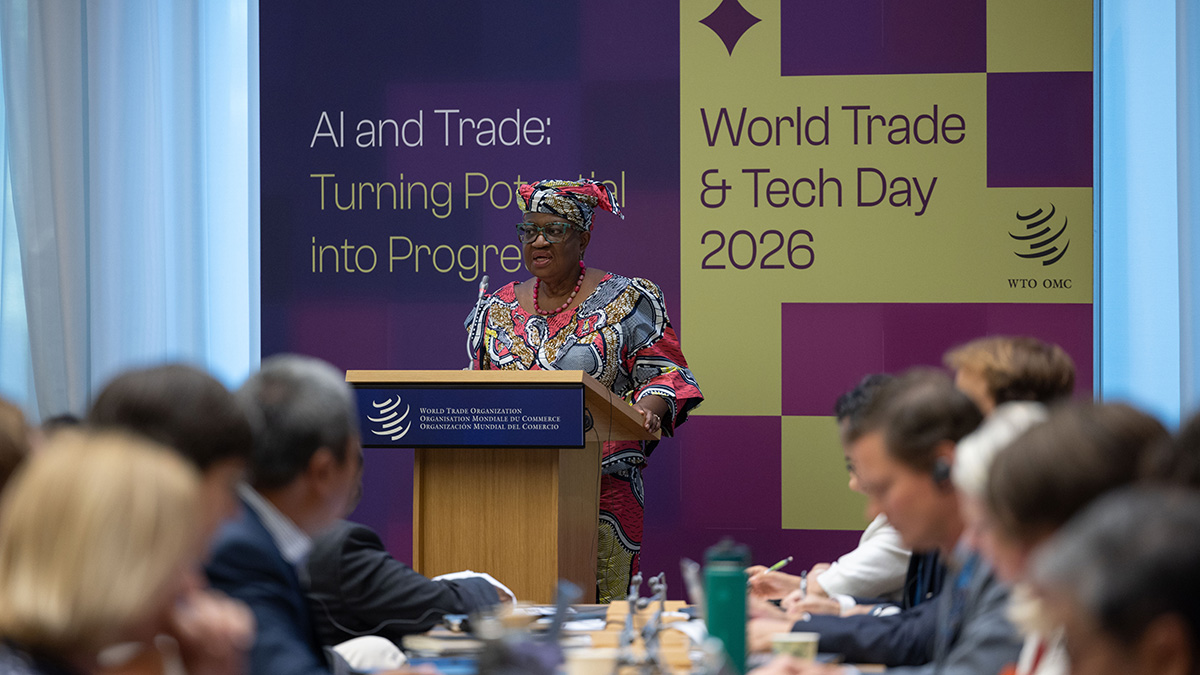
Artificial intelligence is no longer sitting on the edge of international commerce. It is starting to shape how goods are produced, how services cross borders and how businesses make decisions inside global supply chains.
That was the message coming out of the World Trade Organization’s first World Trade & Tech Day, held on September 14 under the theme “AI and Trade: Turning Potential into Progress.”
More than 600 people registered to attend the event in person, with roughly the same number signing up online, as governments, technology companies, academics and trade specialists gathered to examine what AI means for cross-border commerce.
AI Is Already Showing Up in Global Trade Numbers
The relationship between artificial intelligence and global trade is becoming much more visible in the numbers. WTO Director-General Ngozi Okonjo-Iweala said global merchandise trade volume grew 4.6% last year, with the organization estimating that around 42% of that expansion came from trade in AI-related products. That suggests the AI boom is no longer limited to software subscriptions or model development. It is increasingly tied to physical goods moving through international supply chains.
Those goods include semiconductors, servers, networking equipment and other technologies needed to build and operate AI systems. Demand for computing power has pushed these products deeper into the global trade system, making AI-related hardware an increasingly important part of international commerce.
The AI Supply Chain Is Global by Design
Artificial intelligence depends on a highly international supply chain. A chip can be designed in one country, manufactured in another, packaged somewhere else and eventually installed in a data centre on the other side of the world. The same applies to networking systems, cloud infrastructure, critical minerals and many of the services that keep modern AI platforms running.
The WTO argues that this global structure makes trade policy increasingly important to the future of AI. Restrictions on semiconductor exports, tariffs on technology products or fragmented technical standards can affect how quickly companies build infrastructure and how easily AI services expand into new markets.
In that sense, global trade is becoming part of the foundation of the AI economy rather than simply a separate policy issue.
WTO Rules Were Written Before the LLM Era
Many existing WTO agreements already cover parts of the technology ecosystem behind artificial intelligence. The Information Technology Agreement helps reduce tariffs on technology products, while agreements covering services, intellectual property and technical trade barriers also influence how digital technologies move across borders.
The problem is that most of these frameworks were created long before generative AI, large language models and autonomous AI agents became mainstream. The rules were designed for an earlier generation of digital trade, not for software systems capable of making complex commercial decisions on their own.
That does not make the existing rules irrelevant. It does mean governments may need to rethink how they apply when AI starts participating more directly in transactions, procurement and international business operations.
Agentic AI Could Change How Companies Trade
One of the more striking ideas discussed at the event was the possibility that AI could become a new decision layer for the global economy. Sakana AI co-founder and chairman Ren Ito said autonomous AI systems are beginning to take on tasks across procurement, logistics, compliance and supply-chain management.
That shift could significantly change how businesses buy and sell across borders. Instead of employees manually searching for suppliers, comparing prices and reviewing documents, AI agents could eventually handle much of that work automatically. A system might identify vendors, evaluate costs, check compliance requirements and recommend a transaction before a person becomes involved.
More advanced systems could go further and communicate directly with other AI agents representing suppliers, logistics companies or service providers. Agentic commerce is often discussed in relation to online shopping, but its larger impact may eventually appear in business-to-business trade.
Smaller Economies See AI as a Way to Compete
Smaller economies also see artificial intelligence as a potential way to gain a stronger position in international trade. Singapore Digital Development and Information Minister Josephine Teo said stable trade conditions could help ensure that AI-driven economic opportunities do not remain concentrated among a small group of major technology powers.
Representatives from Iceland, El Salvador and Jamaica also discussed how their governments are approaching AI through digital infrastructure, workforce development and trade policy. El Salvador, for example, is already using AI tools to study how trade negotiations could affect different sectors of its economy.
For smaller countries, competing in AI may not require building the world’s largest frontier models. Opportunities could instead emerge in digital services, specialised talent, logistics, data processing and AI-assisted professional services that can be delivered across borders.
Cars Are Becoming Part of the AI Trade Story
Artificial intelligence is also becoming embedded in physical products, and the automotive industry is one of the clearest examples. NIO founder, chairman and CEO William Li discussed how modern electric vehicles increasingly depend on AI, computing systems, software platforms and connected sensors.
That transformation changes what international trade looks like for car manufacturers. Exporting a vehicle is no longer just about meeting mechanical or safety requirements. Companies increasingly have to deal with software standards, data rules, AI systems and digital compatibility across different markets.
The same issue will likely appear in robotics, industrial equipment, drones, medical devices and other products that increasingly rely on embedded AI. As that happens, the line between digital trade and physical trade will become harder to define.
AI Is Already Being Used Inside Trade Operations
The event also highlighted several examples showing that AI is already being used in real trade operations. Twelve organizations, including customs agencies, presented case studies demonstrating how artificial intelligence can support activities connected to trade facilitation.
The WTO has also created an AI for Trade in Action database that collects practical examples of how organizations are using AI in international commerce. These applications show that the technology is moving beyond research projects and entering day-to-day trade processes.
Customs processing, document analysis, shipment risk assessment, compliance screening and supply-chain forecasting all involve large amounts of repetitive data. Those are areas where AI systems can immediately reduce manual work and speed up decision-making.
AI Trade Rules Could Become the Next Big Policy Fight
The rapid expansion of AI is creating a difficult policy problem for governments. Countries want access to advanced technology and AI infrastructure, but many are also becoming more protective of semiconductors, data, intellectual property and strategically important technologies.
Those priorities can quickly come into conflict. Companies prefer common standards that make it easier to operate across markets, while governments may introduce different national rules covering privacy, security, copyright and AI safety.
The result could be a fragmented global AI market where systems face different technical and legal requirements in every country. The WTO may eventually play a larger role in helping governments manage those differences through international trade rules.
AI and Trade Are Becoming One Conversation
The first World Trade & Tech Day made one thing increasingly clear: artificial intelligence and global trade can no longer be treated as separate discussions. Modern AI systems depend on international semiconductor supply chains, data centres, digital infrastructure and cross-border services.
At the same time, AI is starting to influence how those same trade systems operate. Businesses are using it to manage procurement, logistics, compliance and market analysis, while governments are exploring AI for customs and trade facilitation.
WTO Deputy Director-General Johanna Hill noted that many of the long-term effects are still developing. The decisions governments make now around trade, technology access and digital rules could shape who benefits most from the next phase of AI.
The bigger story may not simply be which company builds the most powerful AI model. It may also be which countries can create trade systems flexible enough to support the technology around it.
Sources
World Trade Organization — World Trade & Tech Day: AI and trade increasingly intertwined
https://www.wto.org/english/news_e/news26_e/dtech_14sep26_488_e.htm
World Trade Organization — Artificial Intelligence and Trade
https://www.wto.org/english/tratop_e/dtt_e/artificial_intelligence_e.htm
