


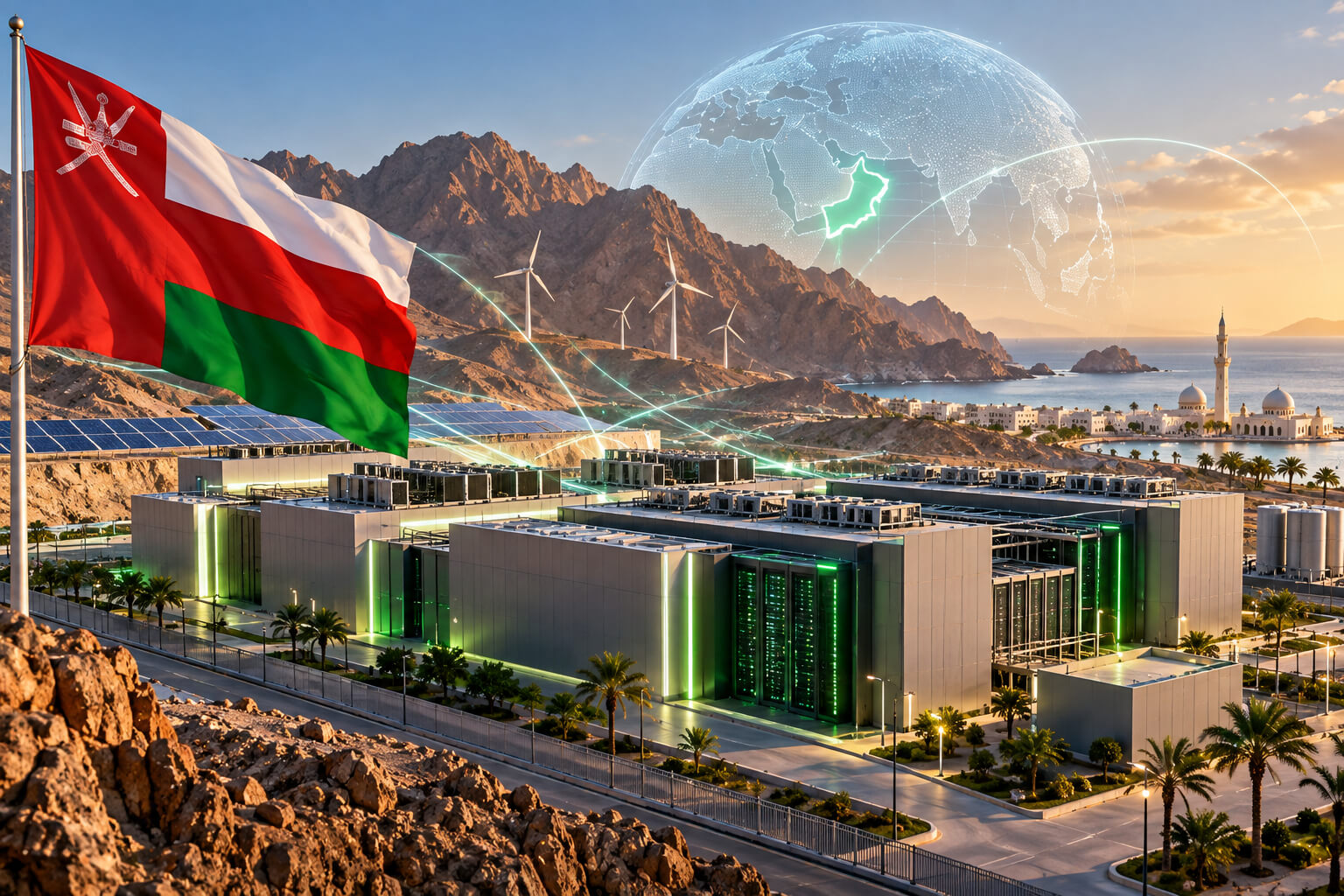
Oman is putting renewable energy at the center of its artificial intelligence infrastructure ambitions.
State-backed clean energy platform O-Green plans to develop more than 200 megawatts of AI-ready data centre capacity by 2028, with projects expected across Oman, Spain and other international markets. The strategy links data centre expansion directly with O-Green’s renewable energy and battery storage portfolio, giving the company a route into one of the fastest-growing areas of global AI infrastructure.
The move comes as demand for AI computing continues to push electricity requirements higher. For countries hoping to attract data centre investment, access to reliable power is becoming just as important as access to chips, cloud infrastructure and connectivity.
O-Green Moves Beyond Renewable Energy Into AI Infrastructure
O-Green’s move into AI-ready data centres builds naturally on its existing renewable energy business. The company has developed a portfolio exceeding 11 GW across 12 countries, including solar, wind and battery energy storage projects. Instead of treating renewable power generation and data centres as separate businesses, O-Green wants to combine them. That could give future AI and cloud facilities direct access to large-scale clean energy resources designed around their electricity needs.
This is becoming increasingly relevant as AI infrastructure developers look for locations capable of supporting power-intensive computing. A data centre packed with GPUs needs far more than servers and cooling equipment. It needs dependable electricity, often around the clock. O-Green’s advantage is that energy infrastructure is already at the center of its business model.
More Than 200MW of AI-Ready Capacity Is Planned by 2028
O-Green is targeting more than 200 MW of AI-ready data centre capacity by 2028, with planned developments in Oman, Spain and additional international markets. That capacity could support workloads including artificial intelligence training, AI inference, cloud computing and high-performance computing.
The figure is significant because AI-focused facilities are becoming increasingly dense in terms of power consumption. Operators are no longer simply looking for available land and network connectivity. They also need locations where energy supply can scale alongside computing demand. O-Green is positioning its projects around that reality from the start.
Duqm and Mahout Could Become Part of Oman’s AI Energy Backbone
One of O-Green’s largest renewable developments is located across Duqm and Mahout, where the company is working on a 2.7 GW Continuous Renewable Energy project. The project combines solar energy, wind generation and battery energy storage, with the system expected to provide around 770 MW of firm renewable power.
That kind of energy profile could support energy-intensive industries, including AI data centres and high-performance computing facilities. The battery storage component is particularly important because solar and wind output naturally fluctuate. Data centres, however, do not operate only when the sun is shining or the wind is strong. Combining different renewable sources with storage makes it possible to provide a more stable supply of electricity.
Oman Is Addressing AI’s Growing Power Problem
The expansion of artificial intelligence is creating a less glamorous problem behind the scenes: electricity demand. Training large AI models and running millions of daily AI queries requires enormous computing infrastructure, and that infrastructure needs continuous power.
Oman appears to be treating that issue as part of its AI strategy rather than something to solve later. The country has been developing initiatives around green data centres, high-performance computing, cloud infrastructure and renewable-powered digital facilities. O-Green’s data centre plans fit into that wider effort by connecting future AI capacity directly with clean energy production.
The Green Artificial Intelligence Alliance Adds Another Layer
Oman has also established a Green Artificial Intelligence Alliance, bringing together government entities and industry stakeholders to explore ways of making AI development more sustainable. The initiative focuses on reducing the environmental impact of AI infrastructure while encouraging the use of renewable energy, efficient processors, green data centres, energy-efficient servers and advanced cooling systems.
The alliance shows that Oman is not treating green AI simply as a branding exercise. Its strategy looks across the full infrastructure stack, from power generation and storage to computing hardware and software efficiency. That gives O-Green’s data centre ambitions a broader national context.
Oman’s Digital Triangle Supports the Same Direction
Oman’s Digital Triangle initiative is another part of the country’s wider push into advanced digital infrastructure. The strategy is designed around geographically distributed but digitally connected zones that can support cloud services, artificial intelligence, data centres and other advanced digital applications.
For AI infrastructure companies, that creates a more complete proposition. Renewable power alone is not enough. Data centres also need strong fiber connectivity, access to international submarine cables, suitable land, cooling infrastructure and policy support. Oman is gradually assembling those pieces rather than relying on a single headline project.
The AI Designated Zone Could Attract More Technology Companies
Oman has also announced an AI Designated Zone in Al Seeb, Muscat, intended to attract AI companies, startups, research organizations and technology investors from Oman, the Middle East and Africa. The initiative could help create demand for the kind of computing infrastructure O-Green plans to build.
If more AI companies establish operations in the country, local demand for cloud services, data storage, GPU computing and high-performance computing could increase. That would give Oman another reason to expand domestic data centre capacity instead of depending heavily on infrastructure located elsewhere.
Oman Wants the Digital Economy to Play a Bigger Role
The data centre push is also tied to Oman’s longer-term economic ambitions. The country wants the digital economy to contribute significantly more to national GDP by 2040, with artificial intelligence, cloud computing, data infrastructure and advanced digital technologies expected to play a growing role.
Building local AI infrastructure can support that goal in several ways. It can attract foreign investment, create demand for specialized technology skills and give local companies easier access to computing resources. It can also make Oman more attractive to global cloud and AI infrastructure providers looking for new regional locations.
Other Green AI Data Centre Projects Are Already Emerging
O-Green is not the only company looking at large-scale AI infrastructure in Oman. Earlier projects have included plans for a 150 MW green hyperscale AI data centre, involving companies from Oman, the UAE and Italy. The development was positioned around renewable energy and more efficient data centre technologies.
That suggests Oman’s AI infrastructure market could become increasingly competitive. Several large-scale projects in the same market would also strengthen the surrounding ecosystem, including network connectivity, engineering expertise, cooling technology, power infrastructure and specialized data centre services.
Renewable Energy Could Become Oman’s AI Advantage
The AI infrastructure race in the Gulf is getting crowded. Countries across the region are investing in data centres, sovereign AI systems, cloud platforms and advanced computing capacity. Oman may not need to copy those strategies exactly.
Its strongest opportunity could come from energy.
Oman has large renewable resources, available land and an expanding digital infrastructure strategy. By linking those advantages directly with AI-ready data centres, the country could appeal to operators looking for computing capacity with a lower-carbon energy profile.
O-Green’s 200 MW target by 2028 remains a development goal, and the real test will be how quickly those facilities move from planning into operation. Still, the direction is clear. O-Green is no longer focused only on producing renewable electricity. It increasingly wants to turn some of that energy into computing power.
Sources
Middle East AI News
https://www.middleeastainews.com/p/omans-o-green-targets-200mw-of-ai
Ministry of Transport, Communications and Information Technology, Oman
https://www.mtcit.gov.om/media-4/news-announcements-11/news-85/launch-of-comex-2025-announcement-of-the-green-artificial-intelligence-alliance-and-unveiling-of-the-ai-designated-zone-and-digital-triangle-projects-461
