


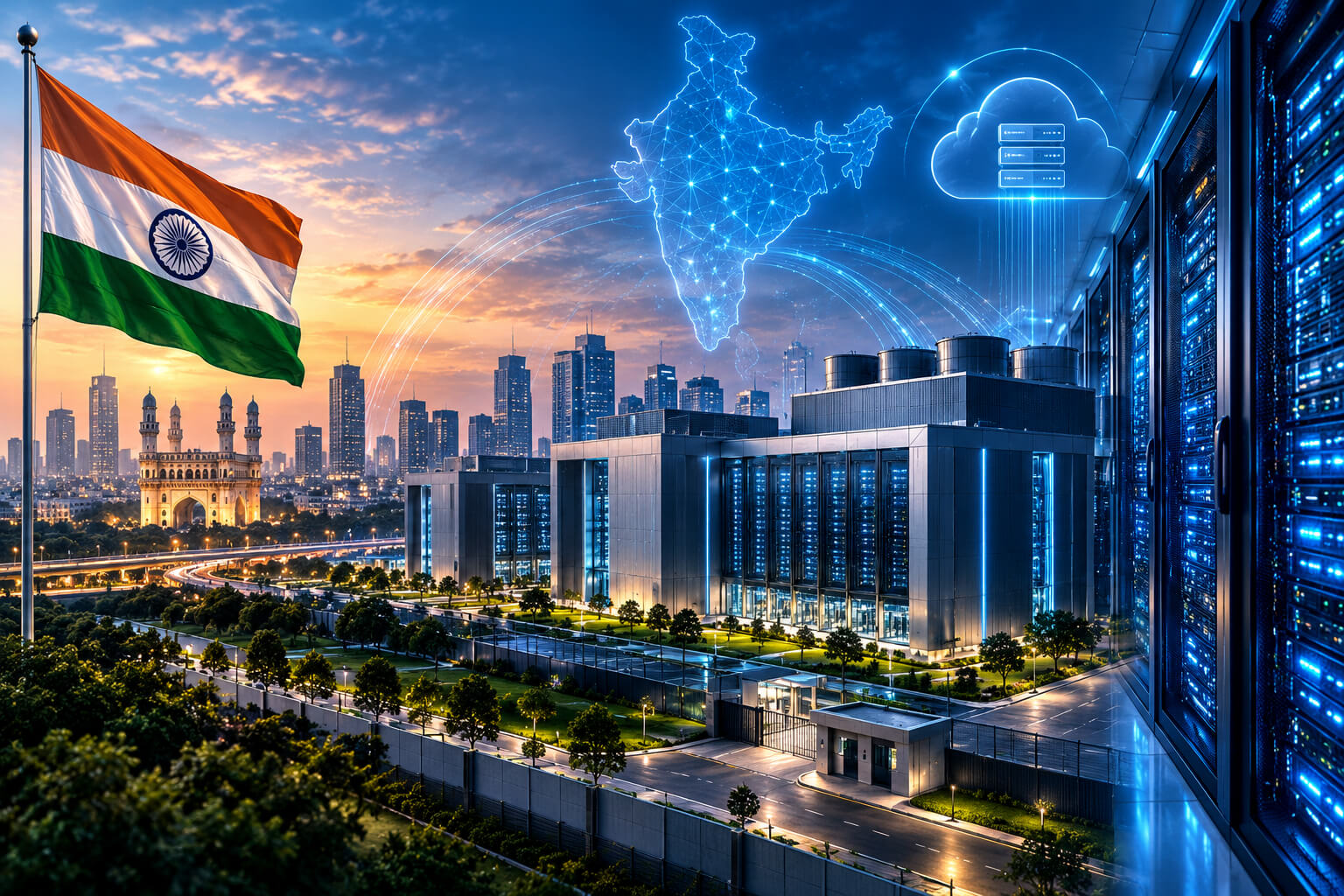
India’s AI race is quickly becoming a race for physical infrastructure. One notable development is the TCS AI data center in Hyderabad, which adds significant capacity to the country’s growing tech landscape.
Tata Consultancy Services is preparing one of the country’s biggest bets yet on the computing capacity needed to support artificial intelligence. Its data center subsidiary, HyperVault, has secured 264 acres in Hyderabad for a new AI-focused campus that could eventually reach 1 gigawatt of capacity. HyperVault and its partners are expected to invest as much as 700 billion rupees, roughly $7.4 billion, in developing and managing the project.
The scale immediately puts the project into a different category from an ordinary enterprise data center. TCS is building it for frontier AI companies, hyperscalers and organizations running GPU-heavy workloads for AI training and inference. It also signals something broader: India wants considerably more of the infrastructure sitting underneath the global AI boom.
HyperVault Secures 264 Acres in Hyderabad
HyperVault has secured 264 acres for the planned campus, giving the company room to build a facility that could eventually become one of the largest AI infrastructure developments in India. TCS does not intend to construct the entire project in a single push. Instead, HyperVault plans to develop the campus in phases, with new capacity coming online as customer demand grows and technology requirements change.
That phased model makes sense for a sector moving this quickly. GPU systems are becoming denser, power requirements are rising and cooling technology continues to change. Building gradually gives HyperVault more freedom to adjust the infrastructure rather than locking the whole campus into today’s specifications.
The Campus Could Reach 1GW of AI Capacity
At full build-out, the Hyderabad facility could provide up to 1GW of data center capacity. TCS says the campus will support high-density GPU deployments designed for AI training, inference and other demanding computing workloads.
One gigawatt is a substantial amount of power for a single technology campus. That number also illustrates how dramatically AI is changing data center design. Traditional cloud workloads already required large facilities, but modern AI clusters are pushing operators toward higher rack densities, larger power blocks and much more sophisticated cooling systems.
HyperVault is being built around that reality from the beginning.
TCS Is Designing the Facility for GPU-Heavy AI Workloads
The Hyderabad campus will use infrastructure designed specifically for modern AI computing rather than trying to adapt conventional data center architecture later. HyperVault says its facilities will support technologies including direct-to-chip liquid cooling, high rack densities, resilient power infrastructure and high-speed connectivity.
Cooling is becoming particularly important. Large clusters of AI accelerators create enormous amounts of heat, and traditional air-cooling systems can struggle as chip densities rise. Liquid cooling allows operators to remove heat more efficiently and pack greater computing capacity into the same physical space.
That may sound like a technical detail, but it is increasingly one of the things deciding where the world’s most powerful AI systems can actually run.
The Investment Could Reach $7.4 Billion
HyperVault and its partners are expected to invest up to 700 billion rupees in developing and managing the Hyderabad campus, equivalent to roughly $7.4 billion. The amount places the development among the more significant AI infrastructure commitments emerging from India as demand for large-scale compute accelerates.
The investment will not necessarily arrive all at once. Because HyperVault intends to expand the site in phases, capital spending is likely to follow the rollout of capacity, customer commitments and broader market demand.
The size still matters. AI infrastructure is becoming incredibly expensive, and the companies able to secure land, electricity, cooling technology, networking and GPU capacity are increasingly building an advantage that software alone cannot easily replicate.
TCS Is Expanding Beyond Traditional IT Services
The project also pushes TCS further beyond its traditional position as an IT services and consulting giant. CEO and Managing Director K Krithivasan has described HyperVault as part of the company’s wider “Infrastructure-to-Intelligence” strategy, connecting physical AI infrastructure with TCS’s cloud, engineering, enterprise transformation and artificial intelligence businesses.
The idea is fairly straightforward. If enterprises need help building AI applications, they will also need somewhere to train, deploy and run those systems. TCS increasingly wants to operate across both sides of that equation.
HyperVault gives the company exposure to the infrastructure layer while its existing services businesses continue working higher up the AI stack.
OpenAI Is Already Part of TCS’s Broader AI Infrastructure Strategy
The Hyderabad development also sits inside a much bigger HyperVault strategy. Earlier in 2026, TCS disclosed a multi-year partnership with OpenAI involving AI infrastructure in India. The initial phase involves 100MW of capacity, with an option to scale as high as 1GW.
TCS’s 2025-26 annual report said the first 100MW phase of its broader HyperVault infrastructure plan would be built for OpenAI as an anchor customer. The company has also said HyperVault is engaging hyperscalers, semiconductor companies and AI model providers as it expands its capacity in India.
That context makes the Hyderabad project more interesting. TCS is not building speculative server space and hoping someone arrives later. It is trying to position HyperVault directly inside the supply chain for frontier AI computing.
Hyderabad Is Becoming a Bigger AI Infrastructure Hub
Choosing Hyderabad gives HyperVault access to one of India’s most established technology ecosystems. The city already hosts major cloud, software and technology operations, while Telangana has been pushing to attract larger AI and digital infrastructure investments.
TCS says Hyderabad offers the scale, technical talent and business ecosystem required to serve global customers. Telangana officials have also presented the campus as a strategic investment that could strengthen the state’s position in artificial intelligence and advanced digital infrastructure.
The project could have effects well beyond TCS itself. Large AI data centers require electrical infrastructure, networking equipment, construction contractors, cooling specialists, engineers and maintenance teams. Once a campus reaches this scale, an entire supporting ecosystem tends to grow around it.
Green Energy and Water Use Will Be Part of the Build
A facility approaching 1GW naturally brings environmental questions with it. TCS says HyperVault intends to incorporate green energy and water-neutral design principles as the Hyderabad campus is developed.
That is becoming harder for data center operators to ignore. AI facilities consume enormous quantities of electricity, while cooling can place additional pressure on local water resources depending on the technology used. Operators are under growing pressure to increase computing capacity without creating equally dramatic increases in environmental impact.
HyperVault says its broader infrastructure model combines green power with reliability while using liquid cooling and other technologies designed specifically for high-density AI workloads.
India’s AI Competition Is Moving Into Gigawatt Territory
For several years, much of the AI conversation in India focused on software development, startups, enterprise adoption and access to foundation models. Infrastructure is now becoming just as important.
The reason is simple. AI systems cannot scale without enormous amounts of computing capacity. More sophisticated models require more GPUs. Those GPUs require electricity, cooling, networking and increasingly specialized buildings. Eventually, the physical infrastructure becomes part of the competitive advantage.
TCS appears to see that shift clearly.
A 264-acre campus capable of reaching 1GW and attracting investment of as much as $7.4 billion is not simply a real estate project with servers inside it. It is a bet that AI compute itself will become strategic infrastructure.
HyperVault Could Give TCS a Bigger Role in the Global AI Market
TCS has spent decades helping companies manage software, cloud systems and digital transformation. HyperVault gives it an opportunity to participate much closer to the hardware and infrastructure powering the next generation of AI.
That could prove valuable as hyperscalers, frontier AI developers and enterprises search for additional compute capacity outside the world’s traditional data center markets. India offers a large technology workforce, an expanding digital economy and growing government interest in sovereign AI infrastructure.
The Hyderabad campus brings those pieces together in one unusually large project.
TCS still has to build it, secure customers for future phases and manage the enormous power requirements involved. But the direction is already difficult to miss. The company’s AI strategy is moving beyond consulting and software.
It is becoming physical.
Sources
Reuters — September 5, 2026:
India’s TCS unit to invest up to $7.4 billion for AI data center campus
https://www.reuters.com/world/india/indias-tcs-unit-invest-up-74-billion-ai-data-center-campus-2026-09-05/
Tata Consultancy Services — September 5, 2026:
TCS’ HyperVault to establish large-scale AI data center campus in Telangana
https://www.tcs.com/who-we-are/newsroom/press-release/tcs-hypervault-establish-large-scale-ai-data-center-campus-telangana
