


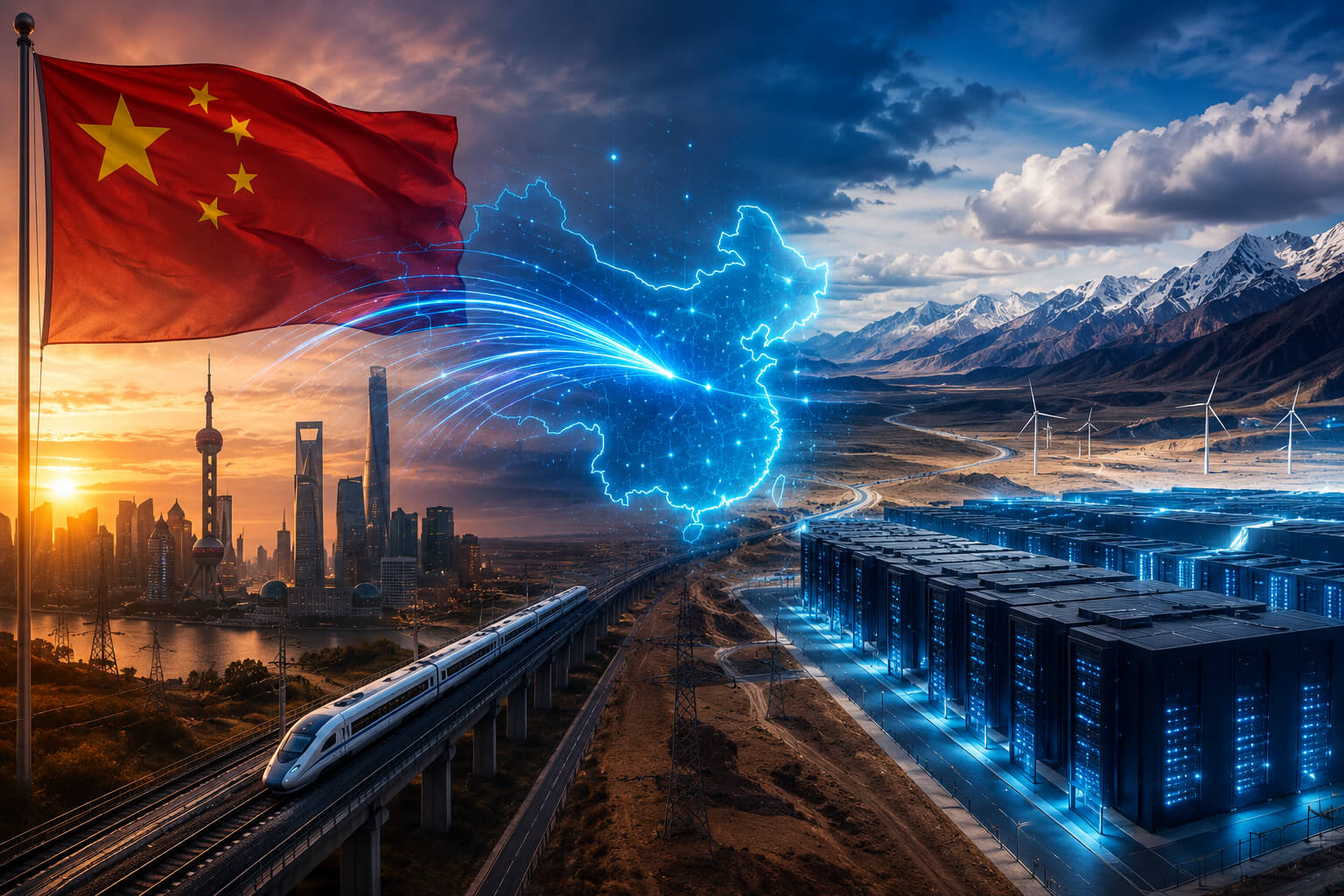
China’s AI boom needs more than advanced chips and ambitious models. It needs electricity. Lots of it. That demand is pushing some of the country’s biggest computing projects far from its eastern technology hubs. Rural areas in western China are becoming an important part of the strategy.
Guizhou Province is one example. Huawei operates its largest data center there. Dozens of other facilities have also appeared across the southwestern province in recent years.
The shift is deliberate. China wants computing infrastructure closer to abundant renewable energy, cooler climates, and available land. At the same time, Beijing sees computing power as increasingly important to national competitiveness.
China’s AI Boom Is Moving Into Rural Areas
China’s biggest AI infrastructure projects are not staying in Beijing, Shanghai, or Shenzhen. Many are moving toward less populated western regions. Guizhou has become a major destination. Huawei’s largest data center sits in the province’s Guian New Area. Other operators have built facilities nearby. China expects its overall data center capacity to nearly double within five years. The expansion comes as competition with the US puts more pressure on computing capacity.
Huawei’s Massive Data Center Shows What Is Changing
Huawei’s Guizhou complex looks more like a small European town than a server facility. Yet behind that unusual design sits a major piece of China’s computing infrastructure. Its location is no accident. Guizhou offers space, a relatively cool climate, and access to renewable power. Those advantages become more valuable as AI models demand increasingly large amounts of electricity. The surrounding Guian New Area has also changed as data center investment has arrived.
Beijing Calls It Eastern Data Western Computing
China gave the strategy a formal name in 2021: Eastern Data Western Computing. The basic idea is straightforward. Much of China’s technology demand comes from its developed eastern regions. The west has more space and significant energy resources. Beijing wants to connect the two. Computing workloads can move toward areas better equipped to handle their electricity and infrastructure requirements. AI has made that strategy much more urgent.
Renewable Energy Is a Big Part of the Plan
AI data centers consume enormous amounts of electricity. China wants its data centers to obtain 80 percent of their power from renewable sources by 2030. That gives regions such as Guizhou and Inner Mongolia an advantage. Both have expanded renewable generation. Solar and wind projects can provide electricity for large computing facilities. Data centers could also consume renewable power that might otherwise go unused during periods of excess generation.
Data Centers Could Help China Use Surplus Renewable Power
Renewables create an awkward problem when production exceeds demand. Grid operators sometimes have to curtail that electricity. Large data centers offer another place for the power to go. Rystad Energy senior analyst Simeng Deng told AFP that data centers can help absorb surplus renewable generation. That creates an unusual connection between China’s AI ambitions and its energy transition. More computing demand could give renewable projects another large customer.
Rural Communities Are Seeing New Roads and Jobs
The infrastructure boom has visibly changed parts of Guian New Area. Residents told AFP that transportation has improved since the data centers arrived. Local businesses have also benefited from workers moving through the area. Residents pointed to new employment opportunities and nearby universities. One local said villagers can now find jobs closer to home. Previously, many had to travel elsewhere for work.
The Economic Payoff Is Less Clear Than the Construction Boom
New buildings do not automatically mean widespread prosperity. Researchers have raised questions about the local economic benefits of data centers. Such facilities require enormous investment in land, servers, and infrastructure. However, they do not always create large numbers of permanent jobs. Singapore Management University researcher Andrew Stokols said broader economic spillover remains difficult to achieve. The hope is that other digital industries eventually grow around these computing hubs.
Guizhou’s GDP Has Grown Faster Than Its Wages
Guizhou highlights that contradiction. The province recorded average annual GDP growth of 7.4 percent during the past decade. Yet wage growth ranked near the bottom nationally during the same period. Researchers at Taiwan’s DSET said this suggests infrastructure investment has limits. Data centers can bring major spending on equipment and land. That does not guarantee equally strong growth in local incomes.
The Data Center Push Is Also Adding Financial Pressure
There is another side to the infrastructure race: debt. Guizhou has spent heavily while offering incentives to attract data center projects. The province now carries one of China’s heavier debt burdens. DSET data showed Guizhou ranked 30th among provinces for its debt-to-revenue ratio in 2024. It ranked 27th for debt relative to GDP. That raises a difficult question about how much regional governments should spend to attract AI infrastructure.
China Sees Computing Power as National Power
China’s data center expansion is bigger than a property development story. Beijing increasingly treats computing capacity as strategic infrastructure. Chinese policy discussions were connecting computing power with national strength even before the generative AI boom. AI has only intensified that thinking. Stokols said computing power has become essential to competitiveness in the digital era. The growing AI race has accelerated the trend.
The AI Race Is Becoming an Energy Race Too
AI competition is often framed around models, chips, and software. China’s western data center build-out shows another side of it. Electricity, land, transmission networks, and physical infrastructure now matter just as much.
China has plenty of reasons to keep building. AI companies need more compute. Renewable projects need customers. Western regions want investment. Beijing wants greater technological capacity.
Those interests line up surprisingly well.
The harder question is whether rural communities will capture enough of the economic upside. Massive server farms can transform a landscape quickly. Transforming household incomes is another matter.
Either way, China appears committed to the build-out. The AI race is no longer happening only inside laboratories. Increasingly, it is being fought through power grids, server halls, and huge computing campuses far from the country’s traditional technology centers.
Sources
Taipei Times / AFP — China goes rural in quest to power AI data centers
Taipei Times article
