


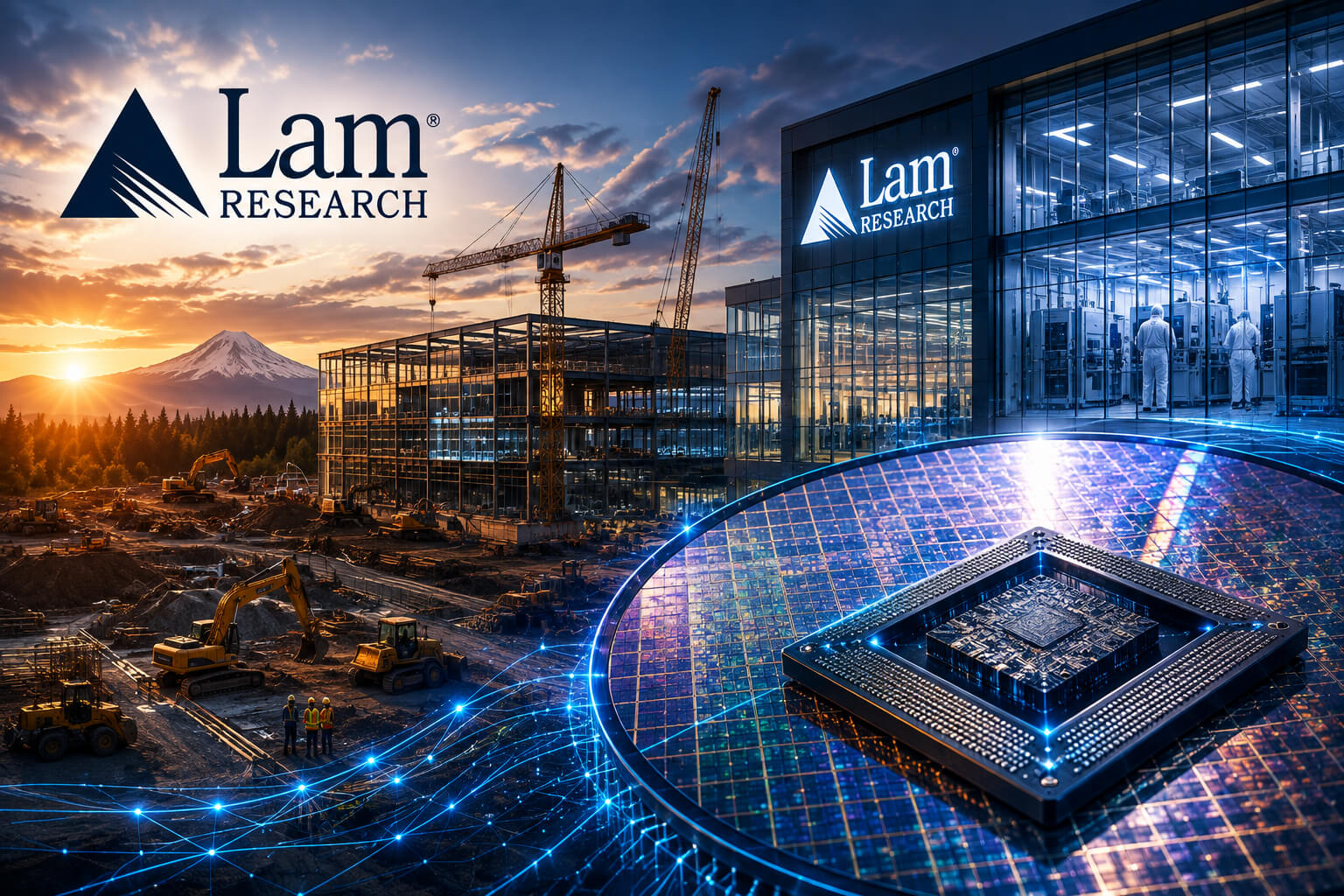
Lam Research is putting another major piece of infrastructure behind the AI chip boom. The new Lam Research Oregon AI chip lab represents a significant step for the company in advancing chip technology.
The semiconductor equipment company has broken ground on a new research and development lab in Tualatin, Oregon. The facility will support work on advanced chips used for AI and high-performance computing. It is also the first major milestone in Lam’s planned $3 billion-plus expansion of its global lab network.
The timing makes sense. AI chips are becoming more complex. Memory demand is rising. Advanced packaging is moving fast. Chipmakers need new materials and tighter process control.
Lam wants the new Oregon lab to shorten the time between experimentation and manufacturing.
Lam Research Starts Construction on a New Oregon R&D Lab
Lam Research marked the start of construction on August 26 in Tualatin, Oregon. The new facility will cover about 120,000 square feet. It will sit within Lam’s existing R&D campus in Oregon’s Silicon Forest. The company expects the lab to increase cleanroom space at the site by more than 50%. That gives engineers more room for experiments and process development. Lam also plans to use the facility for closer work with major chip customers.
The Lab Is Built Around the Needs of AI Chips
AI hardware is pushing semiconductor manufacturing into harder territory. New chips need denser memory, more advanced logic, and tighter packaging. That means chipmakers must experiment with new materials and processes. Lam says the Oregon lab will focus on advanced deposition and etch development. Materials science and hardware validation will also be part of the work. These are critical steps in building smaller and more powerful chips.
Cleanroom Capacity Will Expand by More Than 50%
The cleanroom expansion is one of the biggest parts of the project. Lam expects the new lab to add tens of thousands of square feet of cleanroom space. That means more equipment can run at the same time. More experiments can also happen without waiting for existing capacity. This matters because AI-related chip development is moving quickly. Lam wants to compress those development cycles and get new processes ready for fabs sooner.
Customers Will Work Side by Side With Lam Engineers
The new lab will not operate as an isolated research center. Lam plans to bring customers directly into the development process. Engineers from Lam and its customers can work together on tools and processes. That collaboration can begin at the idea stage. It can continue through testing and fab deployment. This model helps reduce the gap between research and commercial production. Lam says similar collaboration across its existing network has already shortened development timelines.
The Oregon Project Is Part of a $3 Billion Global Expansion
The Tualatin lab is only one piece of a much larger plan. Lam intends to invest more than $3 billion over five years in its global R&D lab network. The company expects that expansion to increase experiment capacity by more than 50%. Its labs span the United States, Asia, and Europe. Together, they support more than one million experiments every year. Lam wants those locations to work as one connected research system.
Lam Wants Its Labs Working Around the Clock
Lam’s global lab model is built around continuous development. Research performed in one region can be shared with teams elsewhere. That lets different labs work in parallel across time zones. One site can focus on materials research. Another can handle process development. Customer-facing centers can then test those ideas closer to production. Lam says this approach has helped shorten process development by as much as 2.5 times in recent customer projects.
Intel and Micron Are Watching the Expansion Closely
The groundbreaking also brought executives from Intel and Micron into the discussion. Both companies work closely with Lam on semiconductor manufacturing. Intel Foundry executive Naga Chandrasekaran said the new facility could support faster process development and technology evaluation. Micron executive Manish Bhatia pointed to surging AI demand for memory. That demand is putting more pressure on the semiconductor industry to expand capacity and move faster.
AI Is Increasing Pressure on Semiconductor Manufacturing
The AI boom is not only about GPUs and data centers. It is also reshaping the equipment used to make chips. Advanced AI systems need high-performance logic, larger memory capacity, and more complex packaging. Each of those areas creates new manufacturing challenges. Lam specializes in equipment used for wafer fabrication. Its deposition and etch tools play an important role in producing advanced semiconductor structures. AI demand is making those processes even more important.
Oregon’s Silicon Forest Gets Another Major Semiconductor Investment
The project also strengthens Oregon’s long-standing semiconductor industry. Lam has operated in the state for more than 30 years. Its footprint includes facilities in Hillsboro, Sherwood, and Tualatin. The company already runs manufacturing and R&D operations there. The new lab will expand that presence further. Lam says the completed expansion could become its largest investment in Oregon so far.
Construction Could Generate Around 900 Jobs
The economic impact extends beyond semiconductor research. A third-party assessment estimates that construction could support about 900 jobs over three years. It also projects around $500 million in economic output during that period. Once the expansion is finished, Lam expects more than 400 new company jobs. The project could also increase the number of jobs supported by Lam across Oregon to more than 11,000.
The New Lab Is Expected to Open in 2028
Lam currently expects the new Oregon facility to open in 2028. It will form part of a wider multi-building expansion at the Tualatin campus. More capacity is the obvious goal. The bigger story, though, is speed. AI chip development is forcing semiconductor companies to test new ideas faster. Lam is betting that more labs, closer customer collaboration, and continuous experimentation can help it keep pace.
AI’s Infrastructure Boom Is Moving Deeper Into the Chip Supply Chain
Much of the AI investment story has focused on data centers, GPUs, and cloud infrastructure. Lam’s Oregon project shows another layer of that spending. The companies making chip manufacturing possible are expanding too.
The reason is fairly simple. Better AI models need better chips. Better chips require new manufacturing techniques. Those techniques need labs where engineers can test materials, equipment, and processes at scale.
Lam is investing heavily in that part of the chain. Its new Oregon facility is not scheduled to produce consumer AI products. It sits much further upstream. Still, the work done there could shape the hardware that powers the next generation of AI systems.
Sources
- PR Newswire — Lam Research Breaks Ground on New Oregon Lab to Accelerate AI Era Semiconductor Research & Development Locally, Globally
https://www.prnewswire.com/news-releases/lam-research-breaks-ground-on-new-oregon-lab-to-accelerate-ai-era-semiconductor-research–development-locally-globally-302860979.html - Lam Research — Lam Research Announces Plans to Invest More than $3B to Expand Global Lab Network
https://newsroom.lamresearch.com/2026-08-13-Lam-Research-Announces-Plans-to-Invest-More-than-3B-to-Expand-Global-Lab-Network%2C-Increase-Innovation-Velocity-in-the-AI-Era
