


Artificial intelligence isn’t disappearing from the travel industry. Quite the opposite. It’s becoming ordinary. But what does the travel industry beyond AI look like as the technology becomes mainstream?
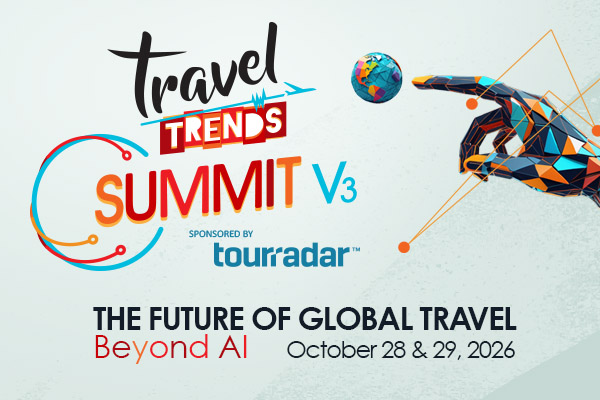
That shift is at the center of Travel Trends Summit V3, a two-day virtual event scheduled for October 28–29, 2026. More than 40 founders, executives, investors, marketers and technology leaders are expected to take part, but the summit isn’t being pitched as another marathon discussion about AI tools.
The question this time is more interesting: What happens when AI is simply part of the infrastructure?
That changes the conversation.
Instead of debating whether travel companies should use artificial intelligence, the industry is beginning to wrestle with what AI does to discovery, bookings, distribution, customer relationships, company culture and even the value of human expertise.
AI Is Moving From Experiment to Infrastructure
For the past few years, plenty of travel companies have treated generative AI as an experiment. Write an itinerary. Summarize an email. Generate marketing copy. Build a chatbot. See what happens. That phase isn’t exactly over, but it’s getting less interesting.
Travel Trends Summit V3 is built around what comes next — when AI stops being the shiny new application sitting on the side and starts becoming part of the normal technology stack. Once that happens, the bigger questions aren’t really about prompts. They’re about business.
Who controls travel discovery when AI travel assistants can increasingly search, book, change and manage trips? What happens to traditional search and booking funnels? How much of customer service becomes automated? Which brands still feel distinctive when every competitor has access to similar models?
There’s also an uncomfortable question underneath all of this: if AI makes technology cheaper and easier to deploy, what actually becomes a competitive advantage?
Day One Goes After the New Travel Technology Stack
The first day of the summit will lean heavily into technology, distribution and operations. Executives connected with companies including TourRadar, Phocuswright, Mindtrip, Railbookers, Kaptio, Fora and TravelAI are expected to discuss how AI is already changing travel discovery, booking and commercial relationships.
There will also be live demonstrations from travel technology companies rather than presentations built entirely around future promises. That distinction matters. AI announcements have become incredibly easy to make. Production systems are harder.
A travel company can say it has an AI strategy. Getting an automated system to work reliably with inventory, pricing, customer data, payments, cancellations and existing software is another story.
That challenge is already becoming visible in corporate travel, where Direct Travel is pushing AI agents deeper into booking, servicing and travel-program operations. The summit appears interested in that messier part.
Then Comes the Human Problem
Day two changes direction.
Marketing, branding, investment, community and leadership move closer to the center of the conversation, with participants from organizations including Propellic, WeRoad, Travel Massive, Pinerary, Thayer Ventures and Plug and Play. This may turn out to be the more important half of the event.
AI can generate an itinerary in seconds. That doesn’t automatically mean a traveler trusts it. It can create marketing campaigns at enormous scale. That also means the internet gets filled with even more interchangeable marketing.
Travel has always sold something technology struggles to manufacture on its own: taste, trust, reassurance, access and the feeling that another person actually understands what kind of trip you want. As AI gets better, those human advantages may become more valuable, not less.
Investors Are Asking Different Questions Too
There’s another layer here: money. Chris Hemmeter of Thayer Ventures and Amir Amidi of Plug and Play are scheduled to discuss what investors are looking for heading into 2027, including which travel technology ideas are still fundable and which pitches are already losing their appeal.
That’s worth watching because simply attaching “AI” to a startup is becoming a weaker differentiator. When nearly every software company can integrate language models, investors have to look further down.
Proprietary data matters. Distribution matters. Customers matter. Revenue matters. And eventually somebody asks the awkward question: could a larger company recreate this AI feature in six months? The answer will separate actual businesses from thin AI wrappers.
More Than 40 Travel Leaders, But the Theme Is Bigger Than AI
The official summit site describes the 2026 event as an expansion beyond artificial intelligence into areas including emerging technology, revenue strategy, customer acquisition, partnerships and scaling travel companies.
Confirmed speakers span a fairly wide part of the travel ecosystem, including people from Microsoft, Brand USA, Lonely Planet, Forbes Travel Guide, Fora, Railbookers, Mindtrip, Kaptio and TourRadar.
The virtual format also remains intentional. Previous editions attracted more than 2,000 participants from over 50 countries, according to the organizers, and attendance has reportedly doubled each year since the event launched in 2024.
For the 2026 summit, organizers initially announced limited complimentary registrations. Sponsor support has since allowed them to remove that cap and offer unlimited free registration, with the regular two-day pass valued at $149.
The AI Conversation Is Growing Up
There’s something telling about an industry AI summit deciding that its most useful topic is now Beyond AI. It doesn’t mean the technology has become less important.
It probably means the opposite. When a technology becomes deeply embedded in business, people eventually stop obsessing over the technology itself. They start talking about what it changes. Travel appears to be getting closer to that point.
AI-powered pricing, loyalty and customer-service systems will continue moving forward. Agentic systems will probably take on more actual tasks instead of merely generating suggestions. Search behavior could shift. Marketing economics could shift with it. Yet somebody still has to build a brand people remember. Somebody still has to earn trust.
And somebody still has to decide where machines genuinely improve the travel experience — and where adding more automation just makes travel feel colder. That may be the more useful definition of “beyond AI.” Not what replaces artificial intelligence. What becomes important because AI is everywhere.
