


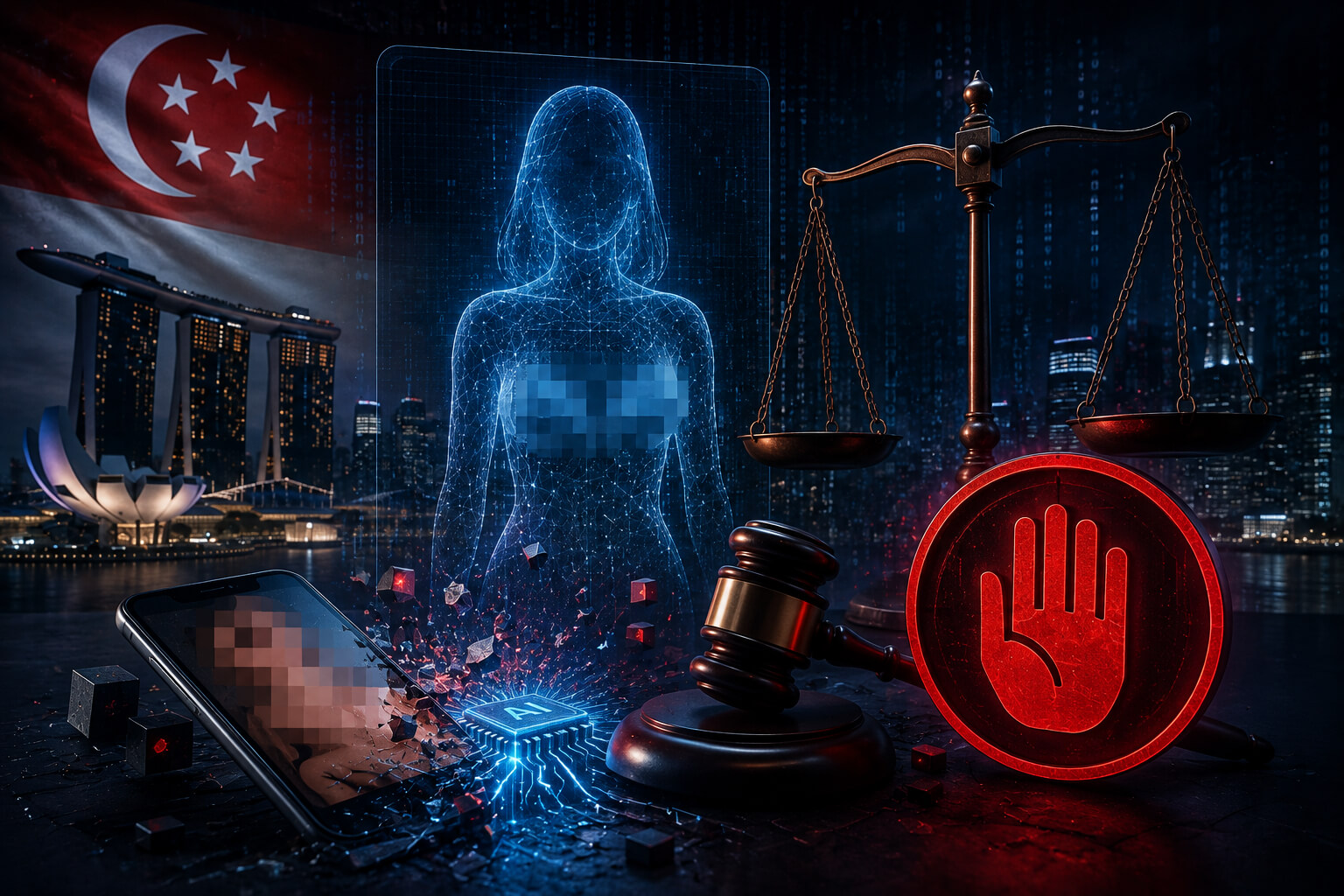
Singapore is putting a clearer legal boundary around one of generative AI’s ugliest uses: creating sexually explicit images of real people without their permission. The new Singapore AI-generated intimate images law is designed to address this serious issue.
New criminal law provisions taking effect on August 17, 2026 will explicitly make it an offense to produce intimate images without consent, including material created entirely with artificial intelligence. Someone convicted can face up to two years in prison, a fine, or both.
The change matters because AI image generators have made an old problem much easier to scale. A person no longer needs an authentic explicit photo to create something convincing. Sometimes there is no original intimate image at all.
A face, a handful of ordinary photographs and the right software can be enough.
Singapore’s Law Now Explicitly Covers Fully Synthetic AI Images
Singapore already had laws covering sexually explicit deepfakes created by altering existing photographs or recordings.
Generative AI created an awkward new category.
Modern systems can produce an image from scratch rather than simply manipulating an existing photo. Singapore’s Ministry of Home Affairs said the definition of an intimate image therefore needed to cover synthetic AI-generated images, arguing that such material can be just as harmful as traditional manipulated deepfakes.
The revised law also creates an explicit offense for producing an intimate image of another person without consent.
That wording is important. Authorities do not have to wait for a fabricated image to go viral before the act becomes relevant under the new provision. The production itself is being directly addressed.
Singapore’s government had previously noted that people creating this material could already potentially be prosecuted through laws covering possession or access. The amendment removes some of that legal ambiguity by specifically naming production as an offense.
AI Deepfakes Are No Longer Just a Platform Moderation Problem
For years, much of the fight against explicit deepfakes has happened through social networks, search engines and content moderation policies.
Singapore is treating the issue more directly as criminal conduct.
Officials have argued that threatening someone with a fake intimate image can cause damage even when the supposedly compromising image does not actually exist. Generative AI makes that threat much more believable because creating realistic-looking fabricated material has become dramatically easier.
There is another uncomfortable reality here. Once an explicit fake reaches messaging groups, forums or social platforms, deleting the original upload rarely guarantees that every copy disappears.
The harm can keep moving long after the first post is gone.
Singapore police have said they can also use powers under the Online Criminal Harms Act to direct online service providers to block Singapore users from accessing AI-generated obscene images that are circulating online.
Tougher Rules Apply When Children Are Involved
The penalties become more serious when minors are involved.
According to the new provisions reported by GMA News and Agence France-Presse, when the material depicts a child younger than 14, the offense carries mandatory imprisonment of up to two years, with the offender also potentially facing a fine or caning.
Singapore has taken a particularly strict position on AI-generated child sexual abuse material.
The Ministry of Home Affairs confirmed in March 2026 that criminal offenses covering sexually explicit images of children apply to computer-generated material as well. Prosecutors do not need to prove that an actual child was used to create the image as long as the generated image resembles a real child.
That closes another loophole AI could otherwise create: the argument that no real child appeared in the source material.
Singapore does not accept that distinction as a reason to treat realistic AI-generated child abuse imagery lightly.
The Changes Go Beyond AI Images
AI-generated material is getting most of the attention, but it is only part of Singapore’s broader criminal law changes.
The legislation also strengthens the country’s ability to prosecute people accused of grooming minors overseas and subsequently committing sexual offenses, including circumstances where the offender or victim traveled from Singapore before the offense.
For offenses involving a victim younger than 14, imprisonment can reach seven years, according to the report.
The wider direction is fairly clear. Singapore is updating sexual offense laws around behavior that increasingly crosses borders, platforms and technologies.
AI happens to be the fastest-moving piece.
Why Singapore’s AI Law Matters Beyond Singapore
Deepfake regulation is turning into a test case for governments trying to keep criminal law from falling several steps behind generative AI.
The technical distinction between a manipulated photograph and an entirely synthetic photograph means very little to the person being depicted.
That distinction can matter enormously in legislation written before consumer AI tools became capable of generating photorealistic people on demand.
Singapore is trying to erase that gap.
Its approach also shifts some of the conversation away from whether AI companies can successfully block abusive prompts. Safety filters matter, but models change, open-source tools exist and determined users find workarounds.
Criminal law tackles a different question: What happens to the person who actually makes the material?
Singapore now has a much clearer answer.
Creating non-consensual intimate imagery does not become harmless simply because the pixels came from an AI model.
Sources
- GMA News Online / Agence France-Presse — “Singapore criminalizes AI-generated abuse images”
- Singapore Ministry of Home Affairs — Criminal Law (Miscellaneous Amendments) Bill
- Singapore Ministry of Home Affairs — Second Reading of the Criminal Law (Miscellaneous Amendments) Bill
- Singapore Ministry of Home Affairs — Penalties involving actual and AI-generated sexually explicit images of children
