


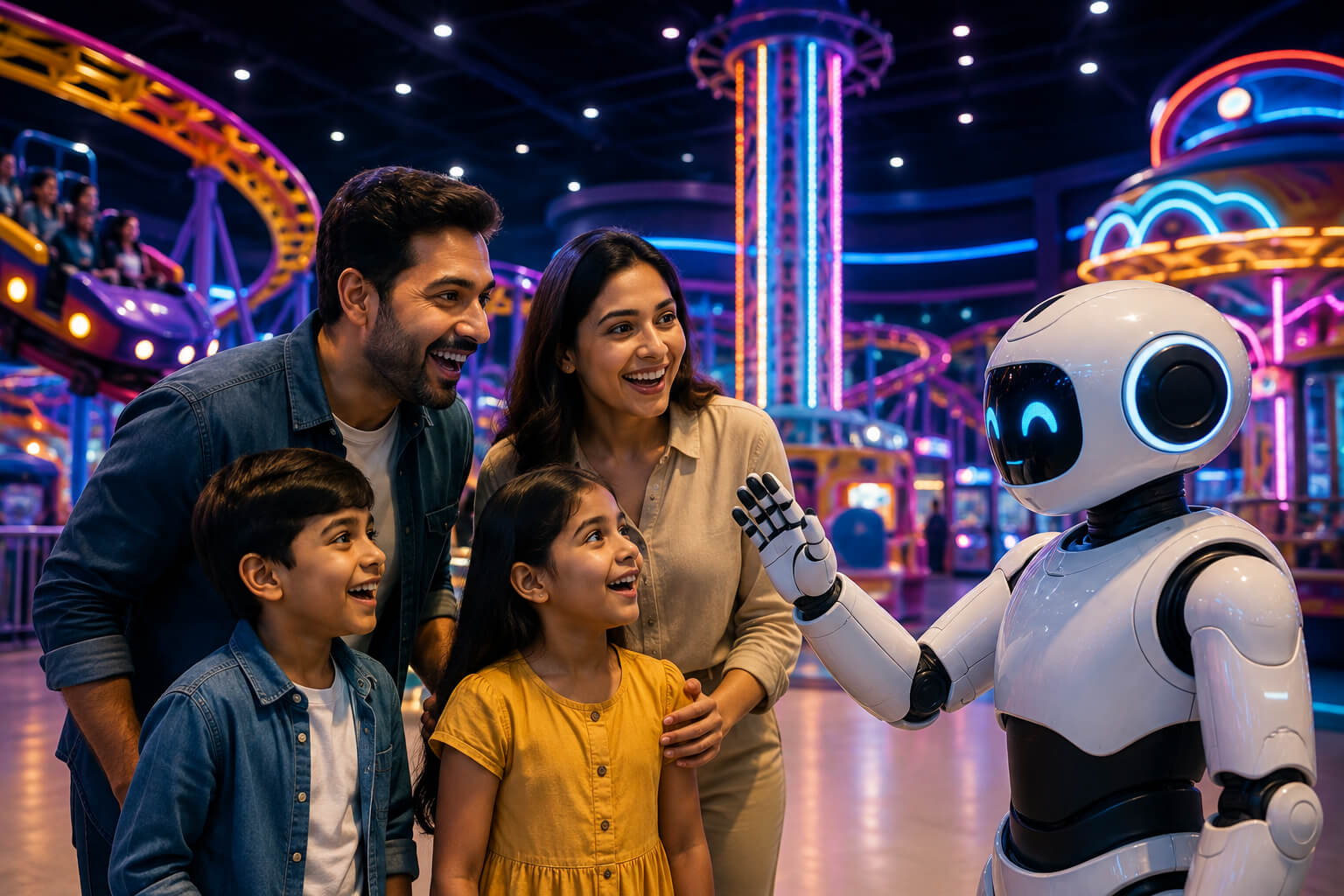
Artificial intelligence is moving into another corner of everyday life: indoor family entertainment. One exciting development is the Rush Maxx AI guest experience, which is helping to transform how visitors interact and enjoy these venues.
Rush Maxx and Rush Fun Park have announced a phased initiative that will use AI, automation and connected digital systems across parts of the customer journey. The idea is fairly practical. Help people find attractions, compare options, ask questions, organize parties and complete bookings without bouncing between half a dozen disconnected channels.
This is not an announcement about robot employees roaming an arcade. The companies are looking at something less flashy and potentially more useful — AI working quietly behind the scenes.
AI Takes on the Messy Part of Planning a Day Out
Planning a birthday party or family outing can get strangely complicated.
A customer might start with Google, check Maps, scroll through social media, open a company website, send a form, call a location and then return later to finish a booking. Rush Maxx and Rush Fun Park want to connect more of those steps.
Their developing system could support attraction discovery, birthday-party inquiries, ticket information, promotion questions, party-package comparisons, reservation reminders, waiver reminders and follow-ups when someone starts an inquiry but never finishes it. AI could also help sort customer-service requests and route them to the right employee or location.
That last part matters. Entertainment businesses deal with plenty of repetitive questions, but the answers are not always identical. Prices, attractions, packages and promotions can change from one location to another.
Automation can handle the predictable stuff. Humans still make more sense when the question becomes specific.
The Companies Aren’t Pitching AI as an Employee Replacement
Rush says the initiative is meant to assist staff rather than turn its parks into fully autonomous operations.
Potential applications include AI-assisted inquiry classification, automated party follow-ups, promotion matching, internal knowledge retrieval and customer-journey analytics. The companies are also considering specialized AI agents connected to approved software tools and business systems.
In other words, the AI could eventually do more than answer a chatbot question.
An authorized agent might recognize that someone is asking about a birthday package, pull relevant information, record the inquiry, trigger a follow-up and send the request toward the appropriate location. That kind of workflow is where agentic AI starts becoming interesting for ordinary businesses.
Not because it looks futuristic. Because somebody no longer has to manually copy information from one screen to another.
Rush Maxx Is Starting From an Already Digital Business
Rush Maxx operates an indoor entertainment venue at Ingram Park Mall in San Antonio. Its attractions include bowling, arcade games, go-karts, laser tag and other active-play experiences, alongside food, parties and group events. The company’s website already lets visitors explore attractions, pricing and event options online.
Rush Fun Park has a broader footprint, with locations listed across San Antonio, Universal City, Phoenix, Peoria and Chandler. Attractions differ by site.
That gives the companies a useful testing ground for AI-driven customer service. A generic answer isn’t enough when one park has an attraction another one doesn’t, or when party packages and promotions depend on location.
The useful AI system is the one that knows the difference.
AI Is Also Becoming Part of Local Search
There is another piece to the project that goes beyond customer support.
Rush is also thinking about how people discover entertainment venues now that online search is changing. Consumers increasingly move between conventional search engines, maps, social platforms and AI-generated answers while deciding where to go.
The initiative therefore includes search visibility, digital marketing and AI-assisted automation. DIQSEO.com is supporting areas including SEO, content, conversion optimization and digital marketing. CybrSpc.ai is involved with software, integrations and customer-journey automation, while SYMPL LABS is supporting concepts involving AI agents, memory systems, reusable skills and LLM integrations.
That mix is worth watching.
For years, local entertainment businesses optimized primarily for searches such as “birthday party venue near me” or “indoor activities in San Antonio.” Those searches are not disappearing, but AI assistants are becoming another layer between a customer and the business they eventually choose.
Being understandable to AI systems may soon matter almost as much as appearing prominently in traditional search results.
The Real Test Will Be Whether Guests Notice Less Friction
Rush says the longer-term goal is to connect customer discovery, marketing, inquiries, reservations and operational information without repeatedly moving the same information between disconnected platforms.
That is a much better benchmark than simply saying a company “uses AI.”
Guests probably won’t care which language model is running somewhere in the stack. They will care if a party inquiry gets answered faster. They will notice if a reservation reminder arrives when it should. They will notice if pricing questions stop requiring three phone calls.
And employees will certainly notice if repetitive administrative work starts disappearing.
The rollout is still described as phased, and several of the proposed capabilities remain potential applications rather than guaranteed features. The companies themselves caution that the expected efficiencies are objectives, not assured outcomes.
So this isn’t a finished AI transformation story yet.
It is an experiment happening in a surprisingly ordinary place — bowling lanes, trampoline parks, arcades and birthday parties.
That may actually make it more revealing.
