


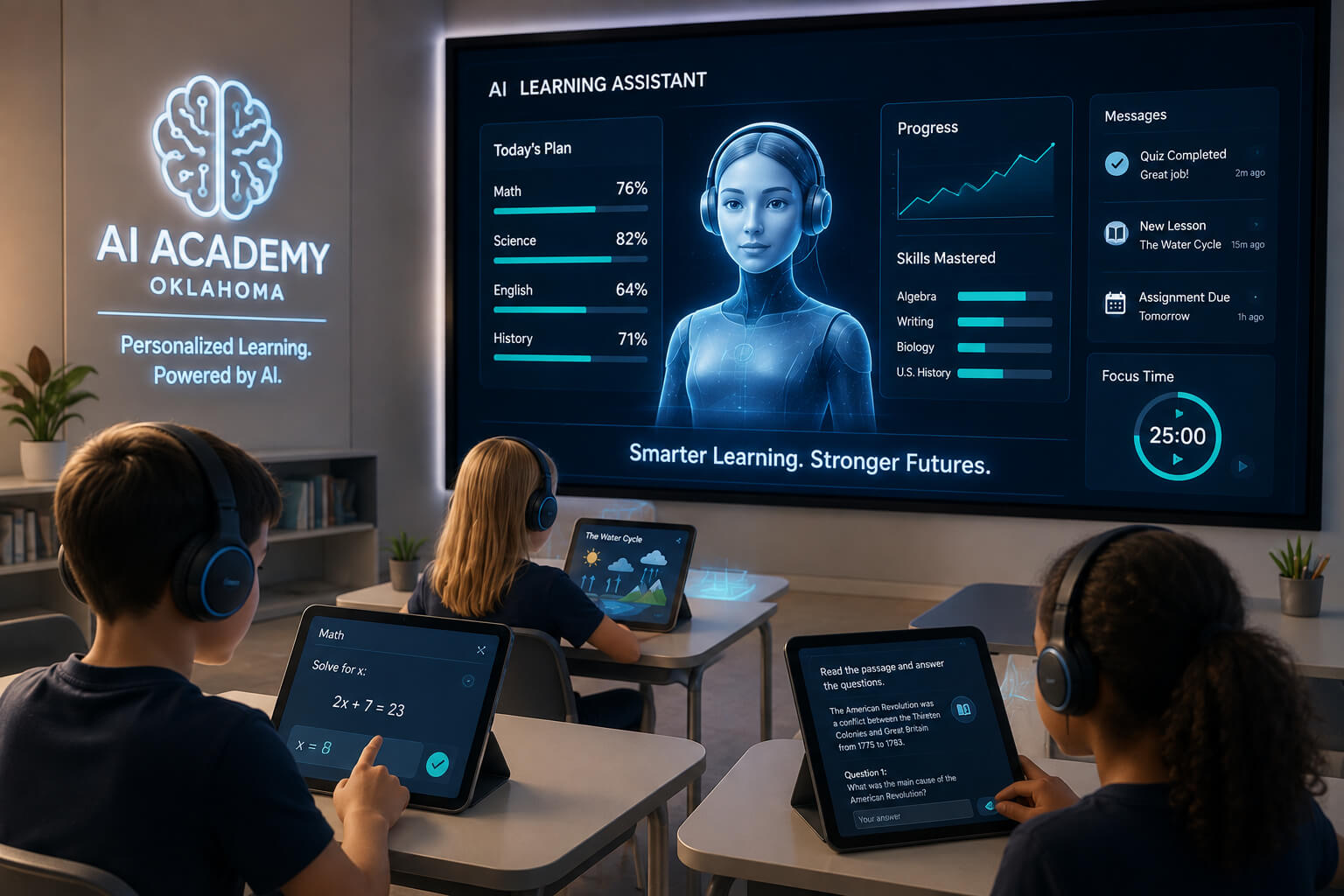
A private school charging $40,000 a year is preparing to open in Oklahoma with an unusual classroom setup: artificial intelligence will handle most academic instruction instead of traditional teachers. This marks the arrival of AI-powered private schools in Oklahoma, offering a new approach to education in the state.
Alpha School plans to launch campuses in the Oklahoma City area and Tulsa for the 2026–2027 school year. Students will spend roughly two hours each morning working through personalised lessons delivered by adaptive learning software.
The rest of the day looks less like a standard classroom. Children will take part in workshops covering communication, entrepreneurship, financial literacy, leadership and other practical skills.
There will still be adults in the building, but Alpha does not call them teachers. It calls them “guides.”
AI Handles the Core School Subjects
Alpha’s model centres on what it calls “2 Hour Learning.”
Students use AI-powered platforms to study subjects such as mathematics, reading, science and language arts at their own pace. The software adjusts lesson difficulty based on how quickly each child understands the material.
A student who already knows a topic can move ahead. Someone struggling with a concept can receive more practice before continuing.
Alpha says this approach removes the need for every child to follow the same lesson at the same speed. The company claims its students complete core academic work in two hours and learn twice as fast as pupils in conventional classrooms. Those performance figures come from Alpha’s own testing and promotional materials rather than a broad, independent assessment of the model.
Oklahoma Families Will Pay $40,000 a Year
Tuition at both Oklahoma locations is listed at $40,000 per student each year.
The Tulsa campus will serve kindergarten through eighth grade, while the Oklahoma City campus is advertised for students from kindergarten through tenth grade. Alpha’s website says the Tulsa school will launch in fall 2026.
That price immediately puts the school beyond the reach of most families. It is also considerably higher than tuition at many established private schools in Oklahoma.
Applications include a separate, non-refundable $100 fee. Alpha describes its programme as an all-inclusive education built around personalised academics and afternoon life-skills workshops.
The Adults in Classrooms Are Called Guides
The phrase “school without teachers” sounds more literal than it is.
Adults will supervise students, offer encouragement, track progress and lead afternoon activities. Alpha calls these employees guides because they do not deliver conventional lectures or teach daily academic lessons.
The company argues that software can manage instruction while guides focus on motivation, confidence and personal development.
That distinction will not satisfy everyone. Teaching involves more than presenting information or adjusting the difficulty of a worksheet. Human educators notice confusion, stress, changes in behaviour and problems that software may never recognise.
This is where Alpha’s experiment becomes more complicated.
Afternoons Focus on Skills Outside Textbooks
Once students finish their morning academic sessions, they move into hands-on workshops and group projects.
Alpha says these activities teach public speaking, coding, entrepreneurship, financial literacy, creativity and problem-solving. Some workshops also involve outdoor education and team challenges.
The pitch is easy to understand. Spend less time sitting through lectures, then use the extra hours for skills that students may need outside school.
It also assumes two hours of screen-based learning can cover enough academic ground to justify cutting most of the traditional school day.
Parents considering the programme will have to decide whether that trade-off makes sense.
Alpha School Is Expanding Across the United States
Oklahoma is only one part of Alpha’s much larger expansion.
The company lists campuses or planned locations across Texas, California, Florida, New York, Illinois, Massachusetts, North Carolina and several other states. Annual tuition varies sharply by market, reaching as high as $75,000 at some California locations.
Alpha plans to grow from roughly a dozen campuses to around 50 during the 2026 school year, pushing its AI-first education model into major cities including Boston, Chicago, Atlanta and Denver.
The expansion comes while public schools are still arguing over much smaller questions, such as whether students should use ChatGPT for homework or whether teachers should allow AI-generated essays.
Alpha has skipped that debate. It has built the entire school around the technology.
The Model Still Faces Questions
Personalised learning software is not new. Schools have used adaptive maths programmes, reading applications and online tutoring systems for years.
What makes Alpha different is the amount of responsibility it gives the technology.
AI does not merely support the teacher. It becomes the main system delivering academic content, measuring progress and deciding what a student should study next.
Questions around data privacy, screen time, software errors and limited human interaction will follow the schools as they expand. There is also the problem of evidence. Alpha promotes strong test results, but families have limited independent research showing how its model performs over several years or across a broad mix of students.
For $40,000 a year, parents are not simply buying access to a private school.
They are buying into a live test of what education might look like when software takes the teacher’s place at the front of the classroom.
