


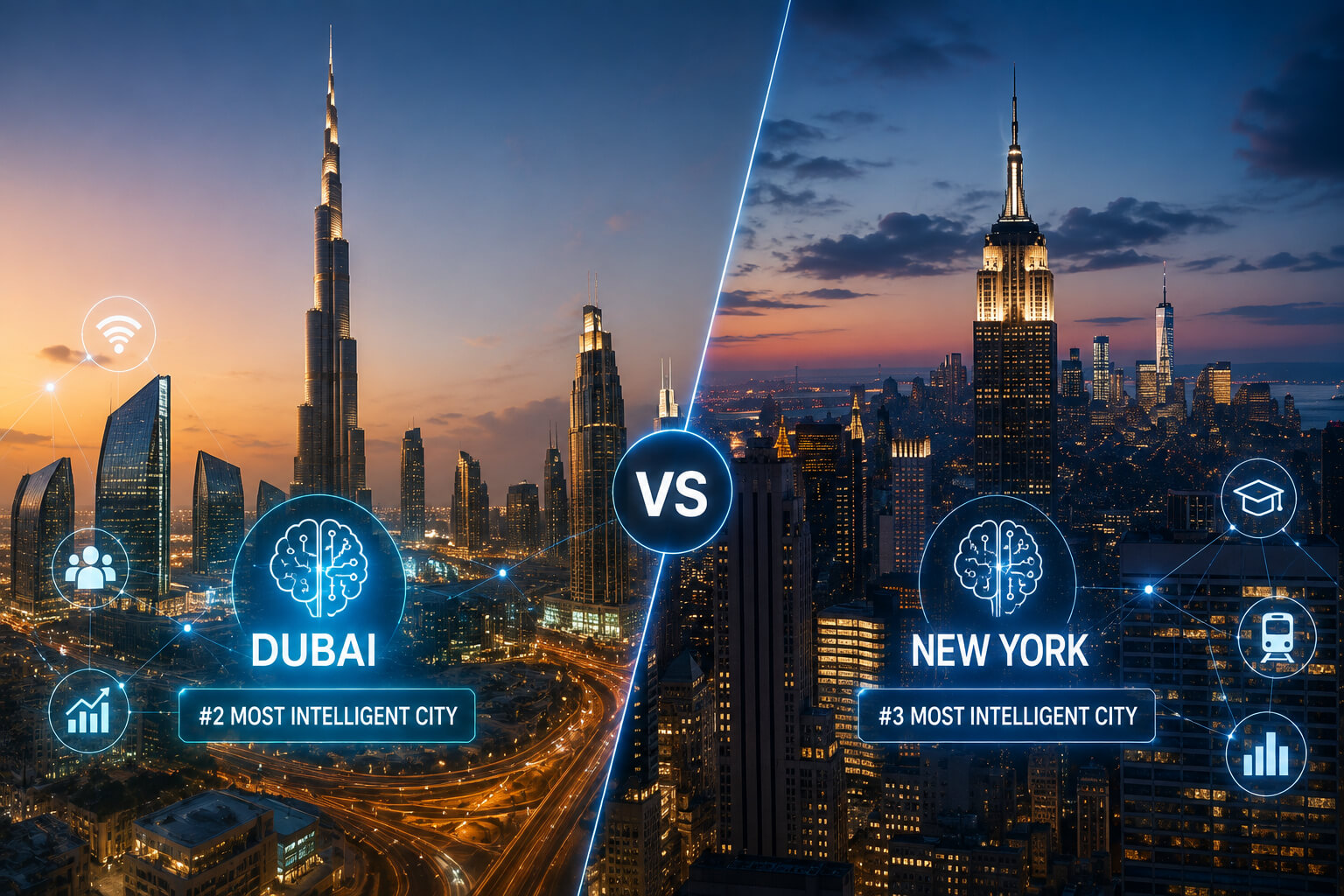
Dubai has moved ahead of New York in the latest Dubai Intelligent Cities Index ranking, a global ranking that looks at how cities actually use artificial intelligence, digital infrastructure and smart services.
Boston Consulting Group placed Dubai second in its inaugural Intelligent Cities Index 2026, behind London and ahead of New York City, Washington and Amsterdam.
The result is not simply a measure of how much technology a city owns. BCG examined whether cities can turn AI systems, digital government platforms and urban data into services that residents and businesses find useful.
Dubai Finishes Second Behind London
BCG assessed 61 major cities across 39 countries for the first edition of the index. London took the top position, followed by Dubai in second place. New York City ranked third, Washington came fourth and Amsterdam completed the top five.
Dubai reportedly earned an overall score of 80. Abu Dhabi also entered the global top 20, placing twentieth with a score of 72.
Only five cities reached BCG’s highest overall maturity category, labelled “leading.” The remaining cities were grouped under accelerating, emerging or developing stages. That ranking system matters. A city could launch dozens of flashy technology projects and still fall behind if residents rarely use them or if government departments cannot scale them properly.
BCG Looked Beyond Smart Infrastructure
The Intelligent Cities Index measured performance across five areas: outcomes, strategy, adoption, ways of working and enablers. Outcomes cover the effect technology has on everyday life, including economic opportunities and quality of life. Strategy looks at whether city leaders have a clear direction for AI and digital transformation.
Adoption measures how widely people and organisations use smart services. Ways of working examine how effectively governments turn plans into functioning programmes. Enablers include funding, talent, infrastructure, data systems and the wider innovation ecosystem.
Dubai performed strongly because it did not rely on one category alone. BCG described the emirate as a “balanced builder,” meaning it showed consistent strength across strategy, technology adoption, implementation and the foundations needed to keep those systems running.
AI Adoption Pushed Dubai Up the Ranking
Dubai stood out most clearly in technology adoption. BCG identified the city as one of the global leaders in deploying smart-city applications and artificial intelligence, alongside places such as Mumbai, Manchester and Boston.
The emirate has rolled out more smart-city use cases than most of the locations assessed. Residents also report high satisfaction with digital services, which creates a useful feedback loop: people use the platforms, governments collect better information, and services improve.
It is a much stronger model than installing technology and hoping people eventually find a reason to use it. BCG found that cities in the top third for AI adoption generally offer more AI-powered public services and stronger quality-of-life outcomes. The relationship is not automatic, but the report argues that wider AI deployment has become an important part of improving how cities function.
Digital Government Has Become Part of Daily Life
Dubai’s advantage also comes from making digital services feel fairly ordinary. Residents can already handle a large number of government and commercial transactions through apps and online platforms. That includes paying bills, accessing documents, managing transport services and completing administrative processes without visiting a physical office.
None of that sounds as dramatic as a robot police officer or an autonomous taxi. It probably matters more. A smart city earns trust when technology removes small frustrations from daily life. Residents do not need to understand the AI running underneath a service. They need the service to work.
BCG’s findings suggest Dubai has been better than most cities at moving technology out of pilot programmes and into systems people repeatedly use.
Talent and Startups Matter as Much as Data Centres
Dubai’s ranking was not built on infrastructure alone.
The report separates intelligent-city enablers into “hard” and “soft” foundations. Hard enablers include AI systems, data platforms, connectivity and physical digital infrastructure. Soft enablers include skilled workers, venture capital, startups, research capacity and collaboration between government and private companies.
Dubai was among 37 cities that achieved a workable balance between both sides. That distinction is easy to overlook. Cities can buy sensors, servers and software. Building an ecosystem that knows what to do with them takes longer.
Without talent, funding and clear governance, expensive infrastructure tends to become a collection of disconnected projects. Dubai’s approach appears more coordinated, with digital government, business investment and startup development moving in roughly the same direction.
New York Shows That AI Adoption Is Not Enough
New York still ranked third, so this was hardly a poor showing. Its position also exposed one of the more interesting findings in BCG’s research. Residents can adopt AI tools quickly without feeling confident about their broader impact.
BCG found that New Yorkers showed relatively high levels of AI adoption but less optimism about the outcomes than residents in cities including London, Berlin and Dublin. San Francisco, despite sitting at the centre of the global AI industry, ranked seventh overall.
That creates an awkward lesson for technology hubs. Producing AI companies does not automatically make a city better at using AI for public services. Resident trust, visible benefits and effective implementation still count.
This Is Different From the IMD Smart City Index
Dubai’s second-place result comes from BCG’s new Intelligent Cities Index, not the separate IMD Smart City Index. The two rankings use different methodologies.
BCG focuses heavily on AI adoption, digital capability, governance and the outcomes created for residents and businesses. The 2026 IMD Smart City Index ranked Dubai sixth among 148 cities and placed Abu Dhabi tenth.
Both studies still point in the same general direction: Dubai has become one of the strongest global performers in digital government and technology-led urban services. The BCG result goes further by showing how quickly the city has turned AI adoption into a competitive advantage.
Dubai’s Next Test Is Scaling AI Without Losing Trust
Reaching second place does not settle the argument over what makes a city intelligent.
BCG found no single route to the top. Some cities progress evenly across every category. Others build an advantage through stronger governance, aggressive technology deployment or deeper innovation funding. Dubai’s model has centred on rapid execution. It launches services, pushes adoption and builds the infrastructure around them.
The harder part comes next. As AI gains more control over transport, public administration, safety systems and city planning, Dubai will need to keep those platforms transparent, secure and easy to challenge when something goes wrong. A fast digital service is useful. A fast digital service that residents trust is far more valuable.
