


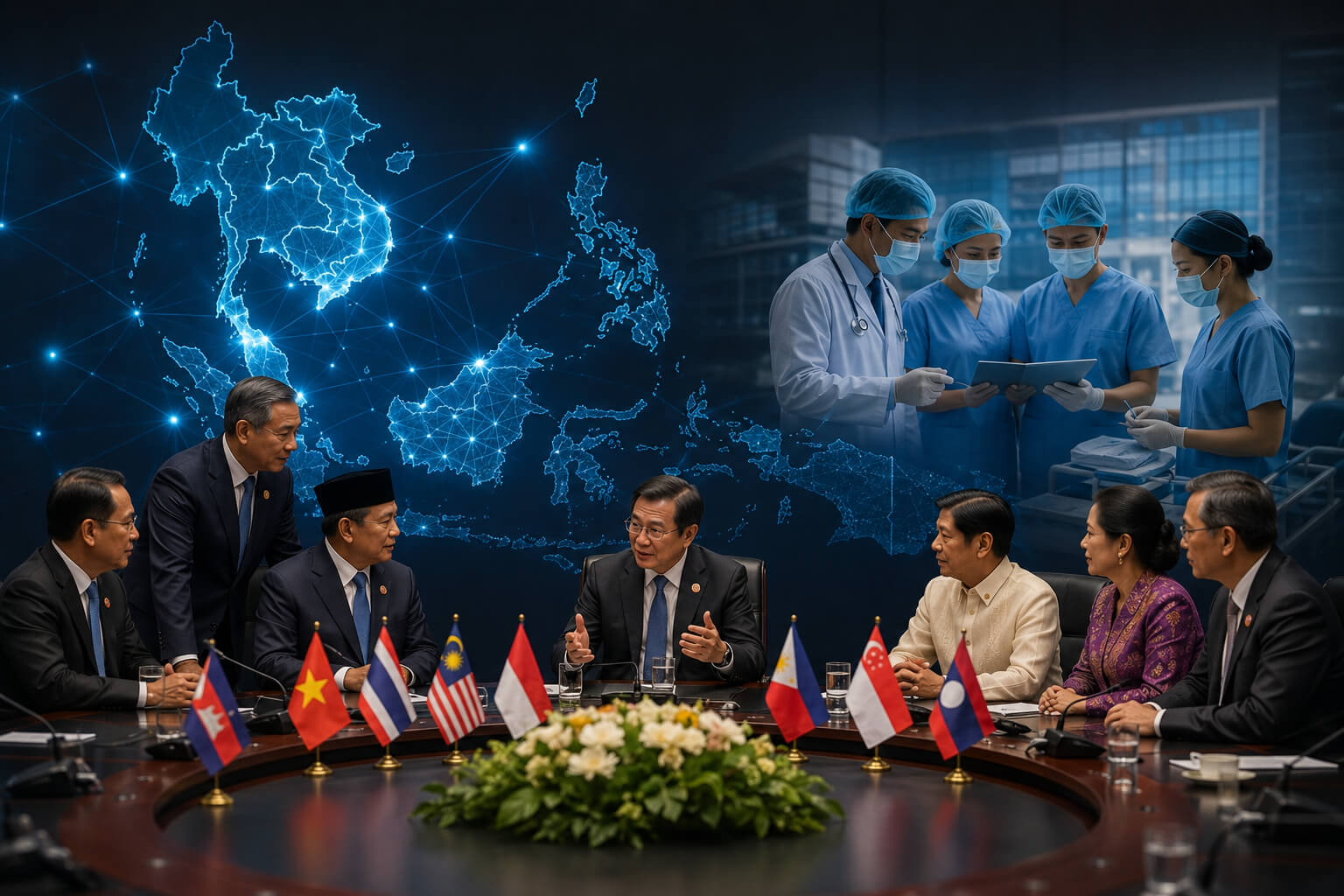
The move underscores the growing significance of AI-enabled healthcare in ASEAN. Governments and industry stakeholders see artificial intelligence, digital health tools and strong data systems as important elements of the region’s next generation health strategy. Moreover, the rise of AI-driven healthcare in ASEAN is set to transform the region’s medical landscape.
According to Manila Bulletin, the 11 leaders of the Association of Southeast Asian Nations reaffirmed their commitment to strengthening regional healthcare cooperation and AI-driven health systems amid pandemic threats. This development comes as the Philippines hosts ASEAN-related meetings in 2026. Besides, Timor-Leste now participates as ASEAN’s 11th member after officially joining the bloc in October 2025.
AI Takes Center Stage in ASEAN Healthcare
Artificial intelligence is becoming a major priority for Southeast Asia’s healthcare transformation. AI can support faster disease surveillance, predictive analytics, hospital management, remote care, medical imaging, and early outbreak detection.
A recent U.S.-ASEAN Business Council statement said ASEAN healthcare systems are at a “strategic inflection point.” This points to the need for digital health adoption, stronger regulatory readiness, and AI systems that deliver measurable patient outcomes.
The added impetus is even more pertinent as ASEAN countries face similar healthcare challenges such as aging populations, gaps in access to healthcare, increasing numbers of chronic diseases and the continuing threat of new infectious disease outbreaks.
Why AI-Enabled Healthcare Is Critical for Pandemic Readiness
The COVID-19 pandemic revealed the vulnerabilities of health systems around the world, from sluggish data sharing to overburdened hospitals to fragmented disease surveillance. Better regional coordination in ASEAN could enable countries to identify threats sooner. In addition, they can respond more rapidly.
AI can assist with:
- Identifying abnormal disease trends across borders
- Enhancing real-time public health surveillance
- Optimizing hospital resource allocation
- Speeding up diagnostics via medical imaging tools
- Providing remote care in underserved areas
- Helping policymakers project healthcare needs
The WHO has already acknowledged the ASEAN’s initiatives to bolster national and regional health resilience. The organization emphasized the ASEAN Comprehensive Recovery Framework and the ASEAN Centre for Public Health Emergencies and Emerging Diseases as significant moves toward a more resilient region.
Regional Cooperation Still Key
The solution to ASEAN’s healthcare challenges is not AI alone. The key will be regional cooperation, transparent governance, secure data-sharing systems and responsible AI policies.
Experts have warned the rollout of healthcare AI should be conducted with caution, particularly in countries where digital infrastructure, data quality and regulatory systems are still developing. A 2025 study in npj Digital Medicine suggested AI could help improve disease outbreak mitigation, diagnostic accuracy, training and access to healthcare in lower- and middle-income countries. However, this will only work if investments are carefully planned to avoid worsening inequality.
That means ASEAN’s healthcare AI strategy will have to balance innovation and safeguards, including patient privacy, cybersecurity, transparency and human oversight.
The Philippines’ Chairship of ASEAN’s Digital Health Agenda
People-centered development, technological innovation, and regional cooperation have taken center stage under the Philippines’ ASEAN 2026 chairship. At the launch of the Philippines’ ASEAN chairship, President Ferdinand Marcos Jr. highlighted AI adoption and technological innovation.
As chair of ASEAN, the Philippines could help shape regional conversations about how AI can be used in hospitals, public health systems, pandemic tracking and the delivery of rural healthcare.
For the Philippines, where access to healthcare remains a challenge in remote islands and underserved communities, this is a huge opportunity. AI-enabled telemedicine, remote patient monitoring and digital health platforms can help bridge the care gap. This is particularly true where there aren’t enough specialists and medical facilities.
The Bigger Picture
The ASEAN push for AI-driven healthcare is mirroring a wider global trend. Governments are no longer viewing artificial intelligence as a technology of the future. They are beginning to see it as core infrastructure for public health resilience.
Southeast Asia could win big. An improved, AI-enabled health system could help the region respond faster to outbreaks, improve patient care and ease hospital pressure. But it will only work if ASEAN can build confidence in systems that protect patient data, empower health workers and deliver benefits beyond mega-cities.
As pandemic threats continue to evolve, AI-enabled health care could be among the most important tools for ASEAN to build safer, smarter and more resilient health systems.
For more Breaking AI news visit: https://breakingai.news
