


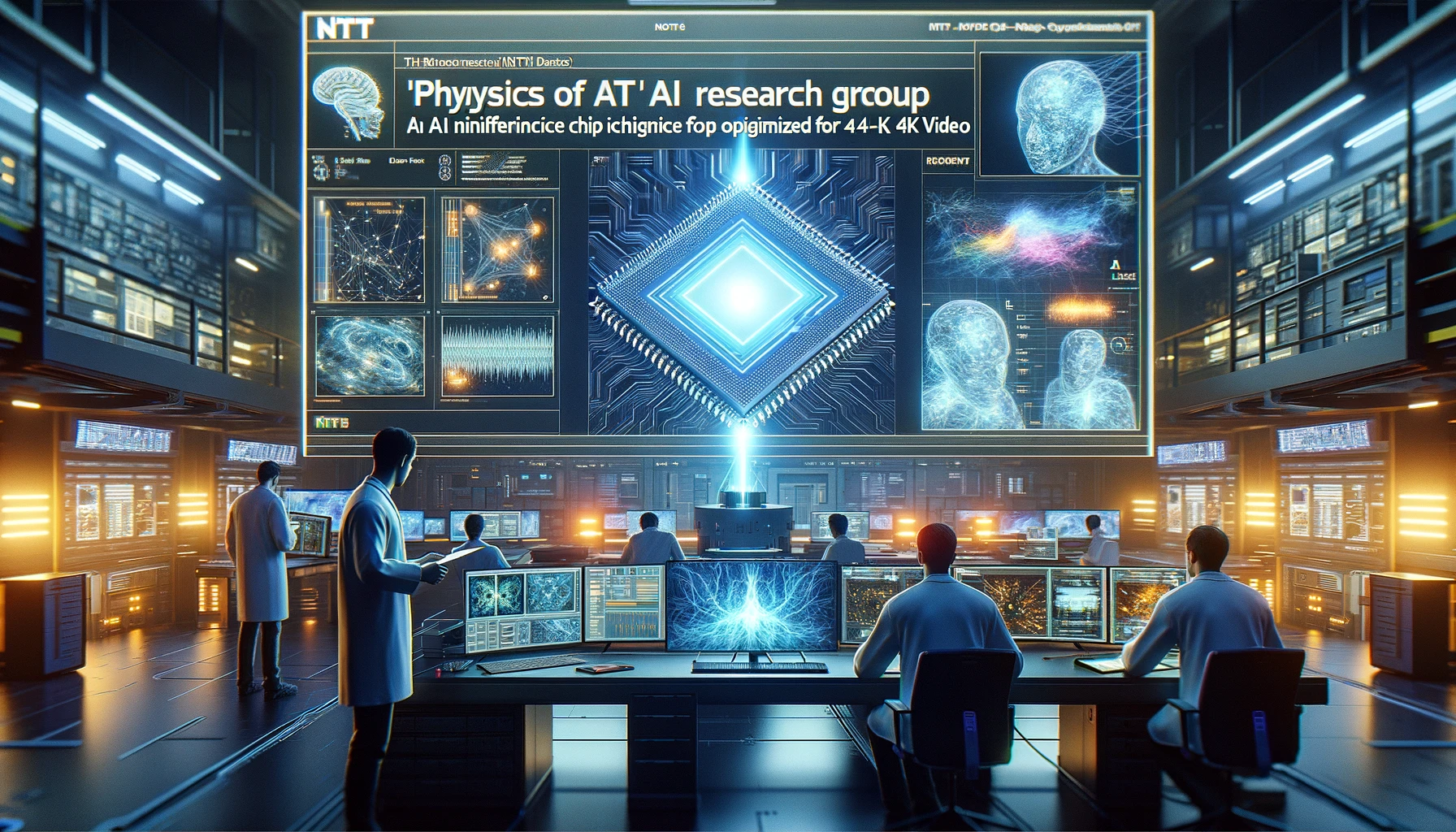
NTT Research announced at its annual Upgrade event that it has started a new AI basic research group, dubbed the Physics of Artificial Intelligence Group.
Physical AI has become a big deal in 2025, with Nvidia leading the charge to create synthetic data to pretest self-driving cars and humanoid robotics so they can get to market faster. NTT Research is launching its Physic of Artificial Intelligence (PAI) Group to get on board.
NTT Research’s new independent group is spinning off of its Physic of Intelligence (PHI) Lab to advance our understanding of the “black box” of AI for better trust and safety outcomes. NTT Research, which has an annual $3.6 billion R&D budget, is a division of NTT, Japan’s big telecommunications company.
Last year, NTT created its “Physics of Intelligence” vision initially formed in collaboration with the Harvard University Center for Brain Science, key contributions made over the past five years, and ongoing collaboration with academic partners.
The new group will be led by Hidenori Tanaka, NTT Research Scientist and expert in physics, neuroscience, and machine learning, in broader pursuit of human/AI collaboration.
The new group will continue to advance an interdisciplinary approach to understanding AI pioneered by the team over the past five years.
Early on, the PHI Lab recognized the importance of understanding the “black box” nature of AI and machine learning to develop novel systems with drastically improved energy efficiency for computation. With AI now advancing at an astonishing rate, issues of trustworthiness and safety have also become critical to industry applications and governance of AI adoption.
In collaboration with leading academic researchers, the Physics of Artificial Intelligence Group aims to address similarities between biological and artificial intelligences, further unravel the complexities of AI mechanisms and build trust that leads to more harmonious fusion of human and AI collaboration. The goal is to obtain a better understanding of how AI works in terms of being trained, accumulating knowledge, and making decisions so that we can design cohesive, safe, and trustworthy AI in the future.
This approach echoes what physicists have done over many centuries: people had understood objects move when forces are applied, but it was physics that revealed the precise details of the relationship, which allowed humans to design machines we know today. For example, the development of the steam engine informed our understanding of thermodynamics, which in turn enabled the creation of advanced semiconductors. Similarly, the work of this group will shape the future of AI technology.
The new group will continue to collaborate with the Harvard University Center for Brain Science (CBS), led by Harvard Professor Venkatesh Murthy, and with Princeton University Assistant Professor (and former NTT Research Scientist) Gautam Reddy. It also plans to collaborate with Stanford University Associate Professor Surya Ganguli, with whom Tanaka has co-authored several papers. The group’s core team includes Tanaka, NTT Research Scientist Maya Okawa and NTT Research Post-doctoral Fellow Ekdeep Singh Lubana.
Previous contributions to date include:
• A widely cited neural network pruning algorithm (over 750 citations in just 4 years)
• A bias-removal algorithm for large language models (LLMs), recognized by the U.S. National Institute of Standards and Technology (NIST) for its scientific and practical insights; and
• New insights into the dynamics of how AI learns concepts
Going forward, the Physics of Artificial Intelligence Group has a three-pronged mission. 1) It intends to deepen our understanding of the mechanisms of AI, all the better to integrate ethics from within, rather than through a patchwork of fine-tuning (i.e. enforced learning). 2) Borrowing from experimental physics, it will continue creating systematically controllable spaces of AI and observe the learning and prediction behaviors of AI step-by-step. 3) It aspires to heal the breach of trust between AI and human operators through improved operations and data control.
“Today marks a new step towards society’s understanding of AI through the establishment of NTT Research’s Physics of Artificial Intelligence Group,” NTT Research president and CEO Kazu Gomi said in a statement. “The emergence and rapid adoption of AI solutions across all areas of everyday life has had a profound impact on our relationship with technology. As AI’s role continues to grow, it is imperative we explore how AI makes people feel and how this can shape the advancement of new solutions. The new group aims to demystify concerns and bias around AI solutions to create a harmonious path forward for the coexistence of AI and humanity.”
The Physics of Artificial Intelligence Group embraces an interdisciplinary approach to AI, with physics, neuroscience and psychology coming together. This approach looks beyond conventional benchmarks, recognizing the need to support goals such as fairness and safety which lead to sustainable AI adoption. In terms of energy efficiency, other groups in the PHI Lab are already engaged in efforts to reduce the energy consumption of AI computing platforms through optical computing and a path-breaking, thin-film lithium niobate (TFLN) technology. On top of that, inspired by the vast differential between watts consumed by LLMs and the human or animal brain, the new group will also explore ways to leverage similarities between biological brains and artificial neural networks.
“The key for AI to exist harmoniously alongside humanity lies in its trustworthiness and how we approach the design and implementation of AI solutions,” Tanaka said, in a statement. “With the emergence of this group, we have a path forward to understanding the computational mechanisms of the brain and how it relates to deep learning models. Looking ahead, our research hopes to bring about more natural intelligent algorithms and hardware through our understanding of physics, neuroscience, and machine learning.”
Since 2019, the PHI Lab has spearheaded research for new ways of computing systems by leveraging photonics-based technologies. TFLN-based devices are explored through this effort, while the Coherent Ising Machine provides new perspectives on complex optimization problems historically very difficult to solve on classical computers.
In addition to a joint research agreement (JRA) with Harvard, the PHI Lab has worked over the years with the California Institute of Technology (Caltech), Cornell University, Harvard University, Massachusetts Institute of Technology (MIT), Notre Dame University, Stanford University, Swinburne University of Technology, the University of Michigan and the NASA Ames Research Center. Altogether, the PHI Lab has delivered over 150 papers, five appearing in Nature, one in Science and twenty in Nature sister journals.
NTT announces AI inference chip for real-time 4K video processing

NTT Corp. also announced a new, large-scale integration (LSI) for the real-time AI inference processing of ultra-high-definition video up to 4K-resolution and 30 frames per second (fps). This low-power technology is designed for edge and power-constrained terminal deployments in which conventional AI inferencing requires the compression of ultra-high-definition video for real-time processing.
For example, when this LSI is installed on a drone, the drone can detect individuals or objects from up to 150 meters (492 feet) above the ground, the legal maximum altitude of drone flight in Japan, whereas conventional real-time AI video inferencing technology would limit that drone’s operations to about 30 meters (98 feet). One use case includes advancing drone-based infrastructure inspection for operations beyond an operator’s visual line of sight, reducing labor and costs.
“The combination of low-power AI inferencing with ultra-high-definition video holds an enormous
amount of potential, from infrastructure inspection to public safety to live sporting events,” said Gomi, in a statement. “NTT’s LSI, which we believe to be the first of its kind to achieve such results, represents an important step forward in enabling AI inference at the edge and for power-constrained terminals.”

In edge and power-constrained terminals, AI devices are limited to power consumption an order of magnitude lower than that of GPUs used in AI servers; tens of watts by the former compared to hundreds of watts by the latter. The LSI overcomes these restraints by implementing an NTT-created AI inference engine. This engine reduces computational complexity while ensuring detection accuracy, improving computing efficiency using interframe correlation and dynamic bit-precision control. Executing the object detection algorithm You Only Look Once (YOLOv3) using this LSI is possible with a power consumption of less than 20 watts.
NTT plans to commercialize this LSI within fiscal year 2025 through its operating company NTT Innovative Devices Corporation. NTT announced and demonstrated this LSI at Upgrade, the company’s annual research and innovation summit. Upgrade 2025 is being held in San Francisco April 9-10, 2025.
Looking ahead, researchers are studying the application of this LSI to the data-centric infrastructure (DCI) of the Innovative Optical and Wireless Network (IOWN) Initiative led by NTT and the IOWN Global Forum. DCI leverages the high-speed and low-latency capabilities of the IOWN All-Photonics Network to address the challenges of modern networking infrastructure including obstacles to scalability, limitations in performance and high energy consumption.
Additionally, NTT researchers are collaborating with NTT DATA, Inc. on the advancement of this LSI in relation to its proprietary Attribute-Based Encryption (ABE) technologies. ABE enables fine-grained access control and flexible policy setting at the data layer, with shared-secret encryption technologies allowing for secure data sharing that can be integrated into existing applications and data stores.
And yesterday, NTT announced that Akira Shimada, president and CEO of NTT, and Katsuhiko Kawazoe, senior executive vice president and CTO of NTT, have published a book, The Identity of IOWN, in which they discuss the IOWN (Innovative Optical and Wireless Network) initiative spearheaded by NTT, a global
technology leader.
The newly translated book explores NTT’s vision of IOWN and how it will enable a more sustainable society in an increasingly data-driven world.
“The Identity of IOWN” is now available on Amazon following publication during NTT’s annual research and innovation summit, Upgrade. Upgrade 2025 is being held in San Francisco April 9-10, 2025.
Source: https://venturebeat.com/
