


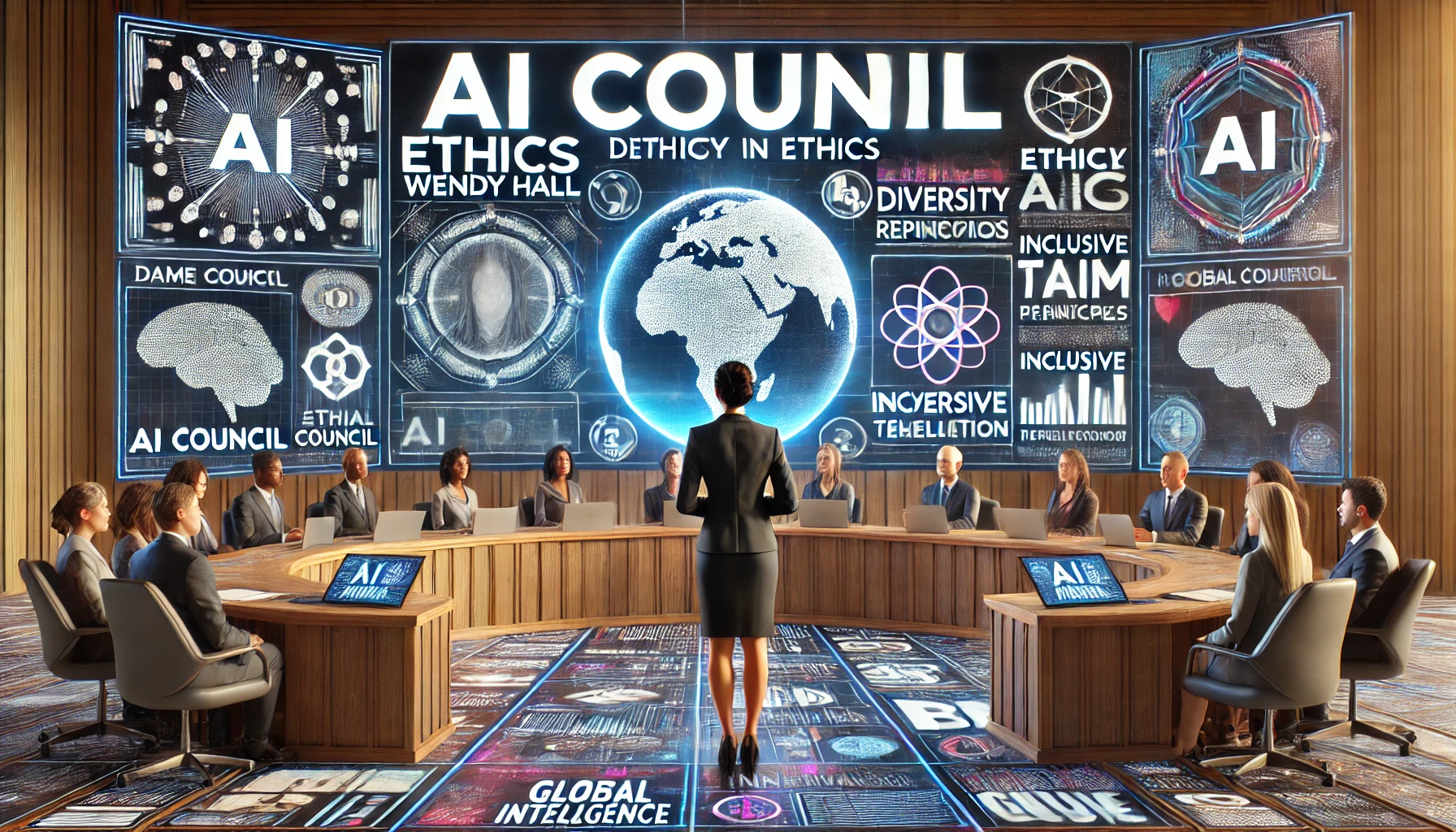
Dame Wendy Hall is a pioneering force in AI and computer science. As a renowned ethical AI speaker and one of the leading voices in technology, she has dedicated her career to shaping the ethical, technical and societal dimensions of emerging technologies. She is the co-founder of the Web Science Research Initiative, an AI Council Member and was named as one of the 100 Most Powerful Women in the UK by Woman’s Hour on BBC Radio 4.
A key advocate for responsible AI governance and diversity in tech, Wendy has played a crucial role in global discussions on the future of AI.
In our Q&A, we spoke to her about the gender imbalance in the AI industry, the ethical implications of emerging technologies, and how businesses can harness AI while ensuring it remains an asset to humanity.
The AI sector remains heavily male-dominated. Can you share your experience of breaking into the industry and the challenges women face in achieving greater representation in AI and technology?
It’s incredibly frustrating because I wrote my first paper about the lack of women in computing back in 1987, when we were just beginning to teach computer science degree courses at Southampton. That October, we arrived at the university and realised we had no women registered on the course — none at all.
So, those of us working in computing started discussing why that was the case. There were several reasons. One significant factor was the rise of the personal computer, which was marketed as a toy for boys, fundamentally changing the culture. Since then, in the West — though not as much in countries like India or Malaysia — computing has been seen as something nerdy, something that only ‘geeks’ do. Many young girls simply do not want to be associated with that stereotype. By the time they reach their GCSE choices, they often don’t see computing as an option, and that’s where the problem begins.
Despite many efforts, we haven’t managed to change this culture. Nearly 40 years later, the industry is still overwhelmingly male-dominated, even though women make up more than
half of the global population. Women are largely absent from the design and development of computers and software. We apply them, we use them, but we are not part of the fundamental conversations shaping future technologies.
AI is even worse in this regard. If you want to work in machine learning, you need a degree in mathematics or computer science, which means we are funnelling an already male-dominated sector into an even more male-dominated pipeline.
But AI is about more than just machine learning and programming. It’s about application, ethics, values, opportunities, and mitigating potential risks. This requires a broad diversity of voices — not just in terms of gender, but also in age, ethnicity, culture, and accessibility. People with disabilities should be part of these discussions, ensuring technology is developed for everyone.
AI’s development needs input from many disciplines — law, philosophy, psychology, business, and history, to name just a few. We need all these different voices. That’s why I believe we must see AI as a socio-technical system to truly understand its impact. We need diversity in every sense of the word.
As businesses increasingly integrate AI into their operations, what steps should they take to ensure emerging technologies are developed and deployed ethically?
Take, for example, facial recognition. We still haven’t fully established the rules and regulations for when and how this technology should be applied. Did anyone ask you whether you wanted facial recognition on your phone? It was simply offered as a system update, and you could either enable it or not.
We know facial recognition is used extensively for surveillance in China, but it is creeping into use across Europe and the US as well. Security forces are adopting it, which raises concerns about privacy. At the same time, I appreciate the presence of CCTV cameras in car parks at night — they make me feel safer.
This duality applies to all emerging technologies, including AI tools we haven’t even developed yet. Every new technology has a good and a bad side—the yin and the yang, if you will. There are always benefits and risks.
The challenge is learning how to maximise the benefits for humanity, society, and business while mitigating the risks. That’s what we must focus on—ensuring AI works in service of people rather than against them.
The rapid advancement of AI is transforming everyday life. How do you envision the future of AI, and what significant changes will it bring to society and the way we work?
I see a future where AI becomes part of the decision-making process, whether in legal cases, medical diagnoses, or education.
AI is already deeply embedded in our daily lives. If you use Google on your phone, you’re using AI. If you unlock your phone with facial recognition, that’s AI. Google Translate? AI. Speech processing, video analysis, image recognition, text generation, and natural language processing — these are all AI-driven technologies.
Right now, the buzz is around generative AI, particularly ChatGPT. It’s like how ‘Hoover’ became synonymous with vacuum cleaners — ChatGPT has become shorthand for AI. In reality, it’s just a clever interface created by OpenAI to allow public access to its generative AI model.
It feels like you’re having a conversation with the system, asking questions and receiving natural language responses. It works with images and videos too, making it seem incredibly advanced. But the truth is, it’s not actually intelligent. It’s not sentient. It’s simply predicting the next word in a sequence based on training data. That’s a crucial distinction.
With generative AI becoming a powerful tool for businesses, what strategies should companies adopt to leverage its capabilities while maintaining human authenticity in their processes and decision-making?
Generative AI is nothing to be afraid of, and I believe we will all start using it more and more. Essentially, it’s software that can assist with writing, summarising, and analysing information.
I compare it to when calculators first appeared. People were outraged: ‘How can we allow calculators in schools? Can we trust the answers they provide?’ But over time, we adapted. The finance industry, for example, is now entirely run by computers, yet it employs more people than ever before. I expect we’ll see something similar with generative AI.
People will be relieved not to have to write endless essays. AI will enhance creativity and efficiency, but it must be viewed as a tool to augment human intelligence, not replace it, because it’s simply not advanced enough to take over.
Look at the legal industry. AI can summarise vast amounts of data, assess the viability of legal cases, and provide predictive analysis. In the medical field, AI could support diagnoses. In education, it could help assess struggling students.
I envision AI being integrated into decision-making teams. We will consult AI, ask it questions, and use its responses as a guide — but it’s crucial to remember that AI is not infallible.
Right now, AI models are trained on biased data. If they rely on information from the internet, much of that data is inaccurate. AI systems also ‘hallucinate’ by generating false information when they don’t have a definitive answer. That’s why we can’t fully trust AI yet.
Instead, we must treat it as a collaborative partner — one that helps us be more productive and creative while ensuring that humans remain in control. Perhaps AI will even pave the way for shorter workweeks, giving us more time for other pursuits.
Photo by Igor Omilaev on Unsplash and AI Speakers Agency.
Want to learn more about AI and big data from industry leaders? Check out AI & Big Data Expo taking place in Amsterdam, California, and London. The comprehensive event is co-located with other leading events including Intelligent Automation Conference, BlockX, Digital Transformation Week, and Cyber Security & Cloud Expo.
Explore other upcoming enterprise technology events and webinars powered by TechForge here.
