


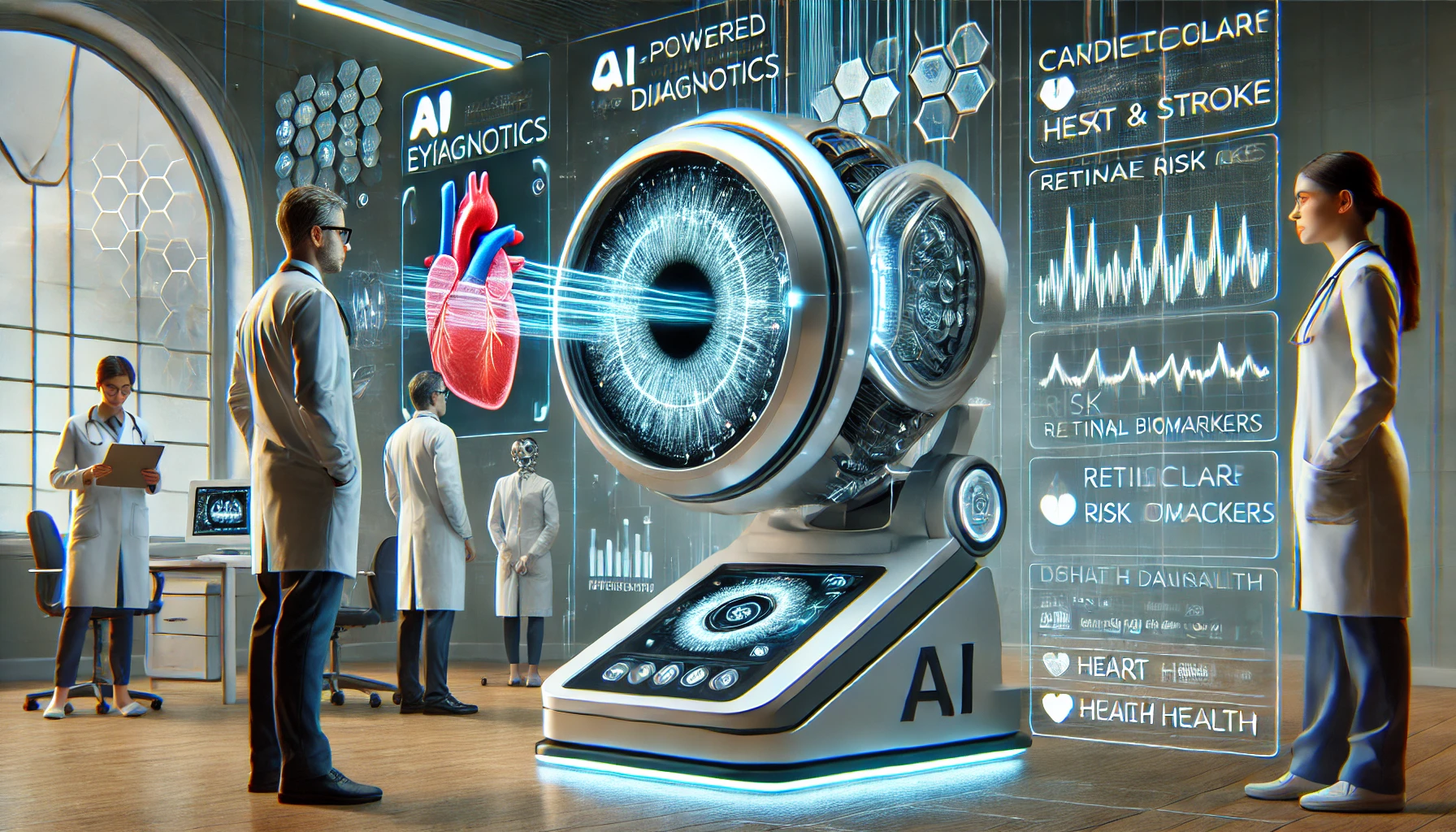
A new study has for the first time tested the use of an artificial intelligence powered eye scan in general practice clinics to screen patients for cardiovascular disease.
Results of the research, published in npj Digital Medicine, found that the fast, non-invasive AI retinal scan could be readily integrated into primary care settings to screen for risk of heart attacks and stroke.
“The ease of use of the retinal camera and high acceptance by doctors and patients demonstrates that it could be integrated into clinic workflow to screen patients before appointments with their GP,” says the study’s first author Wenyi Hu.
“However, more work needs to be done to improve accuracy in some groups of patients, particularly men over 60.”
About the study
Wenyi Hu conducted the research as part of her University of Melbourne PhD studies in CERA’s Ophthalmic Epidemiology team, along with colleagues including her supervisor Associate Professor Lisa Zhuoting Zhu.
The research involved 361 people, aged 45-70, who were patients at two GP clinics and had been received a full or partial cardiovascular risk assessment – such as a blood pressure or cholesterol test – in the previous six months.
Each patient had an eye scan taken with a desktop retinal camera, which scanned the blood vessels at the back of the eye, and received a real-time AI-generated report of their cardiovascular disease risk.
They were also assessed using a widely utilised clinical risk tool – World Health Organization’s CVD risk chart – which considers age, sex, smoking status, blood pressure, diabetes and total cholesterol.
The risks calculated from retinal images were then compared against the World Health Organization’s CVD risk chart to measure the correlation between the two methods.
Both scoring approaches were then validated against more than 27,500 records from the UK Biobank, revealing that the retinal scan-based scores demonstrated similar accuracy to WHO CVD risk scores in predicting risk of heart attack or stroke over 10 years.
The patients and eight GPs from the participating clinics were also surveyed on their satisfaction with the technology and likelihood to use it in the future.
Study results
The study found :
- Moderate correlation between the accuracy of the retinal scan and the WHO risk scores – with 67.4 per cent of participant results matching, 17.1 per cent having their risk over-estimated by the retinal scan and 19.5 having their risk underestimated.
- Similar ability between the retinal scan and WHO method to predict 10-year risk of coronary heart disease or stroke when compared to data from the UK Biobank
- A 93.9 per cent imaging success rate, with the most patients receiving a retinal scan which could be graded for cardiovascular risk
- 5 per cent of patients and 87.5 per cent of GPs were satisfied with the technology.
General practitioner involvement
Camberwell general practitioner Dr Malcolm Clark’s clinic took part in the research and is a co-author on the paper.
He says retinal scanning has great potential to increase the number of Australians who are assessed for cardiovascular risks.
Dr Clark says in the future retinal scanning could be used as an early triaging tool to alert GPs to patients who need further investigation or tests.
“In the future I would see patients receiving an SMS, reminding them to have an eye scan which would send a report on their risk to their doctor who could then follow up with further tests if needed.
https://googleads.g.doubleclick.net/pagead/ads?gdpr=0&client=ca-pub-4000288052572090&output=html&h=200&slotname=9540773243&adk=3368845628&adf=2851374950&pi=t.ma~as.9540773243&w=840&abgtt=6&fwrn=4&lmt=1743461601&rafmt=11&format=840×200&url=https%3A%2F%2Fwww.miragenews.com%2Fai-eye-scans-new-tool-for-heart-stroke-risk-1436150%2F&fwrattr=true&wgl=1&uach=WyJXaW5kb3dzIiwiMTUuMC4wIiwieDg2IiwiIiwiMTM0LjAuNjk5OC4xNzgiLG51bGwsMCxudWxsLCI2NCIsW1siQ2hyb21pdW0iLCIxMzQuMC42OTk4LjE3OCJdLFsiTm90OkEtQnJhbmQiLCIyNC4wLjAuMCJdLFsiR29vZ2xlIENocm9tZSIsIjEzNC4wLjY5OTguMTc4Il1dLDBd&dt=1743461731475&bpp=2&bdt=4665&idt=247&shv=r20250327&mjsv=m202503250101&ptt=9&saldr=aa&abxe=1&cookie=ID%3D9968e91a97a1a2bf%3AT%3D1739781961%3ART%3D1743461716%3AS%3DALNI_Ma-43O_pABaYmH8HygCgFAS3_Q4-w&gpic=UID%3D0000103e75f9ddc1%3AT%3D1739781961%3ART%3D1743461716%3AS%3DALNI_Mb2X379_ulnWudm8xpnwBzn6-Qy8g&eo_id_str=ID%3Da8956c7c56b79e75%3AT%3D1739781961%3ART%3D1743461716%3AS%3DAA-AfjaOoEKPM3arLGHyLIUQ6uZG&prev_fmts=0x0%2C450x280%2C300x600%2C840x200&nras=1&correlator=8600807711257&frm=20&pv=1&rplot=4&u_tz=60&u_his=1&u_h=1080&u_w=1920&u_ah=1080&u_aw=1920&u_cd=24&u_sd=1&dmc=8&adx=703&ady=2097&biw=1905&bih=957&scr_x=0&scr_y=0&eid=95355973%2C95355975%2C95356498%2C95356505%2C95356788%2C95356927&oid=2&pvsid=3351030780413527&tmod=575045193&uas=0&nvt=1&ref=https%3A%2F%2Fwww.google.co.uk%2F&fc=1920&brdim=0%2C0%2C0%2C0%2C1920%2C-360%2C0%2C0%2C1920%2C957&vis=1&rsz=o%7Co%7CoeEbr%7C&abl=NS&pfx=0&fu=128&bc=31&bz=0&td=1&tdf=2&psd=W251bGwsbnVsbCxudWxsLDNd&nt=1&ifi=4&uci=a!4&btvi=1&fsb=1&dtd=3125
“This could become part of regular health screenings like a cervical screening test or a faecal occult blood test.”
A broader vision for clinical AI
Associate Professor Zhu, says the integration of AI-based eye scans into general practice workflows marks a significant step toward precision public health.
“We are building a future pathway that could offer low-cost, scalable and equitable cardiovascular screening for everyone, including those in remote and underserved communities,” she says.
“AI-powered eye checks could also provide insights into brain and kidney health and part of routine preventative health care.”
Read the study
Wenyi Hu, Zhihong Lin, Malcolm Clark, Jacqueline Henwood, Xianwen Shang, Ruiye Chen, Katerina Kiburg, Lei Zhang, Zongyuan Ge, Peter van Wijngaarden, Zhuoting Zhu & Mingguang He Real-world feasibility, accuracy and acceptability of automated retinal photography and AI-based cardiovascular disease risk assessment in Australian primary care settings: a pragmatic trial npj Digital Medicine (2025)
Modelling shows AI-powered screening for diabetic retinopathy has the potential to prevent blindness by increasing access to scans, protecting sight and reducing healthcare costs.
New research has linked drinking coffee and tea to increased macular retinal nerve fibre layer thickness – which could be an indicator of our brain health.
Source: https://www.miragenews.com/
