


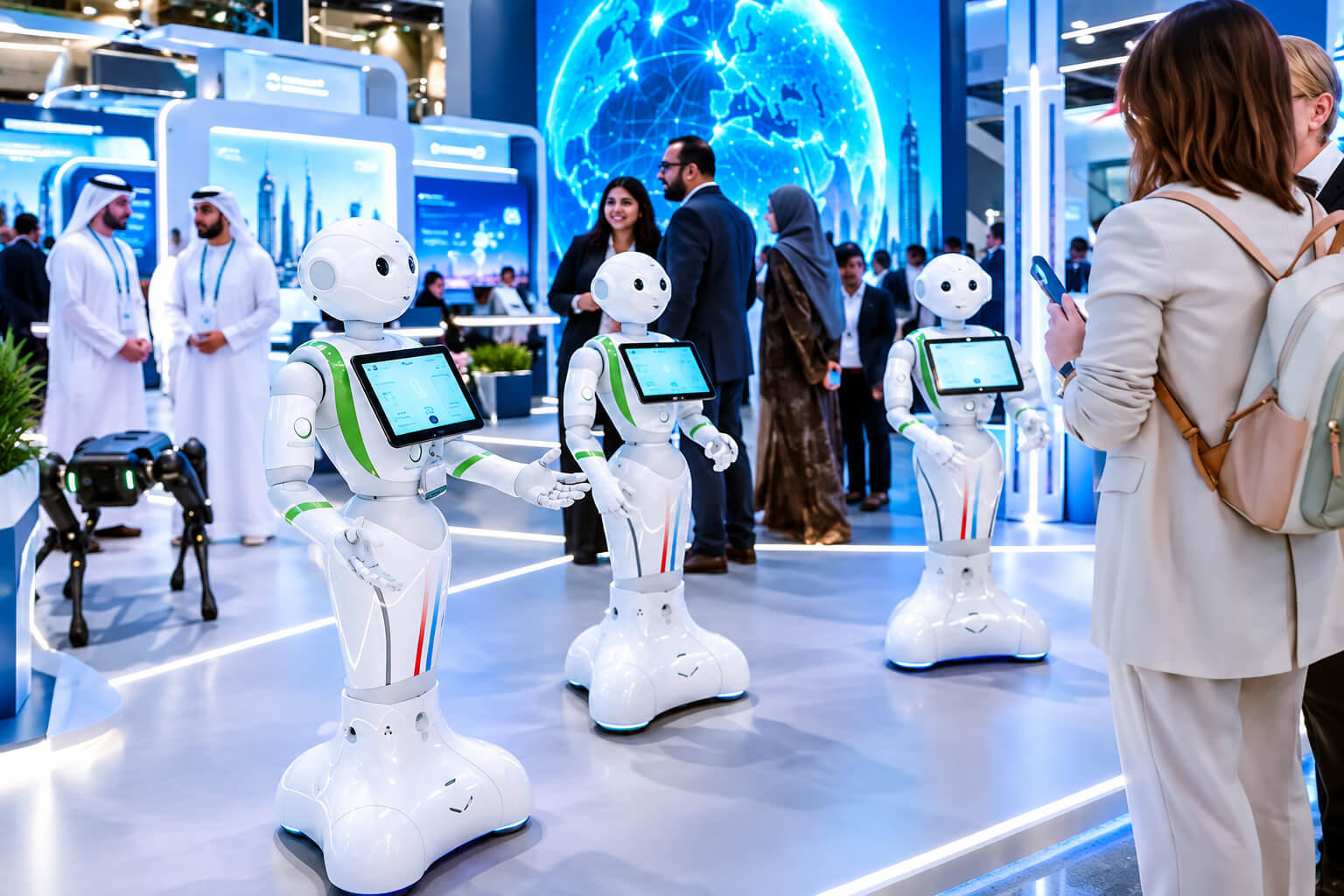
Abu Dhabi is making a fairly clear bet on artificial intelligence: the next phase will be won by whoever can actually put the technology to work.
That means less fascination with what a new model can generate and much more attention on what happens when AI gets plugged into government services, hospitals, infrastructure, research laboratories and large organisations.
That shift will sit at the centre of AI Everything Abu Dhabi 2026, taking place on October 6–7 at ADNEC Centre Abu Dhabi. More than 400 companies and organisations from 60 countries are expected to participate, alongside more than 150 startups and 200 investors.
The timing matters. Companies have spent several years experimenting with generative AI. Governments have done much the same. Now comes the difficult part: connecting those systems to real data, existing workflows and critical infrastructure without creating a security or governance mess.
Abu Dhabi wants to show that this transition has already started.
Abu Dhabi Wants AI Out of the Pilot Stage
For much of the AI boom, experimentation was enough. Companies launched internal assistants, governments tested chatbots and technology teams built proof-of-concept systems that often stopped short of full deployment. That standard is beginning to change as organisations look for measurable results rather than impressive demonstrations.
The conversation around AI Everything Abu Dhabi increasingly reflects that change. The focus is moving toward deployment in finance, healthcare, energy, manufacturing, transport, retail and government. The question is no longer simply whether AI works. Organisations now want to know whether it can operate securely, reliably and at scale inside real business and public-sector systems.
That transition requires more than software. Large-scale AI deployment also depends on computing infrastructure, trusted data, energy, cybersecurity, regulation and workers who understand how to use the technology. It is a less glamorous side of AI than model launches, but it may prove far more important economically.
Government Is Becoming Abu Dhabi’s Biggest AI Test Bed
Abu Dhabi’s government transformation offers one of the clearest examples of the emirate’s push toward practical AI deployment. Rather than limiting artificial intelligence to experimental projects, government departments are increasingly integrating AI into everyday operations.
The Department of Government Enablement says Abu Dhabi has already deployed more than 100 AI use cases across over 40 government entities. These applications cover areas such as service delivery, workforce planning, business compliance and multilingual citizen support.
Some systems can anticipate demand for public services, while others help analyse business activity and provide regulatory guidance. AI is also being used to predict staffing requirements and support services in more than 15 languages. These are not isolated technology demonstrations. They are becoming part of how government agencies operate.
Behind those deployments sits a much larger ambition. Under the Abu Dhabi Government Digital Strategy 2025–2027, the emirate plans to become the world’s first fully AI-native government by 2027. Abu Dhabi has committed AED13 billion to the strategy, covering sovereign cloud infrastructure, AI integration, data-driven services and cybersecurity.
The scale of that investment makes clear that Abu Dhabi views AI as infrastructure, not simply as another software upgrade.
TAMM Shows What an AI-Native Government Could Look Like
TAMM is emerging as one of the most visible examples of how Abu Dhabi wants residents and businesses to interact with government in an AI-driven environment.
The platform connects more than 1,200 government and private-sector services, bringing numerous transactions into a single digital environment. Instead of requiring users to understand which agency manages a particular service, the system is designed to organise government around the user’s needs.
Artificial intelligence could make that model considerably more proactive. Rather than waiting for a resident to search for a service, future systems could identify what the person may need based on their circumstances and guide them through the process automatically.
That represents a significant change from earlier digital-government models, which largely focused on moving paper forms online. Abu Dhabi’s approach increasingly points toward predictive services, conversational interfaces and automated processes operating across multiple departments.
If the model works at scale, the distinction between visiting a government office and using a digital platform could become much less noticeable.
AI Is Also Changing the Government Workforce
Technology deployment alone will not make Abu Dhabi an AI-native government. The people operating those systems matter just as much.
The emirate has therefore been investing heavily in AI training for public-sector employees. According to the Department of Government Enablement, more than 95% of over 30,000 government employees have completed comprehensive AI training.
Government organisations have also introduced Chief Data and AI Officer roles, placing direct responsibility for data strategy, AI adoption, governance and innovation inside public-sector leadership structures.
That matters because organisations often underestimate the human side of AI deployment. Purchasing an advanced platform is relatively easy. Changing how thousands of employees work, make decisions and interact with automated systems is considerably harder.
Abu Dhabi appears to be addressing both sides at once. Technology is being introduced while the workforce is being trained to operate alongside it.
AI Everything Abu Dhabi will extend that discussion into the private sector, where companies are expected to demonstrate digital-worker systems and AI platforms designed to automate complex organisational tasks. One system highlighted ahead of the event is projected to generate roughly $3 million in annual savings.
The bigger test will come after the exhibition floor closes. Businesses will want to know whether those savings continue once AI systems are deployed inside messy, complicated real-world environments.
Healthcare Gives Abu Dhabi Another Real-World AI Arena
Healthcare is another major area where Abu Dhabi is pushing artificial intelligence beyond experimentation.
AI Everything Abu Dhabi will feature technologies covering drug discovery, clinical systems, digital medicine and Arabic-language healthcare applications. These technologies sit within a healthcare ecosystem that is already becoming increasingly data-driven.
An AI-powered patient safety system in Abu Dhabi connects hospitals across the emirate and serves more than 60,000 users, according to information highlighted by Gulf News. Such deployments give developers and healthcare organisations a real environment in which to test how AI performs outside controlled laboratory settings.
Abu Dhabi has also been developing capabilities in genomics and precision medicine. When combined with hospital data, research infrastructure and growing computing capacity, these programmes could create a substantial foundation for medical AI development.
Healthcare, however, also exposes the limits of AI hype very quickly. Accuracy, patient privacy, explainability and accountability become much more important when automated systems influence clinical decisions.
That is why deployment matters more than demonstration. A system can look impressive during a presentation and still struggle when exposed to real patients, incomplete data and complex medical workflows.
Agentic AI Moves From Answering to Acting
Another major theme around AI Everything Abu Dhabi is the rise of agentic AI, which pushes artificial intelligence beyond answering questions and toward performing tasks.
Generative AI systems became popular because they could produce text, images, code and analysis. AI agents go further by planning actions, interacting with software and completing multi-step processes within defined permissions.
The difference sounds subtle, but operationally it is significant.
An AI assistant might explain how an employee should complete a procurement process. An AI agent could potentially open the relevant systems, gather information, prepare documents and execute parts of that workflow.
For businesses and governments, that could create major efficiency gains. It also raises difficult questions around access, security and accountability.
Once an AI system starts taking actions rather than simply offering suggestions, organisations need much tighter controls over what it can view, approve, change or send.
That is why agentic AI is likely to become as much a governance issue as a technology issue.
The AI Race Is Becoming an Infrastructure Race
The rapid growth of AI has created another reality that is harder to ignore: increasingly powerful systems require increasingly large amounts of infrastructure.
Modern AI models depend on computing capacity, data centres, high-speed networks and enormous amounts of electricity. Those systems also require cooling, physical security and reliable access to specialised chips.
As a result, the global AI competition is beginning to look as much like an infrastructure race as a software race.
Abu Dhabi appears well positioned to participate in that shift. AI Everything Abu Dhabi will bring together discussions around AI models, cloud systems, data centres, energy and smart infrastructure.
The emirate’s broader strategy also connects government adoption, research, investment, startups and computing capacity. Those elements reinforce one another.
A city with capital but no computing infrastructure will struggle to scale AI. A city with data centres but limited talent will face a different bottleneck. Abu Dhabi is attempting to build multiple parts of the ecosystem at the same time.
The underlying lesson is straightforward. Building an impressive AI model is one challenge. Running millions of secure, reliable and affordable AI interactions every day is another.
More Than 400 Companies Arrive in Abu Dhabi
AI Everything Abu Dhabi is expected to bring together more than 400 companies and organisations from 60 countries, along with more than 180 global speakers.
The event will feature major technology companies, startups, investors, government agencies and research organisations working across different parts of the AI economy.
Companies and institutions connected to the programme include Mistral AI, AWS, Alibaba Cloud and ASUS, while Abu Dhabi-based organisations such as the Advanced Technology Research Council, First Abu Dhabi Bank and Hub71 are also taking part.
The breadth of participation reflects how quickly AI has expanded beyond the technology sector. Government, healthcare, banking, transport, energy, science and infrastructure are now all part of the same conversation.
Still, exhibition numbers alone will not determine whether the event succeeds.
The more meaningful measure will be what happens afterwards. Demonstrations need to become deployments. Startups need customers. Research projects need commercial or public-sector applications. Governments need measurable improvements in service delivery.
That is where Abu Dhabi’s deployment-focused message will ultimately be tested.
Abu Dhabi Is Betting That AI’s Hype Phase Is Ending
The AI industry has never struggled to produce ambitious predictions. What it has often struggled with is turning those predictions into systems that work consistently in the real world.
Deployment is where artificial intelligence collides with budgets, ageing software, regulation, cybersecurity, workforce resistance and physical infrastructure.
Abu Dhabi appears willing to operate in that less polished part of the AI story.
Its government already has more than 100 AI use cases running across dozens of entities. Billions of dirhams are being directed toward digital transformation. Public-sector employees are receiving AI training. Artificial intelligence is being pushed into healthcare, government services and administrative workflows.
AI Everything Abu Dhabi will put much of that strategy on display.
The larger message reaches beyond the exhibition itself.
The next stage of the AI race may not be decided by which company or country announces the most impressive model. It may be decided by who can deploy AI safely, affordably and at scale in systems that people actually use.
Abu Dhabi clearly wants to be one of them.
Sources
Gulf News — Abu Dhabi puts AI to work as global race shifts from hype to deployment
https://gulfnews.com/uae/government/abu-dhabi-puts-ai-to-work-as-global-race-shifts-from-hype-to-deployment-1.500698086
Department of Government Enablement — Abu Dhabi Government Digital Strategy 2025–2027 accelerates AI-native government journey
https://www.dge.gov.ae/en/news/adg-digital-strategy-update-2025
