


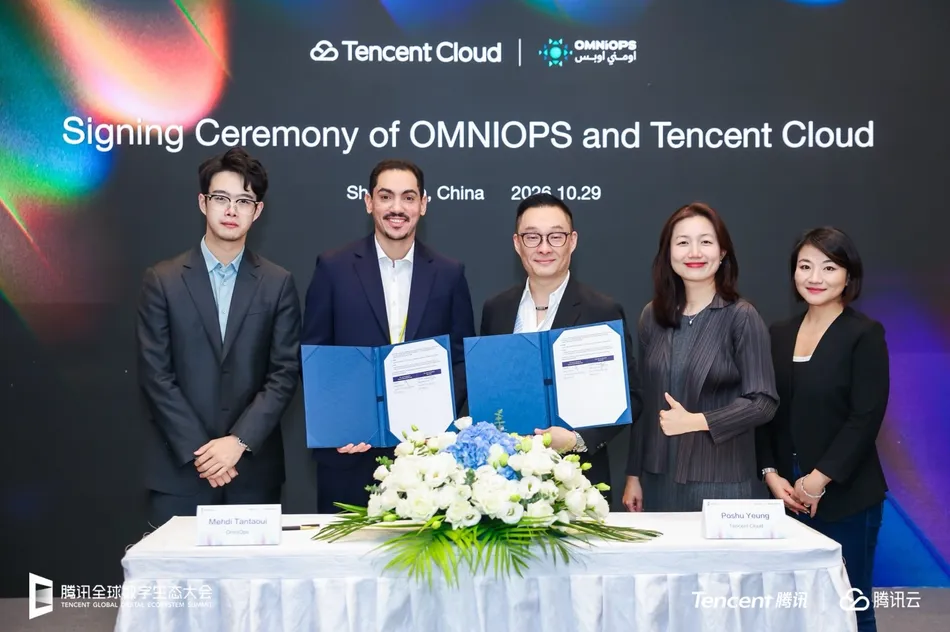
Saudi Arabia’s growing artificial intelligence sector has attracted another major technology partnership. Tencent Cloud and OmniOps have joined forces to strengthen sovereign AI infrastructure in the Kingdom, combining cloud computing capabilities with locally developed AI inference technology.
Announced during the 2026 Tencent Global Digital Ecosystem Summit, the collaboration aims to help Saudi businesses develop, deploy and manage AI applications without facing the full complexity of building their own infrastructure.
The agreement comes as more organizations move beyond AI experiments and begin integrating intelligent systems into everyday business operations. For many companies, the challenge is no longer finding an AI model. It is finding the computing resources, technical expertise and infrastructure needed to run that model efficiently.
Tencent Cloud and OmniOps Combine Expertise to Support Enterprise AI
The partnership brings together Tencent Cloud’s global cloud computing infrastructure and OmniOps’ experience in developing AI inference solutions for the Saudi market. Both companies will contribute technologies intended to make enterprise AI deployment more accessible and efficient.
Tencent Cloud will provide essential infrastructure services, including virtual machines, storage, networking capabilities and technical support. These resources are designed to accommodate demanding AI workloads and help organizations expand their applications as computing requirements increase.
OmniOps, meanwhile, will contribute its proprietary inference optimization technology and local deployment expertise. The Saudi company specializes in helping businesses operate AI models efficiently while addressing infrastructure and operational requirements.
This division of responsibilities gives the partnership a practical focus. Tencent Cloud supplies the computing foundation, while OmniOps works on improving how AI models perform within that environment.
For enterprises that lack the resources to build large-scale AI infrastructure independently, the arrangement could offer a more manageable path toward deploying AI-powered services.
AI Inference Optimization Takes Center Stage
AI inference is becoming one of the biggest operational challenges for businesses adopting artificial intelligence. While training an AI model requires significant computing power, running that model continuously can also generate substantial costs, particularly when thousands of users rely on it.
Inference refers to the process through which a trained AI model generates responses, analyzes information or makes predictions. It supports applications ranging from customer service assistants and automated document processing to enterprise analytics and intelligent business platforms.
OmniOps has developed an inference optimization engine designed to improve how AI models use available computing resources. Its technology aims to increase processing efficiency, improve performance and reduce the cost of generating AI outputs.
The partnership with Tencent Cloud could help extend those capabilities across more demanding enterprise environments. Access to additional cloud infrastructure would allow OmniOps to support larger workloads while maintaining a focus on efficiency.
For Saudi businesses, the potential benefit is straightforward. More efficient inference could make it easier to operate AI applications at scale without allowing infrastructure costs to grow at the same pace as usage.
Saudi Arabia Pushes Forward With Sovereign AI Infrastructure
Data sovereignty has become an increasingly important issue as governments and businesses adopt artificial intelligence. Organizations handling sensitive information need to consider where their data is stored, how it is processed and which entities control the infrastructure supporting their applications.
The Tencent Cloud and OmniOps partnership places sovereign AI infrastructure at the center of its strategy. The companies aim to support enterprise AI environments that address Saudi Arabia’s local operational and data governance requirements.
Sovereign AI infrastructure generally refers to systems that provide greater domestic control over computing resources, data management and AI operations. Such capabilities can be particularly relevant for government agencies, financial institutions and other organizations operating under strict regulatory requirements.
Saudi Arabia has been investing heavily in digital transformation as part of its broader economic development agenda. Building domestic AI capabilities is one element of that effort, but reliable infrastructure remains essential to turning those investments into operational systems.
The collaboration could contribute to that objective by combining international cloud expertise with technology developed for the local market.
OmniOps Expands Its AI Infrastructure Capabilities Through Bunyan
Founded in 2024, OmniOps has focused on developing AI infrastructure services that allow organizations to deploy advanced models without managing every technical component themselves. Its flagship platform, Bunyan, is positioned as a sovereign Inference-as-a-Service solution for the Saudi market.
Bunyan supports AI workloads involving text, vision and speech, providing businesses with access to inference capabilities through a managed platform. Instead of investing in extensive computing infrastructure, organizations can use these services to support applications that require AI processing.
The company has also secured $8 million in pre-seed funding, reflecting investor interest in technologies supporting enterprise AI deployment in Saudi Arabia.
Working with Tencent Cloud could give OmniOps additional infrastructure capacity to expand its services and support customers with more demanding computing requirements.
Mehdi Tantaoui, Chief Product Officer at OmniOps, has emphasized the importance of dependable infrastructure as businesses move their AI applications into production. The collaboration is intended to strengthen the computing foundation supporting the company’s platforms and inference workloads.
That focus reflects a broader shift in enterprise AI development. Businesses are increasingly concerned with whether AI systems can operate reliably under real-world conditions, rather than simply demonstrating impressive capabilities during testing.
Tencent Cloud Strengthens Its Position in the Middle East
Tencent Cloud has been expanding its international operations as demand for enterprise cloud services and artificial intelligence infrastructure continues to grow. The partnership with OmniOps adds another regional collaboration to that strategy.
The company has been developing its infrastructure presence across international markets, including the Middle East, while introducing cloud services intended to support AI development and deployment.
Tencent reported in October 2026 that its active overseas customer base had doubled compared with the previous year. International demand for its AI products and services also recorded triple-digit growth, highlighting the company’s expanding presence outside China.
Saudi Arabia represents an important market for that expansion. The Kingdom’s investments in AI, cloud computing and digital infrastructure have created opportunities for technology providers capable of supporting large enterprise workloads.
Poshu Yeung, Senior Vice President of Tencent Cloud and Head of Tencent Cloud International, identified the partnership as an opportunity to combine Tencent’s infrastructure capabilities with OmniOps’ local expertise and inference technology.
The arrangement could also help Tencent Cloud strengthen its relationships with Saudi enterprises seeking AI solutions that align with domestic business and regulatory requirements.
What the Partnership Means for Saudi Enterprises
The collaboration could help address several barriers that businesses encounter when moving AI applications from development into production. Infrastructure costs, computing capacity and deployment complexity can make large-scale implementation difficult, particularly for organizations without dedicated AI engineering teams.
By combining cloud infrastructure with inference optimization, Tencent Cloud and OmniOps aim to provide a more accessible environment for enterprise AI workloads.
Businesses developing AI-powered customer support systems, document processing tools, analytics platforms or internal automation services could potentially benefit from infrastructure designed to handle growing demand.
The partnership may also support organizations that need more flexibility in how they deploy AI applications. Access to local expertise and scalable cloud resources could simplify some of the technical decisions involved in operating AI systems.
However, the commercial impact will depend on how the companies implement their collaboration. Pricing, service availability, deployment options and measurable performance improvements will determine how attractive the resulting solutions become for enterprise customers.
The companies have not publicly confirmed specific customer deployments under the new agreement.
Saudi Arabia’s AI Growth Will Depend on Scalable Computing Infrastructure
Saudi Arabia’s ambitions in artificial intelligence extend beyond developing new applications. The Kingdom is also working to establish the infrastructure, technical capabilities and business environment needed to support long-term AI adoption.
That requires reliable computing resources and systems capable of handling increasingly complex workloads.
The Tencent Cloud and OmniOps partnership addresses part of that challenge by focusing on cloud infrastructure and AI inference rather than introducing another standalone AI model.
For Tencent Cloud, the agreement creates an opportunity to expand its enterprise AI presence in Saudi Arabia through a local technology partner. OmniOps gains access to infrastructure capabilities that could support the growth of its inference services.
Whether the collaboration delivers meaningful cost savings or performance improvements remains to be seen. Those results will become clearer as the companies introduce services and businesses begin using them.
What the agreement demonstrates is the growing importance of the infrastructure behind artificial intelligence. As more Saudi enterprises move toward production-scale AI, efficient computing and dependable deployment environments will become central to their technology strategies.
