


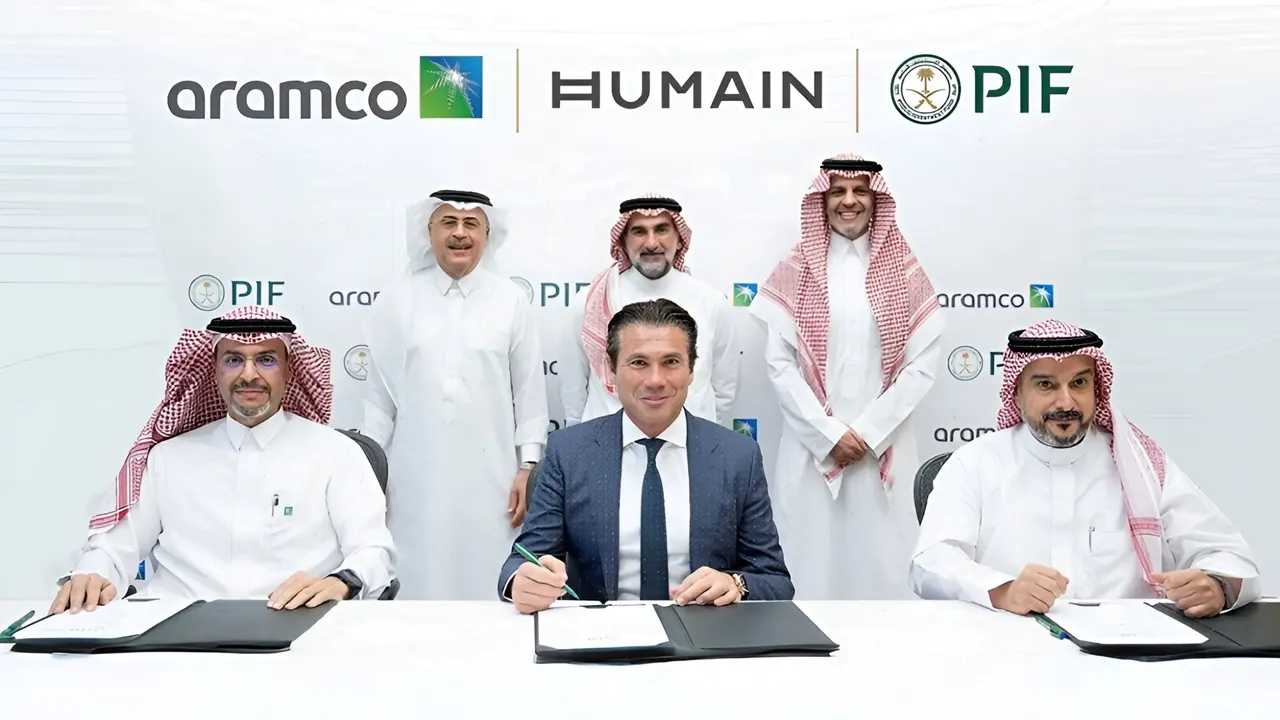
Saudi Arabia’s artificial intelligence ambitions have secured another major financial commitment. Saudi Aramco has completed its acquisition of a 49% stake in HUMAIN, the Kingdom’s state-backed AI company, in a transaction involving approximately SAR 9.9 billion ($2.6 billion) in cash contributions during 2026.
Announced on November 1, 2026, the completed deal leaves Saudi Arabia’s Public Investment Fund (PIF) with a controlling 51% stake. Aramco is also transferring AI, computing, and digital assets to HUMAIN, bringing additional technical capabilities to a company seeking a bigger role in the global AI industry.
The investment puts one of the world’s largest energy companies directly into the business of building artificial intelligence infrastructure. For Saudi Arabia, it brings together two of its most influential institutions behind an increasingly expensive technology ambition.
Aramco HUMAIN Acquisition Strengthens Saudi Arabia’s AI Investment Strategy
The acquisition gives Aramco a substantial minority position in HUMAIN through a wholly owned subsidiary. The agreement follows an earlier arrangement announced in October 2025, when Aramco and PIF outlined plans to combine selected AI investments, capabilities, and expertise under the technology company.
Rather than treating AI as a separate investment opportunity, the partnership brings industrial experience, computing infrastructure, and financial resources into a single business. PIF will maintain majority ownership, while Aramco gains access to HUMAIN’s expanding technology platforms and the potential commercial opportunities they create.
Both shareholders expect the arrangement to accelerate HUMAIN’s development and strengthen its ability to compete beyond Saudi Arabia. The company is targeting customers across government, enterprise technology, and industries that increasingly depend on high-performance computing.
HUMAIN Plans 3 Gigawatts of AI Data Center Capacity by 2030
One of the biggest elements of HUMAIN’s expansion is its plan to deploy 3 gigawatts of AI data center capacity by 2030. The target reflects Saudi Arabia’s intention to become a significant supplier of computing infrastructure as demand for artificial intelligence services continues to grow.
AI data centers require enormous amounts of electricity, sophisticated cooling systems, advanced processors, and reliable network connections. Building facilities at this scale presents a costly challenge, particularly as technology companies compete for specialized hardware and energy resources.
Aramco’s involvement could help HUMAIN navigate some of those demands. The energy producer has decades of experience developing large industrial projects, managing complex infrastructure, and deploying technology across extensive operations. Those capabilities could prove valuable as HUMAIN moves from ambitious infrastructure plans toward actual deployment.
The company’s proposed capacity also positions Saudi Arabia to attract international businesses seeking AI computing resources in the Middle East. Yet infrastructure alone will not guarantee commercial success. HUMAIN will need customers, competitive services, and reliable access to the equipment required to operate its facilities.
Aramco Looks to Expand AI Applications Across Its Energy Operations
Aramco already uses artificial intelligence in its industrial operations, and the HUMAIN partnership could give those efforts a larger technological foundation. The company expects to use HUMAIN’s computing infrastructure and services to develop more advanced industrial applications while improving efficiency across its existing businesses.
AI can help energy producers analyze geological information, monitor equipment performance, optimize production, and identify operational problems before they become expensive failures. These capabilities are particularly valuable in large industrial environments where small improvements can translate into substantial financial savings.
Aramco President and CEO Amin H. Nasser said the company has achieved approximately $11.3 billion in Technology Realized Value since 2023, with AI solutions contributing significantly to that figure. The measurement reflects value generated through technology initiatives rather than direct AI sales revenue.
The HUMAIN investment also creates an opportunity for Aramco to commercialize existing digital assets. Instead of developing technology solely for internal use, the company could benefit from services delivered to a broader market through HUMAIN’s platforms.
HUMAIN Builds an AI Ecosystem Beyond Data Centers
HUMAIN’s ambitions extend well beyond providing computing space. Launched in May 2025, the company is developing a broader artificial intelligence ecosystem that includes next-generation data centers, high-performance computing infrastructure, cloud platforms, advanced AI models, and applications designed for commercial and government use.
Among its technology initiatives is ALLaM, a multimodal Arabic large language model developed to support AI applications involving Arabic-language content. Such technology could help organizations build digital services that better accommodate regional languages and operational requirements.
Developing its own AI models alongside computing infrastructure gives HUMAIN greater control over the services it can offer. The company wants to serve organizations that need more than access to processors, including businesses seeking integrated AI tools and industry-specific applications.
That approach places HUMAIN in competition with established global cloud and AI providers. Its success will depend on how effectively it combines infrastructure, software, technical expertise, and commercial partnerships into services that customers are willing to adopt.
Saudi Arabia Positions AI as a Major Economic Growth Opportunity
The Aramco HUMAIN acquisition comes as Saudi Arabia continues investing in technology industries intended to support economic diversification. Artificial intelligence has become a significant part of that effort, with growing attention directed toward computing infrastructure, advanced software, and the development of local technical expertise.
PIF’s 2026–2030 strategy emphasizes stronger integration across economic sectors, greater private-sector participation, and the development of Saudi companies capable of competing internationally. HUMAIN’s expansion fits within those priorities by creating opportunities for technology investment, specialized employment, and digital infrastructure development.
Saudi Arabia also has an advantage that matters increasingly to the AI industry: substantial energy resources. As computing demand rises, access to dependable electricity is becoming an important consideration for companies planning large-scale data center projects.
But energy availability is only one part of the equation. Saudi Arabia must also attract experienced engineers, secure advanced computing hardware, and establish a customer base capable of supporting the financial demands of its expanding AI infrastructure.
Aramco’s $2.6 Billion Investment Could Open New AI Revenue Opportunities
The transaction gives Aramco exposure to an industry where demand for computing power and AI services continues to attract major investment. By becoming a shareholder and strategic partner in HUMAIN, the company could benefit from infrastructure development, enterprise AI adoption, and the commercialization of its existing digital capabilities.
The financial commitment is significant, although the $2.6 billion figure represents Aramco’s planned cash contributions during 2026 rather than a disclosed valuation of HUMAIN. The transaction also includes AI-related assets whose individual values were not specified in the announcement.
For HUMAIN, the partnership provides more than additional funding. Aramco could become an important industrial customer for its services, giving the AI company opportunities to test and expand applications in demanding operational environments.
The commercial outlook remains uncertain. Building AI infrastructure requires considerable upfront investment, while future returns depend on utilization rates, technology costs, and customer demand. HUMAIN will need to demonstrate that its expanding computing capacity can support a sustainable business.
What the Aramco HUMAIN Deal Means for the Future of Artificial Intelligence
The completed acquisition marks another important step in Saudi Arabia’s effort to establish itself as a global AI technology market. With PIF maintaining majority ownership and Aramco bringing additional capital and industrial expertise, HUMAIN now has substantial institutional support behind its expansion plans.
The partnership could also influence how major energy companies participate in the artificial intelligence economy. Aramco is not simply investing in software development. It is helping finance the infrastructure that businesses and governments will need to deploy increasingly sophisticated AI systems.
HUMAIN’s next challenge is execution. Its planned data centers must be built, its computing services must attract customers, and its technology platforms must compete with established international providers.
Saudi Arabia has committed considerable resources to that ambition. Whether HUMAIN becomes a major global AI supplier will depend less on the size of its investment announcements and more on what it can deliver over the coming years.
Sources
- Middle East AI News – Aramco Completes 49% Acquisition of HUMAIN
- Saudi Aramco – PIF and Aramco Close HUMAIN Transaction to Accelerate Global Growth
- Saudi Press Agency – PIF and Aramco Close HUMAIN Transaction
- Arab News – Aramco Closes $2.6 Billion Deal for 49% Stake in HUMAIN
- Aramco – Building the AI Future
