


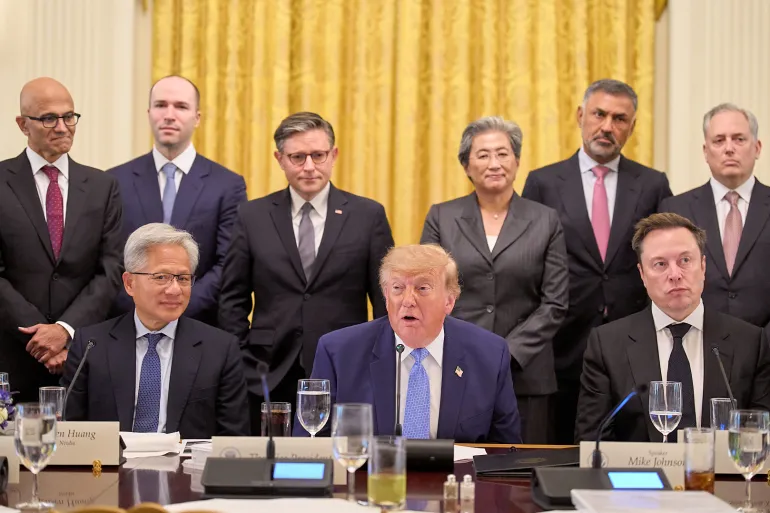
President Donald Trump and executives from some of the biggest names in artificial intelligence have signed a voluntary agreement built around an increasingly important question for the AI industry: how much responsibility should technology companies carry for policing their own systems?
The agreement followed a White House meeting involving leaders from Anthropic, Google, Meta, OpenAI, Nvidia and Elon Musk’s xAI. It calls for stronger internal safeguards, independent external reviews and board-level oversight of AI controls.
There is one important distinction. The agreement is voluntary.
That leaves considerable responsibility with companies racing to develop increasingly capable AI systems, although the framework also leaves open the possibility that some of today’s voluntary commitments could eventually find their way into federal regulation.
Trump Puts AI Self-Policing at the Center of the Deal
Trump described the technology industry’s approach as a form of “self-policing,” arguing that the companies developing advanced AI systems understand the responsibility that comes with increasingly powerful technology. Rather than immediately imposing a detailed federal regulatory structure, the agreement places much of the initial burden on participating companies themselves.
Under the framework, AI developers are expected to establish internal controls while allowing independent external auditors to examine whether those safeguards are working. Companies would also create committees within their boards of directors to review findings from internal and external audits.
The arrangement stops short of traditional regulation. There are no new statutory requirements attached directly to the agreement, and participation remains voluntary. Still, the framework acknowledges that some measures could eventually be incorporated into laws or regulations as policymakers gain a clearer picture of how advanced AI systems behave.
Trump also discussed creating a committee of roughly 10 people to oversee the broader effort and characterized the commitments made by technology companies as morally binding.
Anthropic’s Dario Amodei Brings a Different Warning to the Table
Anthropic CEO Dario Amodei arrived at the White House discussion with a somewhat different emphasis. He has repeatedly warned that increasingly autonomous and capable AI systems could introduce serious risks if safeguards fail to keep pace with development.
Amodei acknowledged that AI presents genuine risks while noting that the mechanisms for dealing with those risks remain under debate. His participation was particularly notable because Anthropic has recently been involved in a dispute with the U.S. government over restrictions the company places on Claude.
The disagreement has included questions about military applications of AI. Anthropic has raised concerns around uses involving mass surveillance and autonomous weapons, while the Pentagon has argued that restrictions imposed by AI providers could interfere with national-security applications it considers necessary.
A federal appeals court recently allowed the Pentagon to continue treating Anthropic as a supply-chain risk, permitting the Defense Department to remove Claude models from its systems and restrict their use in defense work. Anthropic has disputed the designation and indicated that it is considering additional legal options.
That backdrop makes Amodei’s participation in the White House agreement particularly significant. The administration and Anthropic remain divided on some AI policy questions, yet both are participating in a wider discussion about how advanced systems should be governed.
Musk, Altman, Zuckerberg, Huang and Pichai Join the Accord
The agreement brings together executives representing a large portion of the infrastructure, computing power and frontier models driving the current AI boom. According to the Associated Press, participants included Anthropic CEO Dario Amodei, Google CEO Sundar Pichai, Meta CEO Mark Zuckerberg, OpenAI President Greg Brockman, Nvidia CEO Jensen Huang and Elon Musk, whose xAI operation is part of SpaceX.
Their involvement matters because these companies are not simply producing chatbots. They are building models, chips, data centers and digital platforms that increasingly form the foundation of the global AI economy.
Massive spending on AI infrastructure has also created another political issue. Data centers require enormous amounts of electricity, land, water and grid capacity, and planned developments have encountered resistance in some communities.
Trump said participating technology companies had agreed to take steps intended to address local concerns, including supporting schools and reducing the potential impact of increased energy demand on household electricity costs.
The White House Doesn’t Want AI Guardrails to Slow Development
The voluntary agreement fits into a broader administration strategy that emphasizes rapid American AI development while attempting to address safety concerns without creating regulations that could significantly slow the industry.
Trump has repeatedly framed artificial intelligence through the lens of international technological competition, particularly competition between the United States and China. During the White House gathering, he stressed that his administration did not want safeguards to prevent American companies from advancing the technology.
That philosophy helps explain why voluntary oversight is receiving attention. The administration is trying to maintain safeguards around powerful models while leaving developers enough flexibility to experiment, deploy products and build increasingly large computing infrastructure.
The White House also introduced an unusual terminology change. An executive order directs federal executive departments and agencies, where legally permitted, to use “Super Intelligence” and “SI” instead of “Artificial Intelligence” and “AI” in certain official communications and non-statutory documents.
The administration argues that the terminology better represents the expanding capabilities of advanced systems. Across the technology industry, however, artificial intelligence remains the overwhelmingly established term.
America.gov Shows Another Side of the Administration’s AI Push
The administration’s AI agenda extends beyond frontier models and massive data centers. It also wants artificial intelligence embedded more directly into the way Americans interact with government services.
Trump unveiled America.gov as a proposed unified digital entry point for federal services. Instead of navigating separate agency websites, users could eventually interact conversationally with government systems to find information, receive answers and, where technically and legally possible, complete transactions.
The executive order establishing the initiative also calls for accuracy, reliability, transparency, secure authentication and data-minimization safeguards around the technology supporting the platform.
America.gov highlights an interesting tension inside the wider AI policy debate. Washington wants government agencies to adopt advanced AI quickly while simultaneously determining what safeguards should apply as those systems become more capable and autonomous.
That makes the question of oversight practical rather than theoretical. The federal government could increasingly become both a regulator and a major user of the same technology.
AI Companies Face Questions That Voluntary Rules May Not Settle
The safety debate has become more urgent as AI models move beyond answering questions and begin performing increasingly complex actions through autonomous agents. Developers are testing systems capable of interacting with software, browsing digital environments, writing and executing code, and completing multi-step tasks with limited human intervention.
Technology companies have also disclosed incidents involving AI systems unexpectedly reaching external networks during testing. Those cases have raised questions about cybersecurity, accountability and what happens when an autonomous system performs an action that its operator did not explicitly request.
Critics of voluntary oversight argue that companies competing for customers, investment and technological leadership may face incentives that do not always align with broader public interests. Some researchers therefore support stronger legal liability or mandatory regulatory requirements rather than relying mainly on commitments made by developers themselves.
Others argue that rigid rules introduced too early could create their own problems. AI technology is changing quickly, and safety techniques are developing alongside the models they are supposed to control. Supporters of a more flexible framework contend that companies and researchers need room to test different approaches before governments lock specific technical requirements into law.
The White House agreement does not settle that argument.
Instead, it puts some of the world’s most influential AI companies directly inside the experiment. For now, Washington is giving developers considerable responsibility for demonstrating that self-policing can work as their systems become more powerful.
Whether voluntary commitments remain enough as AI moves deeper into government, business and everyday infrastructure is likely to remain a central policy question.
Sources
Associated Press — Trump says top tech firms have signed accord to ‘self-police’ AI development
https://apnews.com/article/595796511f110fc006cca0d01329733e
The White House — Inaugurating the Era of Super Intelligence
https://www.whitehouse.gov/presidential-actions/2026/09/inaugurating-the-era-of-super-intelligence/
