


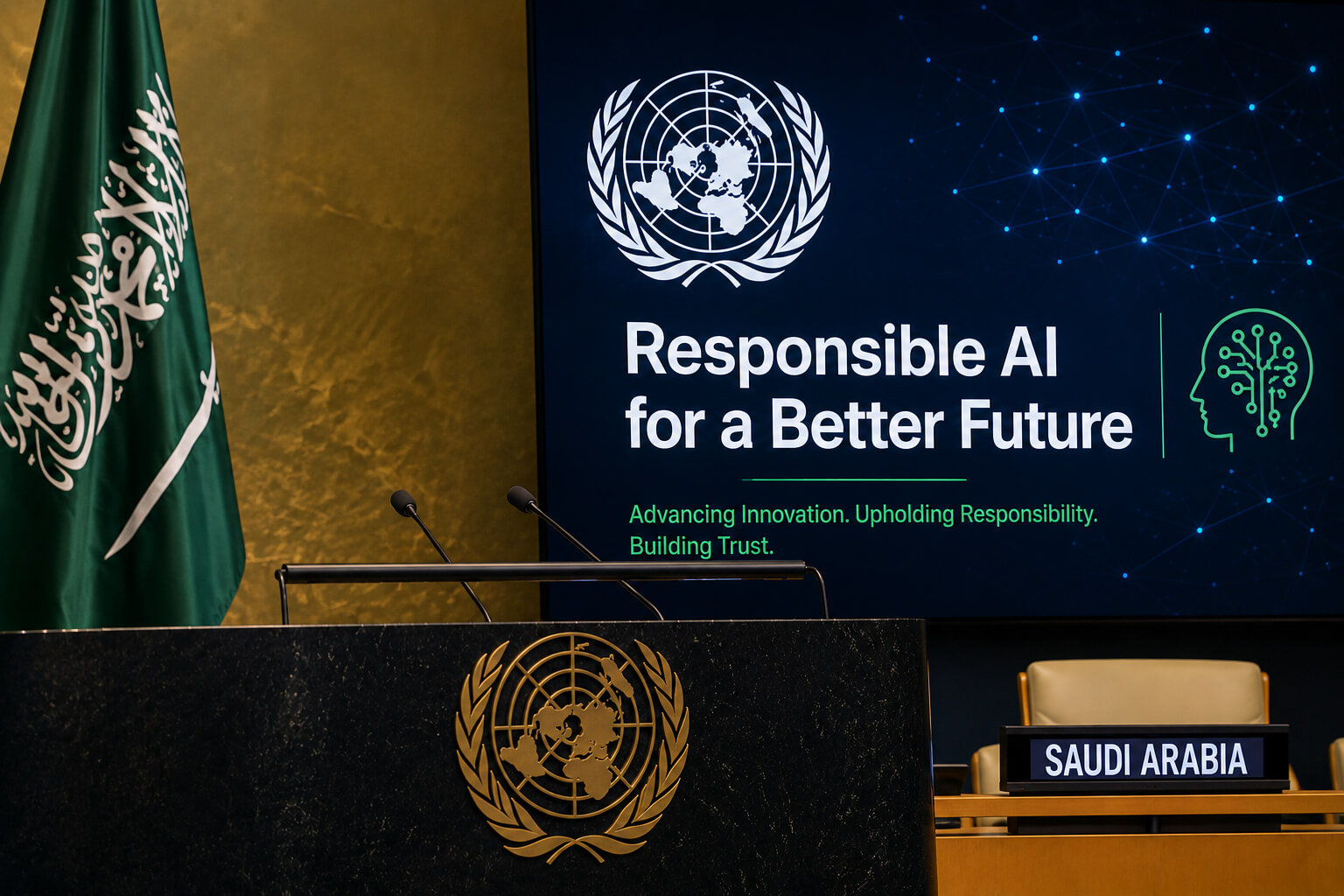
Saudi Arabia has called for responsible AI governance at the UN. The country urged greater international cooperation and called on nations to develop and use artificial intelligence safely, ethically, and in ways that support sustainable development.
Speaking on behalf of the Arab Group during a United Nations General Assembly interactive dialogue in New York, Saudi Arabia emphasized that AI governance must balance innovation with safeguards that protect people, societies, and national policy priorities.
Abdulaziz Alwasil, Saudi Arabia’s Permanent Representative to the UN, delivered the Kingdom’s statement. He spoke during discussions with the co-chairs of the Independent International Scientific Panel on Artificial Intelligence.
Saudi Arabia Backs Global Cooperation on AI
Saudi Arabia welcomed ongoing UN efforts to strengthen global AI governance, including the implementation of the Global Digital Compact and the creation of an independent scientific panel on artificial intelligence.
The Kingdom said responsible AI development requires continued dialogue between governments, the United Nations, the private sector, academic institutions, and civil society. This multistakeholder approach is becoming increasingly important as AI tools affect economies, public services, cybersecurity, media, and everyday life.
With AI’s use growing around the world, governments are being asked to come up with rules that encourage innovation but at the same time reduce the chances of it being misused. Saudi Arabia’s message at the UN was that there should be cooperation rather than fragmented or one-size-fits-all regulation.
AI Policy Must Respect National Sovereignty
A central part of Saudi Arabia’s position was the importance of national sovereignty in AI governance. The Kingdom stressed that UN member states must continue to play a core role in any future global AI governance mechanisms.
“Every country should have the right to determine its own AI policies in accordance with its national development objectives, social needs and economic priorities,” Saudi Arabia said.
This is especially relevant for developing economies and emerging technology markets, where AI strategies may differ from those of the world’s leading technology-producing nations. For Saudi Arabia and the broader Arab Group, international AI governance should not hinder countries’ ability to build local digital capacity or pursue their own development agendas.
Ethical AI Frameworks Are Essential
Saudi Arabia also called for ethical AI frameworks based on transparency, reliability and accountability. These principles are key to responsible AI governance because they help ensure that AI systems are trusted by governments, businesses and the public.
The Kingdom emphasized the importance of safeguarding privacy and human rights, alongside taking into account cultural and societal values. This mirrors a worldwide discussion about how AI regulations can be aligned globally while remaining relevant locally.
Responsible AI governance is not only about avoiding harm, but also about creating systems that people can understand, challenge and trust. Transparency helps users know when AI is being used. Accountability helps determine who is responsible when AI systems cause harm. Reliability helps ensure AI tools work safely and predictably.
Saudi Arabia warns against AI misuse
The Kingdom warned that AI misuse could pose severe risks including misinformation, deepfakes and cyberattacks. These threats have become major concerns. Generative AI tools now make it easier to create fake images, videos, audio, and text at scale.
Saudi Arabia said addressing these risks is important. It can help increase public trust and support the safe use of AI worldwide.
Deepfakes and disinformation created by AI can influence public opinion, harm reputations, and generate political or social instability. Cyberattacks powered by AI can also make digital threats faster, more targeted, and harder to detect.
Why This Matters for Global AI Governance
Saudi Arabia’s remarks come as the UN continues to build international structures for AI cooperation. The Independent International Scientific Panel on AI is intended to provide scientific insight into AI’s risks, opportunities, and global impact.
For the global AI sector, the Kingdom’s statement sends a clear message. AI governance is becoming a diplomatic issue, not just a technology issue.
Countries are now debating who should make AI rules. They are also discussing how to manage risks and keep innovation inclusive.
Saudi Arabia’s stance underscores three key priorities: international cooperation, ethical safeguards, and respect for national sovereignty. Together, these issues are likely to influence future discussions on responsible AI governance at the UN and beyond.
Key Takeaway
Saudi Arabia is calling on the global community to build responsible AI governance frameworks. These frameworks should safeguard human rights, reduce misuse, support sustainable development, and respect national priorities.
The world now faces a key question. How can countries work together to govern AI in a fair, safe, and effective way as the technology becomes more powerful?
