


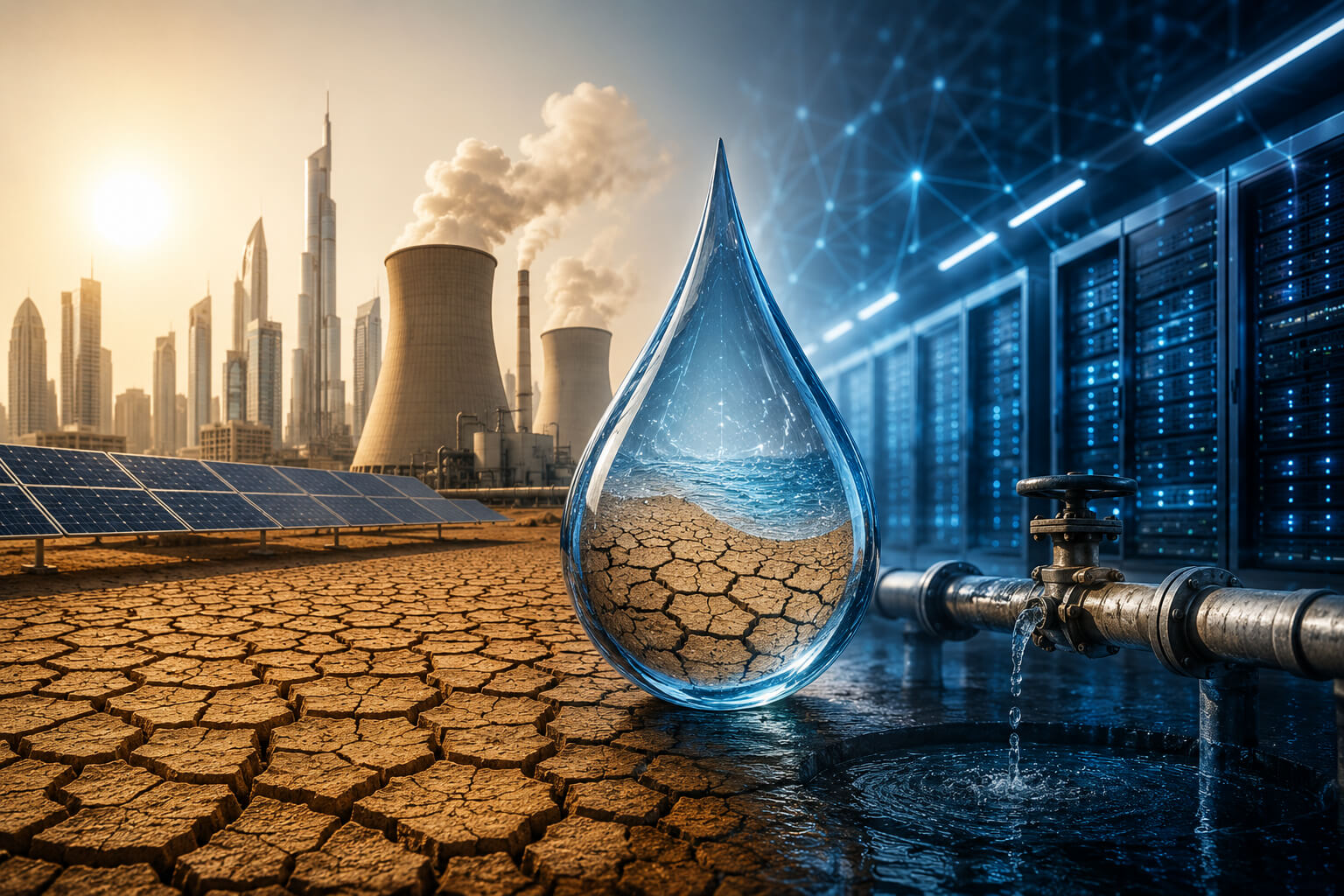
The Gulf Cooperation Council (GCC) has emerged as one of the fastest growing hubs for artificial intelligence development and application in recent years. As the GCC AI boom accelerates, water and energy risks are becoming increasingly important to address. The issue of GCC AI boom water energy risks is now at the centre of policy discussions. Saudi Arabia and the UAE have invested billions into their hyperscale AI infrastructure, data centre projects and cloud computing systems.
But there are rising fears that the GCC’s drive for supremacy in AI could add to the pressure on already scarce natural resources like water and energy. Moreover, these GCC AI boom water energy risks are receiving heightened attention from environmental experts.
GCC AI Boom Poses Threat to Natural Resources
Experts warn that GCC countries’ drive to dominate artificial intelligence could exacerbate water scarcity and raise electricity demands.
In one of the driest and most arid parts of the world, the GCC region’s AI ambitions might lead to increased pressure on limited resources. As the GCC becomes one of the world’s key centers for AI development, its water and energy needs are likely to skyrocket, experts warned.
Gulf AI Boom Will Require Enormous Computing Power
The Gulf’s emergence as one of the key global AI ecosystems will involve constructing numerous hyperscale data centers and developing cutting-edge cloud infrastructure. Therefore, GCC AI boom water energy risks must be carefully managed as these infrastructures expand.
Some of the world’s biggest and most high-profile companies, including Microsoft, Google and Amazon Web Services, among others, have already set up operations in the Gulf.
Several factors are behind the building of Gulf AI infrastructure:
- Government support for the development of artificial intelligence
- Availability of funds and energy sources
- Strategic location between Europe, Asia and Africa
- Goals to diversify economies away from oil
But the Gulf region’s move to AI is also a move to more electricity.
Why AI Data Centers Require Hundreds of Billions of Liters of Water
The operation of large-scale data centers needs massive computing power, generating huge amount of thermal energy. In turn, the process consumes an incredible amount of water for cooling purposes.
Recent estimates indicate that by 2030, data centers in the Gulf might consume hundreds of billions of liters of water annually. Clearly, GCC AI boom water energy risks will remain a priority for the region as AI expands.
The issue is particularly pressing for the Gulf region because:
- The Gulf is one of the world’s driest areas
- Summer temperatures in the Gulf easily reach 45°C (113°F)
- Desalination of seawater requires significant energy and investments
- Cooling demand increases during extreme temperatures
Most water-stressed countries in the world are located in the Middle East and North Africa region.
Energy Demand Will Become Another Challenge
The rapid growth of artificial intelligence infrastructure will also require significant investments in energy networks. AI applications need enormous electricity for processing AI models using GPUs and servers.
In addition, high temperatures in the Gulf will increase the peak load on energy infrastructure. Experts worry rising energy demand will be without upgrades to power grids and renewable energy capacity.
This puts Gulf authorities in the following dilemma:
- Expanding AI capabilities and infrastructure
- Environmental commitment and sustainability
- Electricity demands
- Water resource protection
Experts Recommend Building AI Infrastructure Following Water-Energy Nexus Approach
Many researchers and policymakers are urging the Gulf nations to address the water-energy challenges by developing their AI infrastructure based on the “water-energy nexus” principle.
Some of the proposed solutions include:
- Cooling with Reused Water
- Data centers could use non-potable water instead of millions of liters of fresh water per year.
- AI Uses: Better Cooling Techniques
- Immersion cooling methods are far more efficient than other alternatives.
- Increase Renewable Energy Capacity Clean energy projects can help meet the increasing energy demands of AI infrastructure.
- New government regulations may make data centers more sustainable.
GCC Nations Push Forward With AI Leadership Goals
GCC countries are moving forward with their AI ambitions and looking to further expansions, despite potential environmental challenges. All things considered, GCC AI boom water energy risks will continue influencing policy and investment decisions throughout the region. Saudi Arabia’s Vision 2030 and the UAE’s national AI programs are still among the world’s most ambitious policies on artificial intelligence.
The Gulf states see the applications of AI as tools to help their countries diversify their economies and build sustainable societies. But experts say the success of GCC AI ambitions will rely on sustainable infrastructure expansion.
For more Breaking AI news visit: https://breakingai.news
