


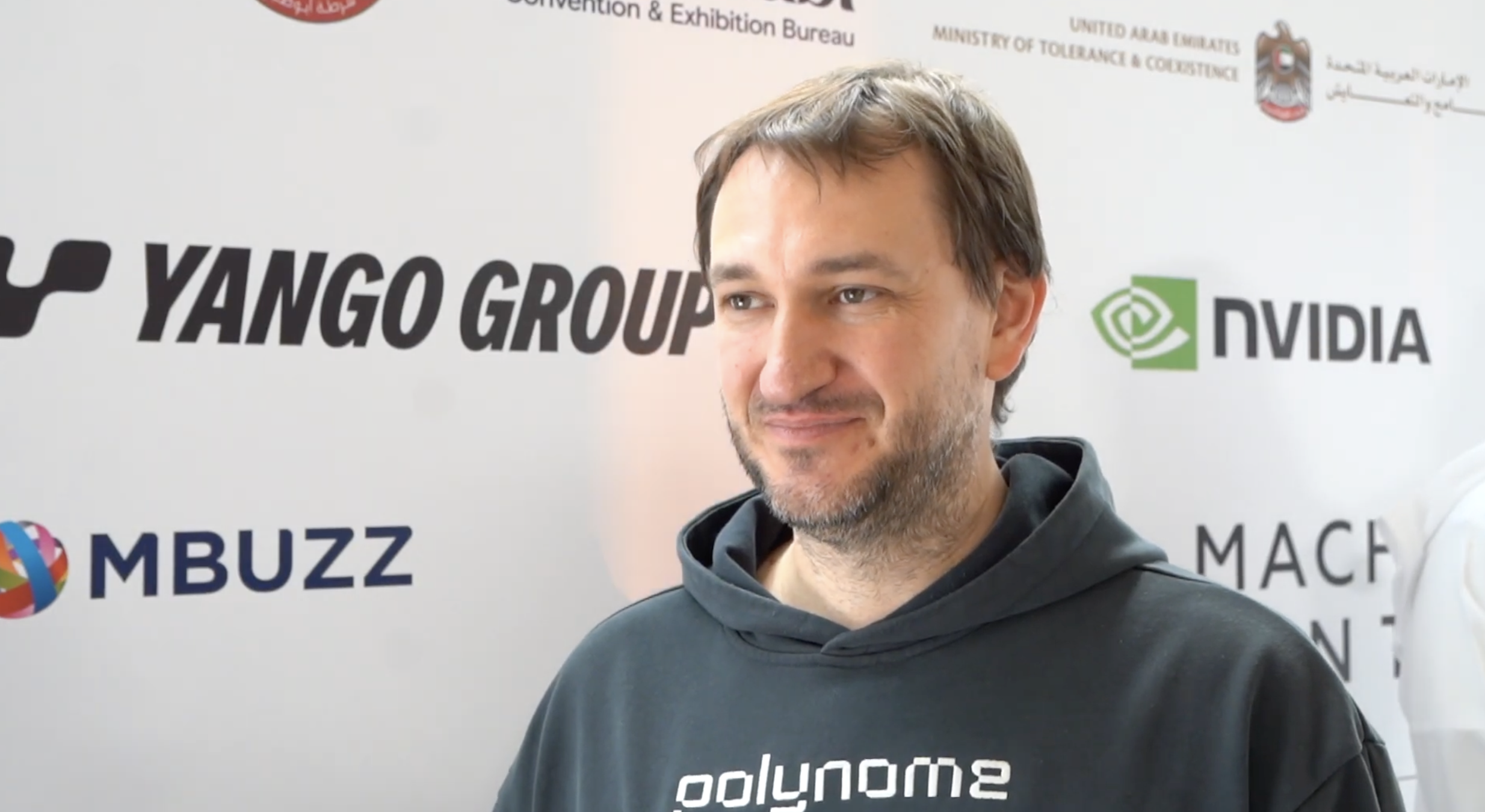
Abu Dhabi, UAE – Alexander Khanin, Founder of Polynome and Founder of the Machines Can See and Machines Can Think Summits, shared reflections on the evolution of the event and the state of artificial intelligence during the Machines Can Think Summit 2026. Khanin spoke in an interview with Justin Cooke at the summit.
Khanin described the third edition of Machines Can Think as a milestone moment. Returning attendees, long term partners, and growing international participation signal sustained impact.
“This year I met many people who told me this was their third time attending,” Khanin said. “That shows continuity, trust, and real value.”
He positioned the summit as a bridge between government, enterprises, academia, and global researchers, with a focus on generating economic and societal outcomes rather than discussion alone.
For 2026, Khanin outlined four core themes shaping the summit agenda. National AI infrastructure forms the foundation, enabling government and economic transformation. Foundation models represent the second pillar. Education and talent development form the third, supported by strong academic participation and MBZUAI as co host. Life sciences and well being applications complete the agenda, including drug discovery and health focused AI.
“These themes reflect where real transformation happens,” Khanin said.
Addressing why the summit anchors in the UAE, Khanin highlighted structural advantages. The country hosts the world’s first Minister of State for Artificial Intelligence, offers global connectivity, and provides strong government backing across AI initiatives.
“The UAE sits at the center of global AI,” he said. “Support from ministries and national institutions creates momentum.”
Khanin also discussed Polynome AI Academy and its role in preparing decision makers and leaders. He emphasized that technical excellence alone does not drive success. Executives must understand where AI adds value and where it does not.
“Knowing what not to do matters as much as knowing what to do,” he said.
The Academy trains leaders on both technical fundamentals and business execution, including return on investment, board communication, and organizational change. This approach addresses two common risks, hesitation driven by fear and adoption driven by hype.
On AI maturity, Khanin noted strong adoption at the consumer level, while enterprise adoption still faces inertia. He expects 2026 to mark a shift toward national scale deployments and wider use of physical AI.
“AI moves from screens into the physical world,” he said. “Robots, vehicles, and embodied systems define the next phase.”
Khanin also addressed the human side of AI adoption. Organizational resistance often causes failure. He cited studies showing most AI deployments fail due to misalignment between technical teams, HR, and leadership.
“AI deployment needs motivation alignment,” he said. “Without it, progress stops.”
Looking ahead, Khanin highlighted two areas driving personal excitement. World models represent the next stage beyond large language models, enabling systems to reason about reality rather than text alone. Physical AI brings intelligence into robots and real world environments.
“These are the next breakthroughs,” he said.
The interview captured the vision behind Machines Can Think Summit 2026, national infrastructure, talent, physical AI, and the human systems required for success.
Media Contact
Breaking AI News – https://breakingai.news/
contact@breakingai.news
Interview conducted by Justin Cooke at Machines Can Think Summit 2026
