


Katie McGinty, Chief Sustainability Officer at Johnson Controls on how AI is driving transformative change in building efficiency and carbon emissions
Buildings are responsible for nearly 40% of global greenhouse gas emissions according to the IEA, yet this aspect frequently remains overlooked in climate discussions.
For Katie McGinty, Chief Sustainability and External Relations Officer at Johnson Controls, this statistic signals both a challenge and an opportunity.
The company, known for its 140-year history and 100,000 employees across 150 countries, focuses on technology innovation that shifts buildings from energy liabilities to intelligent, sustainable resources.
“The climate is telling us that until we decarbonise those buildings, we can’t effectively decarbonise the climate,” she explains. “The great news is that we have a trifecta of technologies today that drives those buildings from being a burden on the climate and the balance sheet to being net zero or even net energy positive.”
This trifecta, efficiency, electrification and digitalisation, is reshaping the perception of built environments.
When utilised properly, these technologies can transform buildings into assets that not only support operations autonomously but also generate revenue by selling electricity back to the grid.
Johnson Controls is pursuing this vision with its own infrastructure.
The company is nearing completion of its own science-based emissions reduction targets.
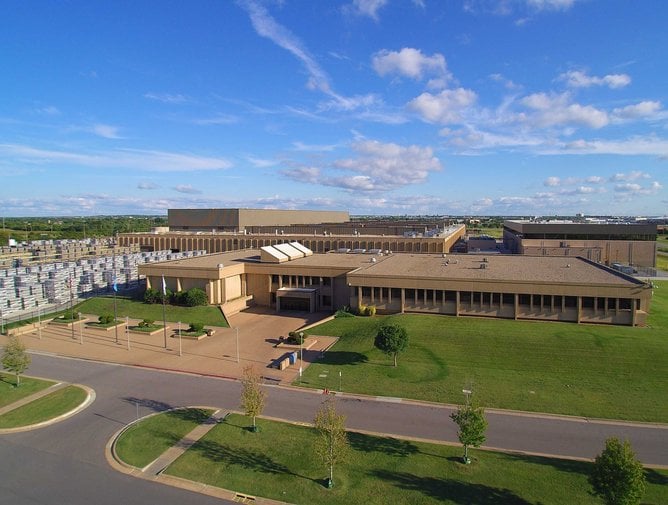
Katie highlights Johnson Controls’ factory in Norman, Oklahoma, as an exemplar.
Being the second-largest energy consumer of the company, this facility faced the challenge of significantly cutting emissions without disrupting crucial operations.
“What we did was to lean into two things: our technologies that drive emission reductions and then frankly, we hired ourselves in ‘as-a-service’ partnership mode,” Katie says. “We minimised or eliminated any need for upfront capital costs and on the backend we delivered significant operating cost reductions.”
The outcome was a 43% cut in emissions and nearly a million dollars saved in annual operating costs, all while preserving “nine nines” of uptime in a critical factory implementing state-of-the-art equipment.
Integrating energy efficiency
Energy efficiency has long struggled with visibility issues.
It’s challenging to illustrate the absence of something in a compelling way, particularly when it concerns abstract concepts like energy.
“One of the challenges in the energy efficiency space for many decades is that it was hard to make the promise and the possibility tangible because, let’s face it, you’re talking about achieving the absence of something,” Katie explains. “Technology has now emerged that delivers that wow factor.”
Heat pumps are one technology showcasing significant energy savings with a visible impact.
Johnson Controls now produces heat pumps as large as a “small aircraft carrier,” highlighting their impressive visual and environmental benefits.
In Canada, a heat pump installed beside a wastewater treatment plant captured excess heat to eliminate 78% of a community’s other heating needs.
Similarly, in Denmark, Johnson Controls explored an abandoned quarry as a potential thermal energy source to aid a hospital, achieving “an 80% reduction in energy-related costs and up to 90% reduction in carbon emissions”.
Optimising existing buildings
Not every building project begins anew. The World Economic Forum estimates that 80% of existing buildings in cities today will still be in use by 2050, comprising up to 60% of urban carbon emissions.
Katie points out that retrofitting older buildings can achieve substantial improvements in emissions and cost savings due to inherent inefficiencies.
The main hurdle is often attracting executive attention. Buildings seldom command C-suite focus unless problems arise.
“The bricks and mortar of an organisation aren’t typically what is capturing the attention and imagination of the boardroom,” Katie explains. “When the CEO shows up and heads for the elevator, she’s pushing B for the boardroom, not B for the basement.”
This mentality needs a shift for organisations to start seeing physical infrastructure as strategic assets, paving the way for transformative projects to emerge when executives embrace this recognition, even momentarily.
Meeting data centre demands
The rapid advancement of artificial intelligence, especially generative AI, is causing data centre capacity to expand, bringing challenges in energy, water, space, and noise.
Johnson Controls addresses these challenges through innovative technologies and partnerships.
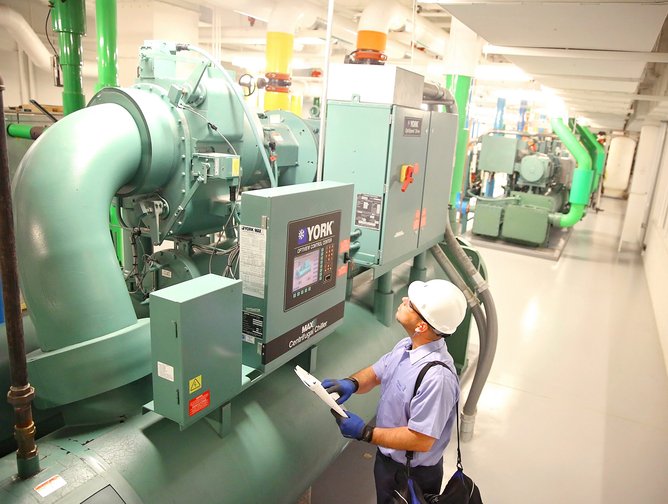
“At Johnson Controls, we’ve been privileged to partner with the data centre companies as well as the chip makers,” Katie says. “Only a year ago, it was thought that our chillers needed to produce water as cold as 5°C to tackle that heat.”

Through collaboration with chip manufacturers, Johnson Controls created solutions to achieve the same cooling with water at 23°C, resulting in a 40% energy saving.
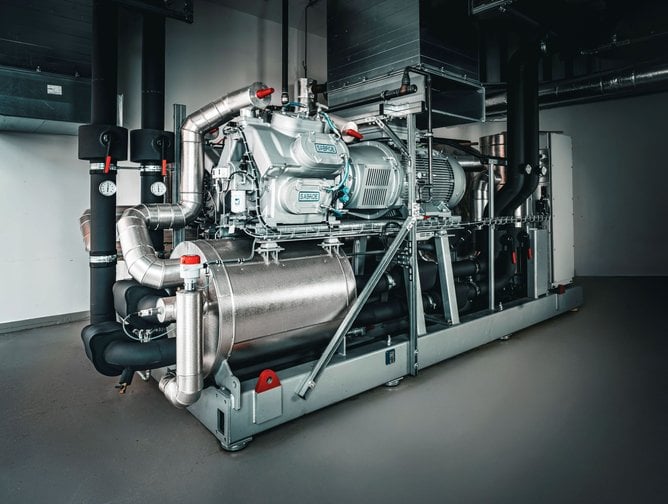
Drawing inspiration from submarines, Johnson Controls adapted magnetic bearing technology to create compressors 44% smaller than traditional oil-bearing versions, enabling more efficient use of space.
This technological evolution supports vertical data centre construction, offering a sustainability story paired with practical applications, as explained by Katie.

When computing intensifies with evolving AI technology, heat management will need creative solutions.
Katie sees an opportunity in this challenge.
“It drives us to ever greater improvements in the operational capabilities of our chillers,” she says. “But it also provides an opportunity to capture that heat and then put it to work for the community as a whole.”
European regions and parts of the United States, like Virginia, are integrating this concept, using waste heat for district heating systems, significantly impacting community infrastructure.
AI’s role in building efficiency
AI development, while increasing data centre demand, also presents opportunities for optimising building performance.
Katie explains that during COVID lockdowns, energy consumption in commercial buildings only fell by 20% despite an 80% drop in occupancy.
“Buildings are almost all analogue,” she says, highlighting the opportunity to transition towards smarter infrastructures.
This shift to digital buildings powered by sensors and AI facilitates energy efficiency.
“The bricks and mortar of an organisation aren’t typically what is capturing the attention and imagination of the boardroom.”
Katie McGinty, Chief Sustainability Officer at Johnson Controls
Johnson Controls’ robust platforms can autonomously manage energy use, adapting to occupancy and environmental conditions.
At Stanford University, this approach reduced peak energy needs by 20%, resulting in annual savings of US$500,000.
“We can achieve on the order of 10% to 20% additional emission reductions, even for brand new buildings and those with the highest level of green certification,” Katie says. “When those buildings were inaugurated and initiated, they may have been tuned so that they had the highest level of green performance, but over time, those set points get changed or those set points migrate.”

From climate culprit to climate champion
AI, energy transition strategies and geopolitical developments are expected to touch every aspect of life, influencing building operations by 2050.
Katie envisions buildings evolving into autonomous entities, capable of responsive actions, ensuring healthy environments for occupants and achieving operational cost efficiency.
She says: “When a building is responding instantaneously to command and instruction it can ensure healthy air for occupants, drive operating costs down and talk to the grid, potentially making the building owner money in selling energy capacity or physical energy back to that grid. The trajectory is exciting.”
“As we do that, the building goes from being a major climate culprit to a real climate champion.”
Source: https://aimagazine.com/