

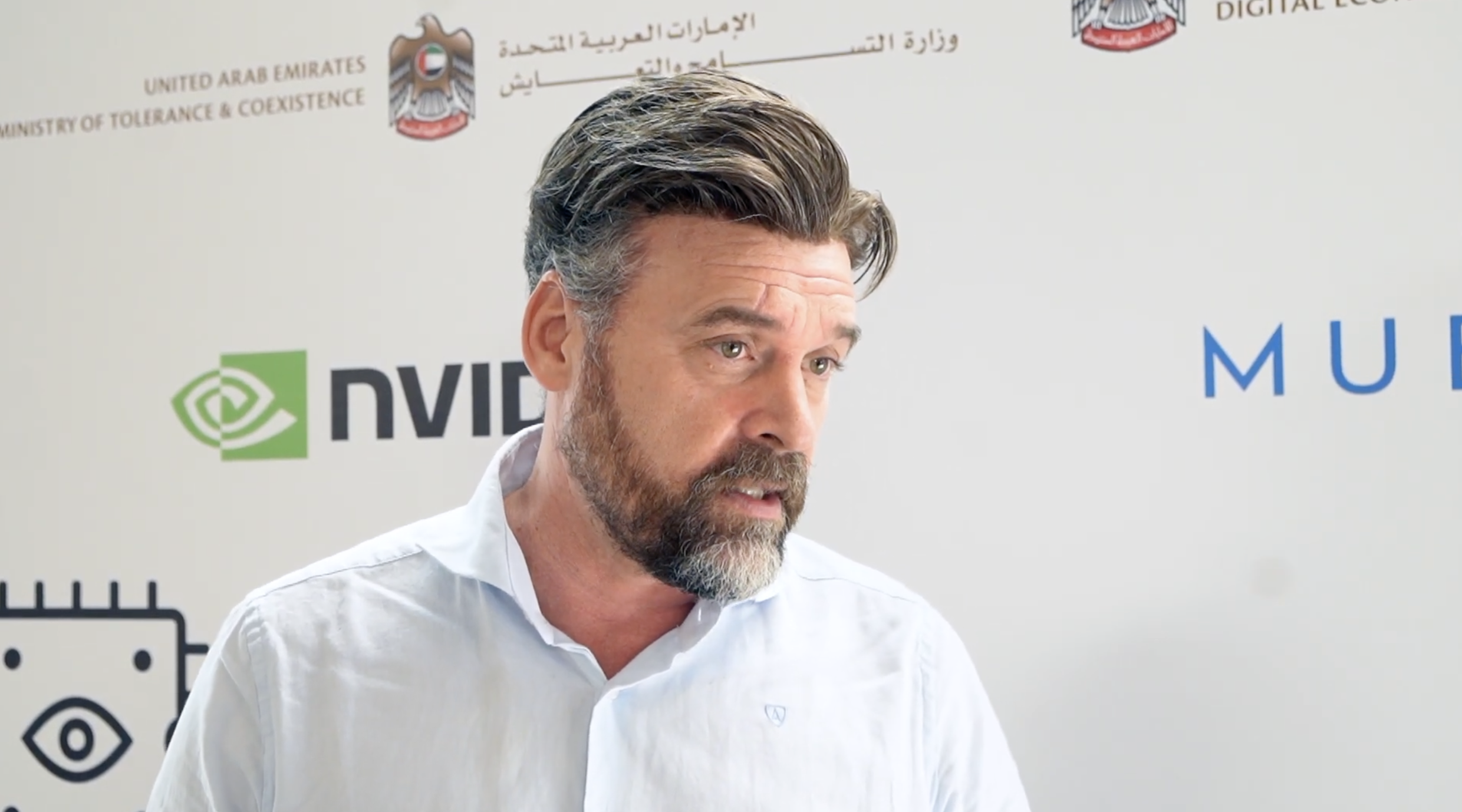
Abu Dhabi, UAE – Prof. Henrik von Scheel, Chairman of the World Economic Forum AI Committee and widely recognized as the originator of the Fourth Industrial Revolution and Digital Revolution, delivered a candid and far-reaching assessment of artificial intelligence during the Machines Can Think Summit 2026. Prof. von Scheel shared his views in an interview with Justin Cooke at the summit.
Von Scheel positioned the global AI landscape firmly within a hype cycle. While expectations are high, he cautioned that most organizations are still far from realizing AI’s promised value.
“We are in the hype bubble,” von Scheel said. “What AI promises and what it actually delivers today are two very different things.”
He emphasized that this phase is not a failure but a natural part of technological evolution. Previous waves, including blockchain and robotic process automation, followed similar paths. Today, many organizations are only now implementing foundational digital optimization work that was promised a decade ago.
“Before you run 100 meters, you must learn how to walk,” he said, noting that many AI projects fail because organizations have not completed basic digitalization, data integration, and operational readiness.
Von Scheel praised Machines Can Think for its emphasis on experimentation and failure as drivers of innovation.
“The willingness to test and fail is where innovation happens,” he said. “That’s what makes this summit special.”
He highlighted the UAE as a global leader in forward-thinking innovation, regulation, and experimentation, calling it a natural home for conversations that bridge enterprise, entrepreneurship, and policy.
A major focus of von Scheel’s remarks centered on human evolution in the age of AI. He highlighted growing collaboration with initiatives such as Women in AI, which have shifted focus from diversity metrics alone toward broader human development and protection.
One of the most pressing challenges, he said, is data ownership. Governments are tasked with protecting citizens, yet lack mechanisms to protect individuals from large-scale AI data extraction.
“Data should be co-owned between governments and citizens,” von Scheel said. “Without that, human autonomy is at risk.”
He also challenged the notion that AI itself represents the true revolution. According to von Scheel, the real disruption will arrive with the bio-revolution around 2030, when data directly interfaces with the human body, influencing health, consumption, and biological processes.
“AI today excites us because it speaks our language,” he said. “But language models represent just one of eight AI disciplines.”
Other disciplines, including molecular AI, materials science, food systems, and personalized medicine, will ultimately have far greater impact on humanity, from renewable plastics to customized healthcare and resilient food supply chains.
Von Scheel warned against uncritical adoption of AI, emphasizing that technology must meet a clear human standard.
“A better future must make us smarter, wealthier, and healthier,” he said. “If AI does not deliver on all three, we should question why we are adopting it.”
He described the current AI economy as the largest infringement on intellectual capital in history, urging stronger safeguards to protect creators, workers, and societies.
Drawing on recent experience at the World Economic Forum and G20 discussions, von Scheel also addressed geopolitical and economic fragmentation. He noted that globalization is being redefined, climate agendas are fragmenting regionally, and AI investment is entering a phase of correction and maturity.
“The innovation party is over,” he said. “What comes next is refinement.”
Despite these challenges, von Scheel expressed optimism. He believes the next phase of progress depends on reinvesting in people as much as in technology.
“We must invest twice as much in humans as we do in technology,” he said. “That is the equation for sustainable progress.”
The interview encapsulated one of the central themes of the Machines Can Think Summit 2026: AI’s future depends not only on algorithms and infrastructure, but on regulation, human development, and societal alignment.
World Economic Forum AI Committee
The World Economic Forum AI Committee refers to the Forum’s work on global AI governance. Through groups like the AI Governance Alliance, the WEF brings together leaders from government, industry, and academia to shape responsible, ethical, and inclusive AI policies worldwide.
Media Contact
Breaking AI News – https://breakingai.news/
contact@breakingai.news
Interview conducted by Justin Cooke at Machines Can Think Summit 2026