


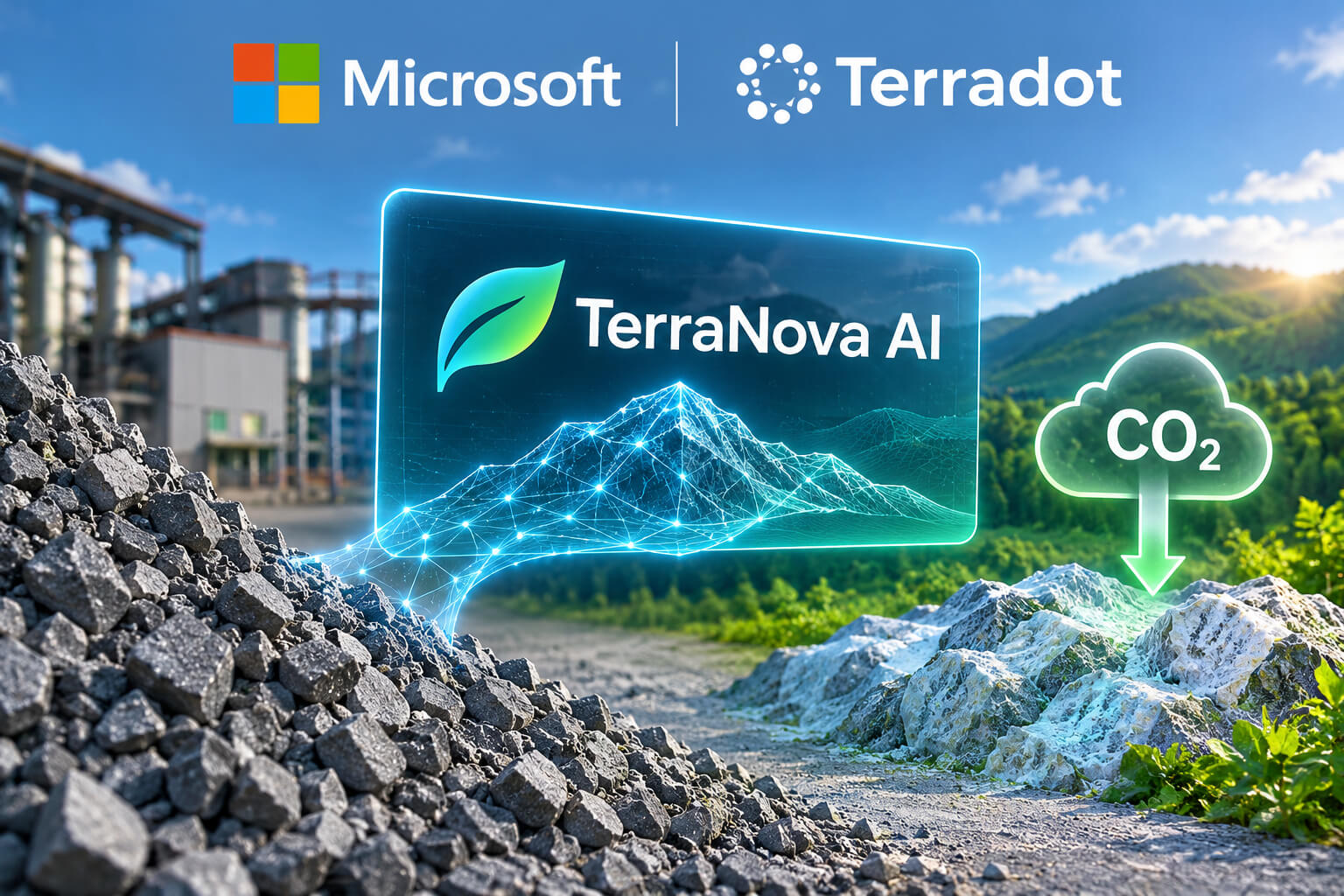
Crushed rock isn’t exactly what comes to mind when people think about advanced climate technology. Yet Microsoft and carbon removal startup Terradot are betting that artificial intelligence could make this ordinary material a much more effective tool in the fight against global warming.
The companies have developed TerraNova, an AI model designed to predict how crushed rock absorbs carbon dioxide when applied to agricultural land. Built using technology from Microsoft’s Aurora weather forecasting model, TerraNova aims to solve a stubborn problem in carbon removal: determining how much carbon dioxide actually disappears from the atmosphere.
Early research suggests the model could reduce soil sampling requirements by as much as 75% at large project sites while maintaining prediction accuracy. If those findings hold up outside research simulations, the technology could make enhanced rock weathering considerably cheaper to monitor and easier to expand.
How Crushed Rock Can Help Remove Carbon Dioxide From the Atmosphere
Rocks have been helping regulate Earth’s climate for millions of years. Through a natural process called weathering, certain minerals react with water and carbon dioxide, gradually removing carbon from the atmosphere. The process works, but nature takes its time. Under ordinary conditions, these chemical reactions can unfold over centuries or even thousands of years.
Enhanced rock weathering attempts to accelerate that process. Scientists crush suitable rocks into smaller particles and spread them across agricultural fields, increasing the surface area exposed to rainwater and carbon dioxide. The chemical reactions occur more quickly, allowing the minerals to capture carbon while farmers continue using their land for crops.
Terradot has been applying this approach to agricultural fields in Brazil and the United States. Depending on the rock type and soil conditions, the material may also help reduce soil acidity and improve nutrient availability. That potential agricultural benefit makes the approach attractive, although its effectiveness varies considerably between locations.
The bigger challenge comes after the rock reaches the ground. Measuring exactly how much carbon dioxide it removes is far more complicated than spreading the material.
Microsoft TerraNova AI Addresses the Carbon Measurement Challenge
Carbon removal companies cannot simply spread crushed rock across farmland and assume the job is finished. They need credible evidence showing how much carbon dioxide the process has removed. That evidence matters to scientists, regulators and companies purchasing carbon removal credits.
Unfortunately, enhanced rock weathering is difficult to measure. Carbon removal rates depend on soil chemistry, mineral composition, rainfall, temperature and other environmental conditions. Even neighboring agricultural fields can produce different results, making broad estimates unreliable.
Traditional monitoring requires researchers to collect soil samples, conduct laboratory tests and analyze chemical changes over time. Terradot has already gathered tens of thousands of samples from its operations, generating valuable scientific data while also highlighting how expensive verification can become.
According to Microsoft, measurement and verification can account for roughly one-third to more than half of enhanced rock weathering costs. TerraNova is designed to reduce that burden by using AI predictions alongside carefully selected physical measurements.
Instead of testing every possible location at the same intensity, researchers could use the model to identify where additional sampling would provide the most useful information.
How Microsoft’s Aurora AI Became the Foundation for TerraNova
TerraNova emerged from an unusual connection between atmospheric forecasting and soil chemistry. Microsoft’s Aurora foundation model was originally developed to analyze complex environmental conditions and generate predictions about weather and atmospheric behavior.
Terradot co-founder Sasankh Munukutla recognized that similar AI techniques might help researchers understand the chemical reactions involved in enhanced rock weathering. The company subsequently collaborated with Microsoft’s Climate Innovation Fund, AI for Good Lab and Microsoft Research to adapt the technology for carbon removal applications.
The resulting TerraNova model combines environmental information with field measurements to predict how crushed rock interacts with different soils and climates. By learning patterns from existing data, the system can estimate chemical changes that would otherwise require extensive physical testing.
One notable result involved the model’s ability to apply knowledge across geographic regions. After learning from agricultural field data in Brazil, TerraNova demonstrated the potential to generate predictions for fields in Mississippi.
That ability could become particularly valuable as enhanced rock weathering projects expand into new agricultural regions. Companies would still need local measurements, but AI could help them begin with more informed estimates rather than building every prediction system from scratch.
TerraNova AI Could Reduce Soil Sampling Requirements by 75%
The most attention-grabbing finding from Microsoft’s research concerns soil sampling. In simulations involving agricultural field data, TerraNova demonstrated the potential to reduce sampling requirements by up to 75% at the largest project sites while preserving prediction accuracy.
That is a substantial reduction for an industry where collecting and analyzing samples can consume a large share of operating budgets. Fewer unnecessary tests could free up resources for expanding field operations, improving scientific models and monitoring additional locations.
The finding does not mean laboratory testing will become obsolete. Physical measurements remain essential for confirming whether carbon removal is occurring and ensuring that AI predictions reflect real environmental conditions. TerraNova is intended to complement that work, not replace it.
The research also has limitations. The reported sampling reductions come from simulations rather than confirmed performance across commercial deployments. Independent evaluation, peer review and further field testing will be necessary to establish how reliably the model performs under different soil and climate conditions.
Even with those uncertainties, the potential financial implications are significant. Reducing verification costs could help make enhanced rock weathering more accessible to companies attempting to scale carbon removal projects.
Terradot Plans to Expand Carbon Removal Operations by 2035
Terradot’s ambitions extend well beyond developing an AI model. The company has already distributed crushed rock across agricultural fields in Brazil and the United States, with those deployments expected to remove up to 100,000 tons of carbon dioxide over time.
Its longer-term target is considerably larger. Terradot aims to reach one million tons of annual carbon removal by 2035, a goal that would require substantial growth in agricultural partnerships, rock distribution, field monitoring and verification capabilities.
Microsoft’s involvement reflects a broader interest in technologies that could support durable carbon removal. Through its Climate Innovation Fund and research teams, the company has worked with Terradot on both the scientific and operational challenges associated with scaling enhanced rock weathering.
TerraNova could play an important role in those plans by making it easier to estimate carbon removal across larger areas. However, AI alone cannot overcome every obstacle. Rock sourcing, transportation costs, agricultural conditions and independent verification will continue to influence whether projects become commercially viable.
The model’s real value will depend on how effectively its predictions translate into lower costs and trustworthy measurements during actual field operations.
Why AI-Powered Carbon Removal Matters for Climate Technology
Artificial intelligence often enters climate discussions because of its growing electricity requirements. Expanding data centers, increasingly powerful models and the infrastructure needed to operate them have raised questions about the technology industry’s environmental footprint.
Microsoft and Terradot’s work highlights a different application. AI can also help researchers investigate complex environmental processes that are expensive or difficult to measure using conventional techniques.
TerraNova does not invent a new method of removing carbon dioxide. Enhanced rock weathering already exists, and the underlying chemical reactions have been part of Earth’s natural carbon cycle for millions of years. What the model attempts to improve is the ability to understand, predict and verify those reactions at scale.
That distinction is important because carbon removal technologies face growing pressure to demonstrate measurable results. Companies purchasing carbon credits need reliable evidence, while researchers must account for environmental differences that can affect long-term performance.
AI-assisted monitoring could help address some of those concerns, provided the models remain grounded in physical measurements and undergo rigorous scientific evaluation.
The Future of AI and Enhanced Rock Weathering
TerraNova represents an emerging approach to climate technology in which artificial intelligence supports scientific measurement rather than replacing the underlying physical process. The crushed rock still performs the carbon-removing reactions. AI helps researchers understand where those reactions are happening, how quickly they progress and where additional measurements are necessary.
If the model continues performing well during real-world testing, enhanced rock weathering companies could eventually monitor larger agricultural areas without increasing sampling expenses at the same rate. That could improve the economics of carbon removal while providing more detailed information about project performance.
There are still unanswered questions. Researchers must determine how well TerraNova generalizes across different rock types, soil conditions and agricultural environments. Its predictions also need to remain accurate as projects expand beyond the locations represented in its training data.
For Microsoft, the project demonstrates how an AI foundation model originally built for one scientific field can potentially support another. For Terradot, the stakes are more practical: lowering the cost of proving that its carbon removal technology works.
The result is an intriguing combination of old geology and modern machine learning. Crushed rock may never look like cutting-edge technology, but AI could make its role in addressing climate change easier to measure, verify and scale.
Sources
- Microsoft Source — How a New AI Model Could Help Crushed Rock Fight Climate Change
- Terradot — Official Website: Enhanced Rock Weathering and Carbon Removal
- Microsoft Research — Aurora: A Foundation Model for the Atmosphere
- IPCC — Climate Change Assessment Reports
