


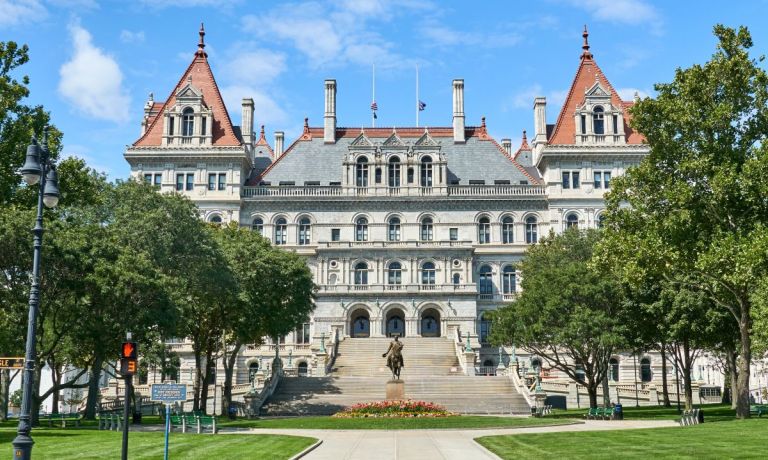
New York has become the first state to take action against so-called “personalized pricing.”
As The New York Times reported Saturday (Nov. 29), a law enacted with the state’s budget requires retailers to notify customers about the use of the practice — also known as “algorithmic pricing” — in which they use artificial intelligence (AI) and customer data to set prices.
According to the report, the legislation is designed to keep stores from abusing customer data to set high prices by, for example, hiking the cost of a hotel room for someone who has already spent heavily on airline tickets.
Under the law, retailers who use personalized pricing must post this disclosure: “THIS PRICE WAS SET BY AN ALGORITHM USING YOUR PERSONAL DATA.”
Business groups contend the law is too broad and will lead to confusion, while consumers’ rights groups are concerned the law is too narrow, the report added. However, there is broad consensus on the significance of the law in regulating the way businesses use customer data.
“It certainly is a big deal,” said Goli Mahdavi, a lawyer at the firm Bryan Cave Leighton Paisner who focuses on AI and data privacy. “Algorithmic pricing bills are probably the next big battleground in AI regulation.”
Lina Khan, the former chair of the Federal Trade Commission, told NYT that the measure would present an “absolutely vital” tool to authorities focused on personalized pricing.
But she added that the practice was threatening to “fully creep across the economy,” and that there was a “ton more work to be done” at the state and federal levels to govern it.
The FTC, under Khan’s leadership, had dubbed these practices as “surveillance pricing.” And in a report at the start of the year, the regulator pointed to mounting examples of retailers using customer behavior to determine prices, in some cases without clear disclosure.
As covered here earlier this year, the practice has also reignited an old debate: How far can businesses go in charging customers different prices for the same product or service?
While things like student and senior discounts are familiar examples of consumers paying different prices for the same goods, based on broad characteristics. personalized pricing takes it further by looking at a consumer’s unique information.
“It’s a form of price discrimination, which is not the greatest phrase in economics, but it’s a phrase that we use often, which is the idea that prices are tailored to a group or even an individual based off of their characteristics,” John M. Yun, associate professor of law at the George Mason University Antonin Scalia Law School, said in an interview with Competition Policy International (CPI), a PYMNTS company. “These characteristics could be your location, it could be that you’re a college student, or that you’re a senior citizen.”
Source: https://www.pymnts.com/